News
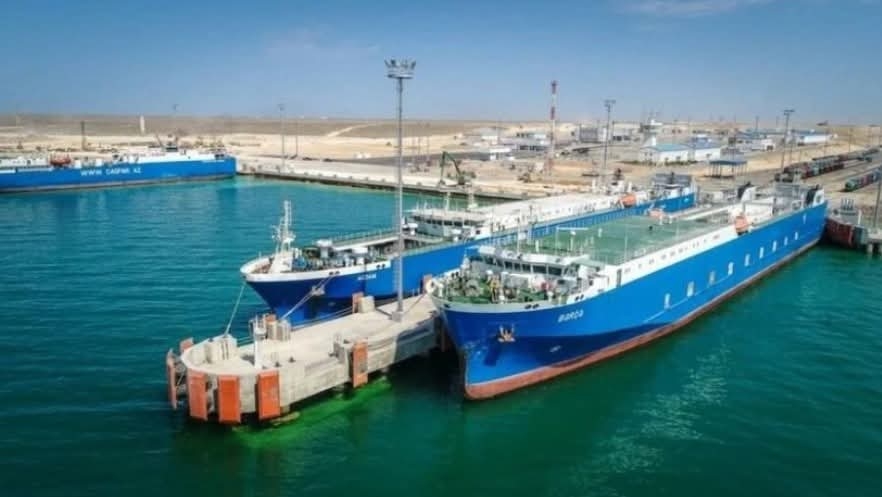
Artificially created barrier at Azerbaijan's Aliati port
2026-03-31
“The corridor is neglected” - an
artificially created barrier at Azerbaijan's Aliati port is called a systemic
problem
Over the past year, the problem of
long-term delays of wagons loaded in Georgia and sent to Central Asia, in
particular, at the Aliati port in Azerbaijan, has become systemic.
Despite the fact that Azerbaijan has its
own combined automobile-rail ferries on the Aliati-Aktau/Kurik route - Agdam,
Nakhichevan, Zarifa Aliyeva, Belakan, Dagestan, Shakhdag - of small capacity,
freight forwarders and transport companies cite administrative barriers
artificially created by Azerbaijani port services as the main reason for the
delays of loaded wagons in Georgia while waiting for the ferry.
According to freight forwarders, there are
frequent cases when wagons loaded in Georgia and destined for Central Asia have
to stop for a month and a half or more while waiting for the ferry due to
delays on the railway tracks leading to the Aliati port. Naturally, such delays
cause them legitimate dissatisfaction.
According to various sources, currently,
700-900 units of wagons are waiting on Caspian Sea ferries and are ready for
loading. This can be confirmed by using the modern Railwagonlocation wagon
tracking information system, which forwarders use to determine the location of
the wagon.
Forwarders cite Azerbaijan’s prioritization
of its own Azerbaijani cargo on the ferry at the Aliati port as the main reason
for the delay in the ferry of wagons loaded in Georgia.
Forwarders cite some examples of delays in
the transportation of Georgian export products through the corridor, in
particular, it takes 2-2.5 months to send a wagon loaded with Borjomi from
Borjomi to Tashkent.
Delayed shipments through the corridor
negatively affect the country's main export product - wine, which takes 2
months to transport to Almaty using the Aktau port.
In the conversation, freight forwarders
note that there are frequent cases when wagons loaded with Azerbaijani cargo,
with the support of local port services, enter ferries illegally, or wagons in
the Georgian queue are deliberately delayed by local port services and replaced
with local motor so-called trailers.
In both cases, the victim is the Georgian
freight forwarder, in such cases it is difficult for them to make any appeals,
as a result the corridor loses its attractiveness.
In addition to the administrative barriers
in the Azerbaijani port, additional infrastructural barriers are added on the
other side of the Caspian Sea, despite the fact that the fare for a wagon on
the ferry route has recently been officially increased by $150, the
difficulties are caused by the prolonged procedures for the use of a heat
engine by the Turkmen railway.
Freight forwarders laconically assess the current state of the corridor's functioning, they openly state that - "the corridor has been neglected".
Overall, freight forwarders note that due
to the administrative and infrastructural barriers on both sides of the
Caspian, the corridor is suffering, its competitiveness is declining, the
corridor is losing its attractiveness, and cargo owners are increasingly
choosing alternative routes.
Given that the issue of the attractiveness of the corridor is a key priority for our country, we believe that verifying the reliability of existing information should be the prerogative of state services.
transcor.ge