News
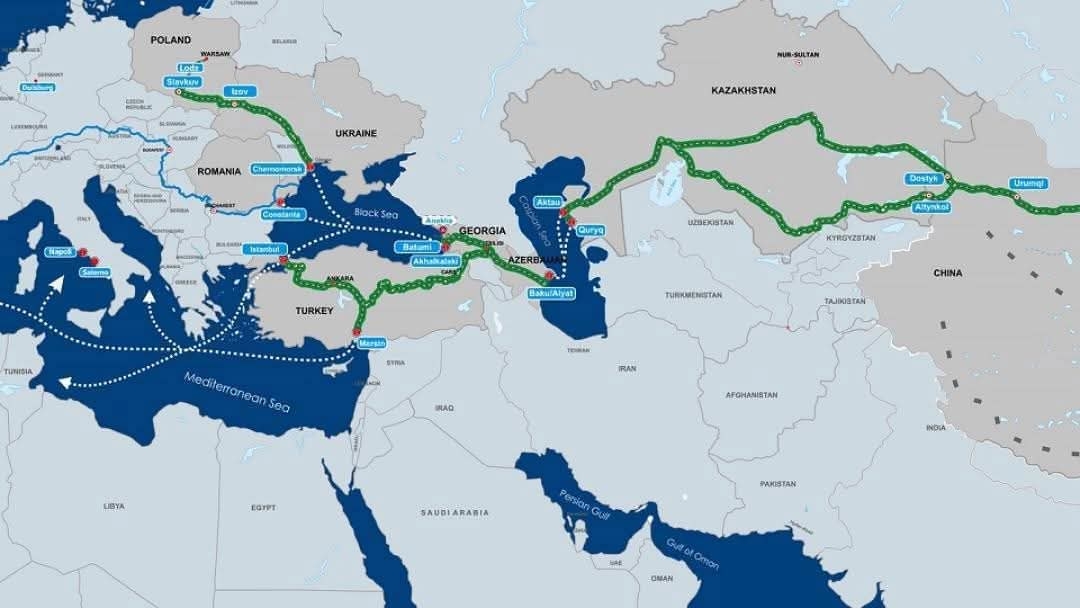
Azerbaijan~Georgia Bridge to the Black Sea
2026-07-25
The Black Sea access, location on one of the main land
corridors connecting Europe and Asia, and numerous free trade opportunities
make Georgia an attractive investment platform in the fields of logistics,
trade, and services. The main elements of this strategy are the development of
East-West and North-South highways, the construction of the Anaklia deep-sea
port, and the modernization of railway and road infrastructure.
Official Tbilisi is well aware that geographical location
can only become an advantage if it is reinforced by solid infrastructure, a
stable political environment, and international partnerships. “We have close
relations with the countries of Central Asia, as well as with our neighbors —
Azerbaijan, Armenia and Turkey — and we want to develop these relations even
further,” Prime Minister Irakli Kobakhidze said in Singapore. Under his
leadership, the Georgian delegation held high-level meetings in Singapore.
It is impossible to imagine Georgia’s rise as a regional
leader without considering the role of Azerbaijan. In fact, this process has
developed on the basis of joint projects that the two countries with the
transport and logistics potential of the South Caucasus have implemented over
the years. Azerbaijan is one of the main creators of energy and transport
initiatives in the region; it has led these projects not only out of its own
economic interests, but also within the framework of the strategy for integrating
the South Caucasus into the global trading system.
Today, the “Middle Corridor” includes Azerbaijan’s
initiatives, the modern port infrastructure it has created in the Caspian Sea
(including the Baku International Sea Trade Port), the Baku-Tbilisi-Kars
railway, and the route connecting it to Europe via Georgia. Thanks to transport
connections and access roads, this direction has become one of the most
promising trade corridors in the world. Against the backdrop of deepening
international relations between China and Europe, the importance of this
initiative is growing every year.
Azerbaijan will not be limited to the function of a transit
country; it will emerge as a reliable partner, a logistics center, and a key
creator of regional cooperation and connections. The construction of the Aliati
Free Economic Zone, the expansion of the Baku port, the modernization of the
railway network, and the digitalization of customs services will significantly
improve Azerbaijan’s transit capabilities. This infrastructure, together with
Georgia’s Black Sea ports, forms a logistics chain.
For this reason, Georgia’s claim to be a regional hub does
not weaken Azerbaijan’s strategic position; on the contrary, it further
strengthens it. The point is that the region’s competitive advantage is based
not on individual countries, but on an integrated transport system. The
emergence of Azerbaijan as the “gateway to the Caspian Sea” and Georgia as the
“gateway to the Black Sea” will shape a new economic reality in Eurasian trade.
In recent years, the growing interest in the countries of
Central Asia has been reflected in the European Alliance’s intention to invest
in alternative transport routes and diversify cargo routes between China and
Europe. Current events show that this process will gain even greater importance
in the near future. This creates the need to deepen coordination between
Azerbaijan and Georgia.
There is no doubt that the high level of political trust and
long-term cooperation between the two countries ensure the success of regional
projects in the fields of energy, transport and trade. The implementation of
projects such as the Baku-Tbilisi-Ceyhan oil pipeline, the “Southern Gas
Corridor” and the Baku-Tbilisi-Kars railway have proven that the joint actions
of Azerbaijan and Georgia not only support their own economies, but also
strengthen the transport and energy security of the Eurasian space as a whole.
Today, when Georgia has clearly stated its goal of becoming
a regional center, Azerbaijan is one of the main pillars in the implementation
of this goal. The basis of this process is solidarity. The South Caucasus would
not have taken the place on the global logistics map that it has today if it
were not for Azerbaijan’s economic strength, transport infrastructure,
opportunities in the Caspian basin and industrial policy.
The current geopolitical situation shows that the “middle
corridor” is no longer just an alternative route; It is transforming into one
of the main elements of Eurasian economic security.
Farid Shafiyev, Chairman of the Center for Analysis of
International Relations (AIR Center), noted that today, in a world full of
instability, transport is a complex matter. The development of transport routes
is no longer considered only in terms of economic advantage — it is a strategic
necessity: the “Middle Corridor” does not only mean transporting cargo from one
point to another; it contributes to the development of infrastructure and
customs procedures, the activation and acceleration of trade, and also provides
for the effective implementation of the project. The countries of the Caspian
region and Central Asia are cooperating to create a more robust and integrated
“East-West” trade network.
According to F. Shafiyev, his approach to development that
brings economic benefits will contribute to regional brotherhood, mutual trust,
and long-term stability. He noted that Azerbaijan is also promoting new formats
for regional cooperation: “These initiatives demonstrate that the countries of
the region are increasingly striving to formalize their future through
practical cooperation.” “This is associated with great responsibility.”
According to him, one of the main opportunities for future
cooperation is the development of transport links. These links make Azerbaijan
and Georgia partners in the strategy that unites Europe and Asia.
In this regard, the deep-water port of Anaklia is of
particular strategic importance. The implementation of this plan will create
new opportunities in the direction of the Black Sea, which will contribute to
the growth of cargo flows and the competitiveness of the “middle corridor”. The
development of the port will also pave the way for a new stage in
Azerbaijani-Georgian transport cooperation. According to the main
representative of BMTM, Nasib Mirzayeva, the deep-water infrastructure of the
Anaklia port will allow the port to receive large-sized ships and serve a
larger volume of cargo. This will expand Georgia's transit capabilities and
increase the overall potential of the "middle corridor".
The participation of Azerbaijani companies and logistics
institutions in this process can strengthen the Baku-Tbilisi strategic
partnership. Azerbaijan and Georgia are not competitors in this partnership, on
the contrary, they are strategic partners that combine transport and logistics
capabilities and complement each other.
Therefore, the combination of maritime facilities created by
Azerbaijan in the Caspian basin and Georgia's exit to the Black Sea enhances
the regional information role of both countries and strengthens international
relations in the world. This allows it to become an important logistical bridge
between Europe and Asia. The productive use of transit potential accelerates
economic development and creates new investment and trade opportunities.
This demonstrates that in the new reality, Azerbaijan and
Georgia are not competitors, but rather partners in a strategy that complements
each other. The future development of the region depends on the deepening of
this relationship, the successful implementation of transport projects and the
formalization of a single logistics space.
In fact, the growing role of the South Caucasus in world trade indicates that one of the important economic routes of the future passes through Baku and Tbilisi. The strategic transport capabilities of Azerbaijan and the transit potential of Georgia will strengthen the region and make it one of the important centers of global logistics.
Punhan Efendiev
"People's Newspaper"
Source: darvaz.com