News
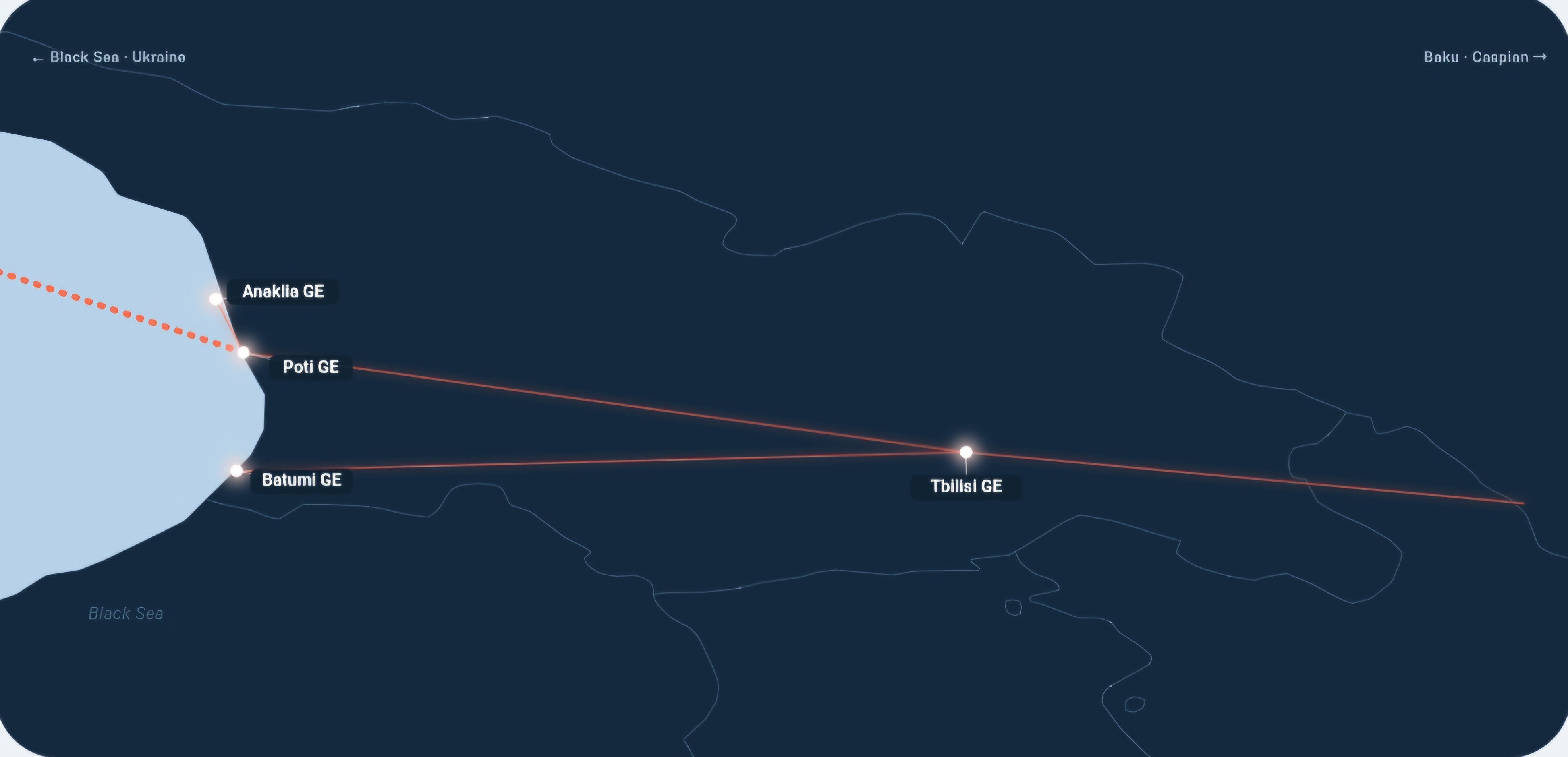
Do we need Anaklia, because we already have Poti and Batumi?!
2026-08-17
A question is often asked: if the ports of Poti and Batumi
already exist, why can’t they simply be deepened and turned into deep-water
ports?
At first glance, the answer is simple — if we need more
depth, we need to deepen the seabed. But in real port engineering, things are
not so simple. Creating a deep-water port does not mean just removing soil from
the seabed. It is a combination of hydrotechnical, hydrological, geological,
navigational and infrastructural tasks.
In the case of Poti, one of the main problems is the impact
of the Rioni River. The river brings a large amount of solid sediment into the
Black Sea, which affects the processes of sediment accumulation in the coastal
zone. Accordingly, deepening the water area and the approach channel once does
not mean that the resulting depth will be maintained permanently. The deeper
and wider we create a navigation channel, the more important it is to study
sediment transport, sedimentation and coastal morphodynamics in detail.
Otherwise, the port may constantly require significant amounts of maintenance
dredging.
In addition, to accommodate a deep-water container ship, it
is not enough to simply have 16–18 meters of water at the berth. An access
channel of appropriate depth and width, a maneuvering basin, a turning basin, a
berth pocket, a safety margin — UKC, as well as taking into account the squat
generated during the movement of the ship are required. If all of these are not
in harmony with each other, a deep berth will practically not provide us with a
full-fledged deep-water port.
Another important issue is the construction of existing
berths. If the berth is initially built for a smaller depth and lower load, a
significant deepening of the bottom in front of it can change the stress state
of the soil and affect the stability of the berth foundation. In such a case,
not only dredging is required, but also the reinforcement of the berth or the
creation of a practically new hydraulic structure.
In the case of Batumi, the problem is different. The port of
Batumi is embedded in the immediate urban structure of the city. Therefore, its
large-scale transformation is associated not only with works from the sea, but
also with spatial restrictions. Large container ships require sufficient
maneuvering space, appropriate water area, berths, terminal area, cranes,
internal roads, railways and infrastructure for handling cargo flows. A
significant expansion of all this in the city is a project of a completely
different scale.
Therefore, the question is not just “Can we deepen from 15
to 18 meters?” Technically, it is possible to deepen a specific section, but
the main questions are: how stable will we maintain this depth, what will be
the cost of permanent deepening, whether the existing infrastructure can
withstand new loads, and whether the port will have enough space to safely
receive and quickly process large ships.
This is where the main difference between the modernization
of Poti and Batumi and the construction of Anaklia arises. Converting an
existing port into a deepwater port often means struggling with the limitations
of the existing infrastructure. In the case of a new port, the required depth,
the geometry of the approach channel, the turning basin, the construction of
berths, the terminal area, and land connections can be determined from the
outset.
Therefore, the development of the ports of Poti and Batumi
is necessary, but their role should not be confused with the function of a
deep-water port. Poti and Batumi can become even more efficient, modern and
productive, but their transformation into full-fledged deep-water container
hubs may require such a large-scale reconstruction that in the end we will not
talk about “deepening” the existing port, but about creating a practically new
port system.
Finally, a deep-water port is not just deep water. It is
depth + channel + maneuvering space + berth + geological stability +
hydrodynamics + sediment management + terminal infrastructure + railway and
road connections.
That is why the importance of Anaklia is not only that it is possible to receive larger ships there. Its main advantage is the ability to create a new port system with the parameters that a modern deepwater port requires from the outset — instead of constantly adapting to the physical and spatial limitations of existing ports.
* * *
The ports of Batumi and Poti perform the most important
function for the Georgian maritime system and will retain their role in the
future. However, their capabilities and geographical location cannot replace
the function of a deep-water port, especially when it comes to directly
receiving modern large container ships and integrating Georgia into
higher-scale international maritime networks.
The main importance of Anaklia is not only the creation of
additional berths. Its importance is that it gives Georgia the opportunity to
create a completely new maritime logistics platform — a port, railway, road
corridors, warehouses, logistics centers and international container networks
into a single system.
Without Anaklia, Georgia will still be a Black Sea transit
country, but its ability to become a regional maritime hub will be
significantly limited. This is especially important for the development of the
Middle Corridor, because the growth of transit cargo does not mean only the
existence of a railway - a maritime gateway is needed that can quickly receive,
process and redirect large volumes of cargo.
Therefore, we should not ask the question - “Do we need
Anaklia, because we already have Poti and Batumi?” The correct question is: can
Georgia create a maritime economy of the scale that the country has the
potential with its existing ports?
In my opinion, partially - but not completely.
Anaklia does not cancel the importance of Poti and Batumi.
On the contrary, all three ports can fulfill a complementary function: Batumi -
specialized and energy cargo, Poti - existing container and multifunctional
operations, Anaklia - large ships, transshipment, large-scale container flows
and future expansion.
Ultimately, without Anaklia, Georgia remains a coastal country; with Anaklia, it has the opportunity to turn its maritime location into a real economic advantage.
Sea Pilot