News
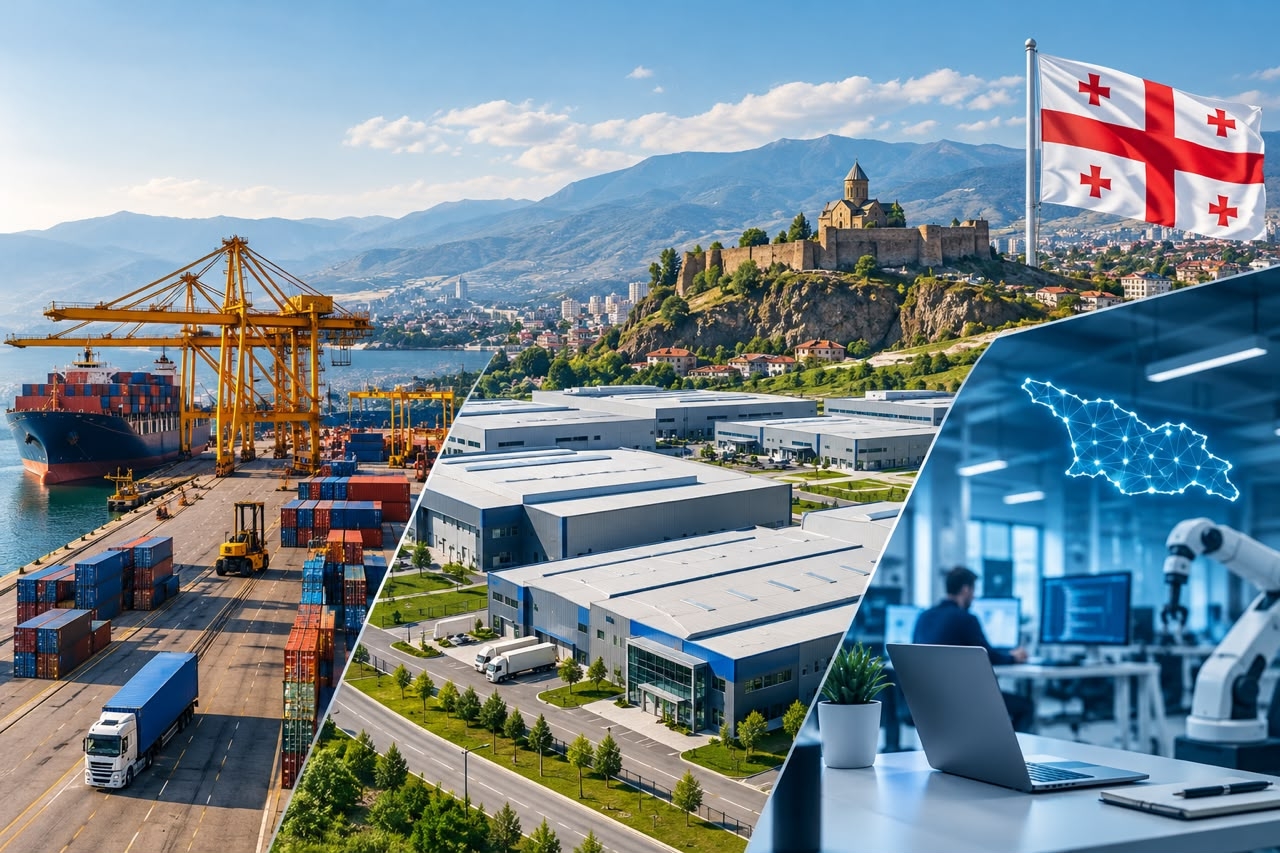
Free Economic Zones, Industrial Parks, and Technology Parks in Georgia
2026-10-25
Countries establish various types of special zones to foster
economic development, attract investment, and facilitate the creation of new
businesses. These include free economic zones, special economic zones, free
industrial zones, industrial parks, and technoparks. Although these terms are
often confused, they differ in their intended purpose and operational
principles.
Free Economic Zones and Special Economic Zones
A "free economic zone" is a broad term
referring to an area where specific economic, tax, customs, or administrative
conditions are applied to promote business and investment. Its objective is to
boost economic activity, develop international trade, attract foreign
investment, and create new jobs.
A "special economic zone" is an area
subject to a distinct regime or specific support mechanisms designed to achieve
a particular economic goal. Such zones may be focused on exports,
manufacturing, logistics, technology, or the development of a specific region.
These two terms carry different meanings in various
countries and are sometimes even used as synonyms for one another.
Consequently, their precise legal definition depends on the legislation of the
specific country.
Free Industrial Zone — for Manufacturing and Trade
A Free Industrial Zone (FIZ) is a specific form of a
free economic regime, primarily designed to foster the development of
manufacturing, processing, warehousing, and trade.
There are four Free Industrial Zones operating in Georgia:
• Poti Free Industrial Zone;
• Tbilisi Free Industrial Zone;
• Kutaisi Free Industrial Zone;
• Kutaisi Hualing Free Industrial Zone.
Special customs and tax regimes apply within these zones.
Subject to conditions defined by law, enterprises may benefit from tax
incentives related to profit and property taxes. Furthermore, the entry of
foreign goods into the zone, as well as certain operations conducted within it,
are eligible for specific customs and VAT exemptions.
However, this does not mean that every operation within the
zone is exempt from all taxes. For instance, the movement of goods from the
zone into the rest of Georgia is governed by applicable customs and tax
regulations, and income tax applies to the wages of employees.
A Free Industrial Zone and an Industrial Park are not the
same thing.
An industrial park is an area that brings together
enterprises and the infrastructure they require—such as electricity, water
supply, roads, warehouses, and other services. Its primary objective is to
create a favorable environment for production.
An industrial park may or may not offer special tax
incentives. The mere fact that an enterprise is located within an industrial
park does not imply that it operates under the same legal regime as a Free
Industrial Zone. Thus, an industrial park is, first and foremost, a model for
housing production infrastructure and businesses, whereas a free industrial
zone is a territory governed by a special legal and economic regime.
Technopark — For the Development of Innovation and
Technology-Based Businesses
A technopark is a space designed for a distinct purpose. It
integrates technological infrastructure, professional expertise, educational
resources, and opportunities for business development.
The goal of technoparks is to transform innovative ideas
into practical products, support startups, introduce new technologies, and
foster the growth of high-tech companies. They offer entrepreneurs workspace,
technological equipment, training, consulting, and professional networking
opportunities.
The success of a technopark is not defined solely by its
buildings and equipment. Rather, it is measured by the extent to which it
assists new businesses in developing products, attracting investment, and
accessing local or international markets. Moreover, a technopark does not, in
itself, entail tax incentives or a special customs regime—this is a separate
legal matter.
What does the average citizen gain from all this?
The existence of free economic and industrial zones does not
automatically mean that citizens will receive direct financial benefits. Their
economic significance should be evaluated based on the extent to which these
zones contribute to the country's development.
Real benefits for society may include:
• The creation of new jobs;
• Growth in local production and exports;
• The attraction of foreign investment;
• The dissemination of new technologies and knowledge;
• The creation of new opportunities for small and
medium-sized businesses.
However, if tax incentives primarily benefit companies,
while the economic gains fail to reach the local population or other sectors of
the country effectively, the efficacy of such a policy becomes questionable.
As for citizens' access to international stock markets and other financial exchanges, that is a separate issue. The existence of free industrial zones does not, in itself, guarantee such access, as it depends on the terms set by specific exchanges, brokerage firms, and financial regulations.
Conclusion
Free economic zones, special economic zones, free industrial
zones, industrial parks, and technoparks are various instruments for economic
development.
Free economic zones and special economic zones create
distinct economic conditions; free industrial zones focus on facilitating
production and trade; industrial parks provide enterprises with infrastructure;
while technoparks serve to foster innovation and technological
entrepreneurship.
For Georgia, the primary objective is to ensure that the establishment of these zones is not limited merely to attracting investment and granting incentives to companies. Ultimately, their success should be reflected in the growth of local production, technological advancement, the creation of decent jobs, and the well-being of citizens.
Zurab Maghradze, DBA
Sources: matsne.gov.ge / gita.gov.ge / wto.org