News
Gateology ● Investments in the Development of TRACECA
2026-09-10
According to data from the Eurasian Development Bank
(EDB), the total cost of projects related to the development of specific
sections of the TRACECA transport corridor—including the Trans-Caspian
International Transport Route—amounts to $42.8 billion.
Data published by the EDB indicates that a large-scale
investment program for the development of Eurasian transport infrastructure is
underway. Particular attention is being paid to Central Asia and the transport
routes connecting China with Europe.
402 Transport Projects Worth $345 Billion
The EDB’s transport project database comprises 402 projects
with a combined investment value of approximately $345 billion.
Of these, 114 projects are being implemented or are in
various stages of preparation in Central Asia; their total value exceeds $71.75
billion.
A significant portion of the investment program is linked to
the development of international transport corridors, including TRACECA and the
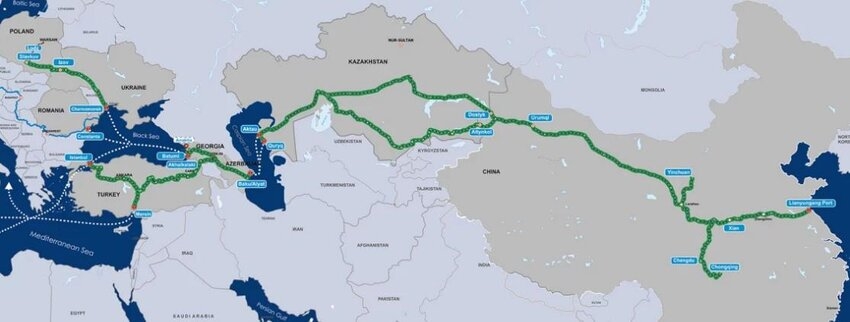
Trans-Caspian International Transport Route (TITR), widely known as the
"Middle Corridor."
Where are the major investments going?
Road infrastructure accounts for the largest
share—approximately 56%—of transport infrastructure development projects in
Central Asia.
Meanwhile, approximately 29.8% of the investment portfolio
is allocated to the development of railway infrastructure.
These sectors are particularly important for the growth of
international freight transport, as the capacity of alternative overland routes
between China and Europe becomes increasingly significant.
Projects worth over $6 billion were completed in 2025
Several major transport projects were completed in Central
Asia in 2025. Their total value exceeded $6 billion.
In Turkmenistan, the Ashgabat–Mary–Turkmenabat highway
was put into operation, as was the section of the "North-South"
international transport corridor stretching from Turkmenbashi through Garabogaz
to the Kazakh border.
In Kazakhstan, the modernization of the Dostyk–Moyynty
railway line was completed. The Kok-Art Pass tunnel has been
constructed in Kyrgyzstan as part of the "North-South" alternative
highway project.
In Tajikistan, specific sections of the Obigarm-Nurabad
road have been put into operation, while in Uzbekistan, the electrification
of the Bukhara-Urgench-Khiva railway line has been completed, creating
the necessary conditions for the development of high-speed passenger rail
services.
What is the Middle Corridor?
The Middle Corridor connects China and Europe via Central
Asia and the South Caucasus.
The route comprises: China → Kazakhstan → Caspian Sea → Azerbaijan → Georgia →
Turkey →
Europe.
Georgia plays a pivotal role in this transport chain, as it
links the Caspian Sea region with Turkey.
Developing the Middle Corridor entails not only the
construction of new roads and railways but also the modernization of existing
infrastructure, the expansion of ports, the development of logistics centers,
and the improvement of border procedures.
How long does cargo transit take?
Transporting cargo from China to Europe via the Middle
Corridor takes approximately 12–15 days.
The route's competitiveness depends not only on
transportation time but also on the throughput capacity of the Caspian Sea
crossing, railways, and ports.
Why is this important for Georgia?
Georgia's location along the Middle Corridor gives the
country a significant transit role.
Cargo arriving from the eastern coast of the Caspian Sea
passes through Azerbaijan into Georgia before heading toward Turkey and Europe.
The Baku-Tbilisi-Kars railway line, which connects
the South Caucasus to Turkey's railway network, is of particular importance.
An increase in cargo turnover along the Middle Corridor
could boost the following for Georgia:
● Transit revenues;
● Port and railway utilization;
● Demand for logistics services;
● Development of warehouses and transport hubs;
● Georgia's significance as a regional transit center.
However, the $42.8 billion figure does not represent
funds already spent.
It is important to correctly interpret the $42.8 billion
figure presented by the EDB.
This amount does not imply that $42.8 billion has already
been allocated or spent.
It refers to the total investment value of transport
projects, encompassing both ongoing and planned initiatives.
Therefore, this figure should be viewed more accurately as
the investment potential for regional transport infrastructure development
rather than as investment that has already been realized.
The regional transport map is changing.
As trade between China and Europe grows, the importance of
transport corridors in Central Asia and the South Caucasus is also increasing.
If a significant portion of the planned projects is implemented, the capacity of the Middle Corridor will expand, and Georgia could become an even more vital transit link between Asia and Europe.
Source: Eurasian Development Bank (EDB); Caspian Geopolitics.