News
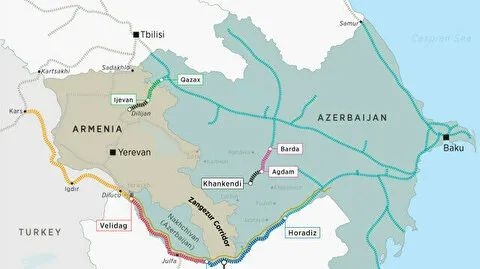
Interests of the countries involved in the Zangezur Corridor project
2025-04-01
After the transition of the
Armenian-Azerbaijani confrontation to a peaceful phase, Azerbaijan and Turkey
began to activate the Zangezur Corridor and intensively connect it to
international transport networks.
With the implementation of the project, the
Pan-Turkic countries will connect with their closest ally – Turkey – via a
direct transport artery through Azerbaijan.
A new transport “arc” connecting with
Europe is being created, which will lead to a new distribution of traffic flows
in the region.
In the formation of the new corridor and
the expansion of trade and transport ties with the European space, in addition
to Georgia, almost all neighboring states – Armenia, Russia, Azerbaijan,
Turkey, Iran, the Central Asian “five” – are interested to a certain extent.
From this perspective, naturally, there are
questions:
Is a new alternative transport corridor
connecting Asia with Europe, bypassing Georgia, being formed?
Will it lead to the diversion of certain
cargo flows from the Georgian railways, ports, and Baku-Tbilisi-Kars branches
to the Zangezuri corridor?
Will the launch of the Zangezuri corridor
affect the new distribution of cargo flows in the region, and what role will
Georgia play in such a distribution?
The “Transport Corridor Research Center”
offers its own analytics on all these and other questions.
Despite the aspirations of neighboring
Azerbaijan and Turkey to develop the Zangezur corridor, there are a number of
obstacles that may hinder the formation of a unified framework for the
corridor, which is primarily related to the violation of the synchronization of
the project implementation and the delay in time.
The Zangezur corridor (see diagram)
consists of five independent sections, on which preparatory work and
construction work on a number of sections are underway at different
intensities.
The Kars-Igdir-Diluj (area of connection
with Nakhichevan) railway is the main part of the Zangezur corridor and
connects Turkey with Azerbaijan. The project is at the implementation stage
(marked with yellow dots on the diagram).
Within the framework of the project, Turkey
plans to build five new stations – Digori, Tuzluca, Igdir, Aralik and Dilucu –
along the 200 km of the railway line. The main part of the works is currently
underway in Igdir.
The double-track railway line will be fully
electrified, and the project is expected to be completed in five years.
The continuation of the Kars-Igdir-Dilucu
project in the territory of Nakhichevan involves the reconstruction of the
existing 177 km railway line between Velidag and Ordubad (marked with red dots
on the diagram).
With the financial resources of Azerbaijan,
it is planned to convert the railway section in the territory of Nakhichevan
from single-track to double-track.
The next – 45 km section of Zangezur is
located in the territory of Armenia. This section is the most problematic and
requires construction from scratch (marked with a blue dot along the territory
of Armenia on the diagram).
The most problematic part of the Zangezur
corridor is the 45-kilometer section of the railway from Azerbaijan to
Nakhichevan via Syunik in Armenia.
This section of the corridor is located on
the territory of Armenia, which is currently in a state of disrepair and
requires reconstruction based on the agreement of the parties.
Despite the fact that Azerbaijan is
intensively carrying out construction work in neighboring areas, Armenia has
not yet taken any steps in this direction. First of all, the uncertainty of the
completion of this section is considered to be a violation of synchronization.
Of the 110-km section of the
Aghben-Fizuli-Horadiz section adjacent to Armenia, 85 km have already been
completed. Azerbaijan is intensively engaged in construction (marked with a
blue dot along the territory of Azerbaijan on the diagram).
As for the next section of the Zangezur
corridor, which ends in Horadiz-Baku on the territory of Azerbaijan, the
railway is already operational here, which ensures the full integration of the
new corridor into the main transport network of Azerbaijan (marked with a blue
dot along the territory of Azerbaijan on the diagram).
The Karabakh war, which ended with the
victory of Azerbaijan, obliges the Armenian side to ensure the unhindered
passage of transport and cargo through the territory of Nakhichevan. In fact,
Armenia is obliged to lift the transport and economic blockade on Nakhichevan.
The Zangezur Corridor is given additional
dynamism by Azerbaijan's aspiration to develop a highway on its territory, in
parallel with the railway infrastructure. In the future, both the railway and
the highway sections will become an integral part of the new corridor.
It is important to note that the most
profitable country is Azerbaijan, since in such a case, it is given the
opportunity to diversify any cargo flow through Nakhichevan, namely, it will be
able to use tariff instruments acceptable to it to direct cargo flow through
its territory either through the Middle Corridor or the Zangezur Corridor.
Therefore, Azerbaijan considers the new
corridor not as an alternative to the Middle Corridor, but as a complementary
corridor.
The launch of the Zangezur Corridor is no
less important for Turkey, because in the event of the commissioning of both
the Baku-Tbilisi-Kars branch of the Middle Corridor and the Zangezur Corridor,
the final collection of cargo will take place at the Kars station. After which
Turkey will be able to direct the consolidated flow in Kars towards Europe.
With the concentration of cargo flows in
Kars, the attractiveness of Kars as a collecting and distributing transport and
logistics center in the region is increasing, which will help balance the
economic imbalance of the eastern regions of Turkey.
The commissioning of the Zangezur route
fully meets the geo-economic interests of the Central Asian "five".
By launching the new route, they are creating an alternative transport
"arc" of the Pan-Turkic countries connecting with the European space
through Turkey.
Despite many unresolved obstacles, the
launch of the Zangezur route is also beneficial for Armenia, since Armenia will
turn from a transit state into a transit state.
The opening of the Zangezur corridor
promises significant benefits for Armenia. The country will have a chance to
become part of international transit, establish rail connections with Iran, and
also acquire a secure land connection to Russia via Azerbaijan.
The latter is critically important for
Armenia, given the high volume of trade turnover with Russia, Armenia, along
with the Georgian route, will have an alternative connecting it to Russia.
Georgia, in turn, will lose the main
transit of oil products from Russia to Armenia using our ports and railways.
In addition, the alternative of
transporting the automobile flow from Russia to Armenia via Azerbaijan will
make the Georgia-Russia connecting highway and the Kazbegi-Larsi tunnel project
financed by Georgia worth $1.2 billion less financially attractive.
For Russia, the Zangezur corridor is not
only an opportunity to connect with Armenia in the shortest way, bypassing
Georgia, but also a convenient access to the markets of Turkey and Iran, as
well as to the Middle East via the Azerbaijani railway. This is fully
consistent with Russia’s desire to develop the North-South transport axis using
various corridors.
Despite the fact that the Zangezur corridor
causes opposition from Iran, Iran is indirectly interested in the
implementation of the corridor.
As for the opposition, Iran clearly sees
the political tandem of Turkey and Azerbaijan, and in the conditions of
integration of pro-Turkish states with them, Iran will find itself facing the
threat of isolation from transport processes.
Iran clearly does not want Turkey to weaken
its role in the region by launching various transport initiatives. By
strengthening the Turkish factor in the region (Turkey) it will easily
"absorb" Armenia, Iran's strategic ally in the South Caucasus.
It is also worth noting the economic
interests of Iran, which will suffer as a result of the unblocking of transport
links with Nakhichevan.
Iran receives income from the supply of gas
to Nakhichevan through the SWOP (redirection) system. In particular, gas is
supplied from Azerbaijan to Iran, and Iran transfers the same volumes to
Nakhichevan. As a service fee, Tehran takes 15% of Azerbaijani transit.
With the opening of the Zangezur corridor,
Iran will be at risk of losing this profit. Since Azerbaijan will have the
opportunity to create the appropriate infrastructure and directly, much
cheaper, transport gas first to Nakhichevan and then to Turkey and Europe.
Over the past 30 years, Turkey has been
buying gas from Iran at a price 45% higher than from Azerbaijan. In the event
of the opening of the Zangezur route, Ankara will be able to receive blue fuel
from Azerbaijan instead of Iran without intermediaries. In this case, Iran will
face a large commercial loss.
When we mentioned that Iran is indirectly
interested in the launch of a new corridor, we meant the decision reached as a
result of negotiations between Turkey and Azerbaijan in October 2023, which
implies the possibility of transferring the transport corridor to Nakhichevan,
bypassing Armenia.
It is unknown under what conditions it was
possible to persuade Tehran to such a deal. Most likely, it was promised to
maintain a privileged status in the transit of goods and energy resources in
the Turkish-European direction.
It is clear that Azerbaijan decided to
compromise with Iran on the Zangezur issue due to Armenia’s continued
reluctance to use Iranian territory for communication with Nakhichevan.
In the list of states presented above,
except for Georgia, everyone has a certain economic dividend. The launch of the
Zangezur corridor will only harm Georgia economically.
Georgia is the only state for which the
launch of the Zangezur corridor will lead to a switch of cargo flows from the
Georgian railway, ports and Baku-Tbilisi-Kars branches to a new direction.
In conclusion, Georgia is not at risk of losing cargo flows as a result of the launch of the Zangezur corridor in the next 5 years. Therefore, at the current stage, the country’s first priority task should be to establish a sustainable and safe transport infrastructure on the Georgian section.
Source: transcor.ge