News
Lapis Lazuli Corridor Becomes Economically Attractive
2025-04-13
Despite the fact that the Lapis Lazuli
Corridor Transit Agreement was signed in 2017 between Afghanistan,
Turkmenistan, Azerbaijan, Georgia and Turkey, there have been no steps towards
the actual implementation of the corridor based on economic profitability until
recently.
In the new geopolitical situation, which is
compounded by the problems of the Suez Canal, the interest of the countries of
the region in the development of the Lapis Lazuli Transit Corridor has
significantly increased.
What opportunities does the Lapis Lazuli
Corridor open up for the countries participating in the project, including
Georgia? What prospects do other countries in the region have to join the Lapis
Lazuli Corridor? What are the possible risks and challenges?
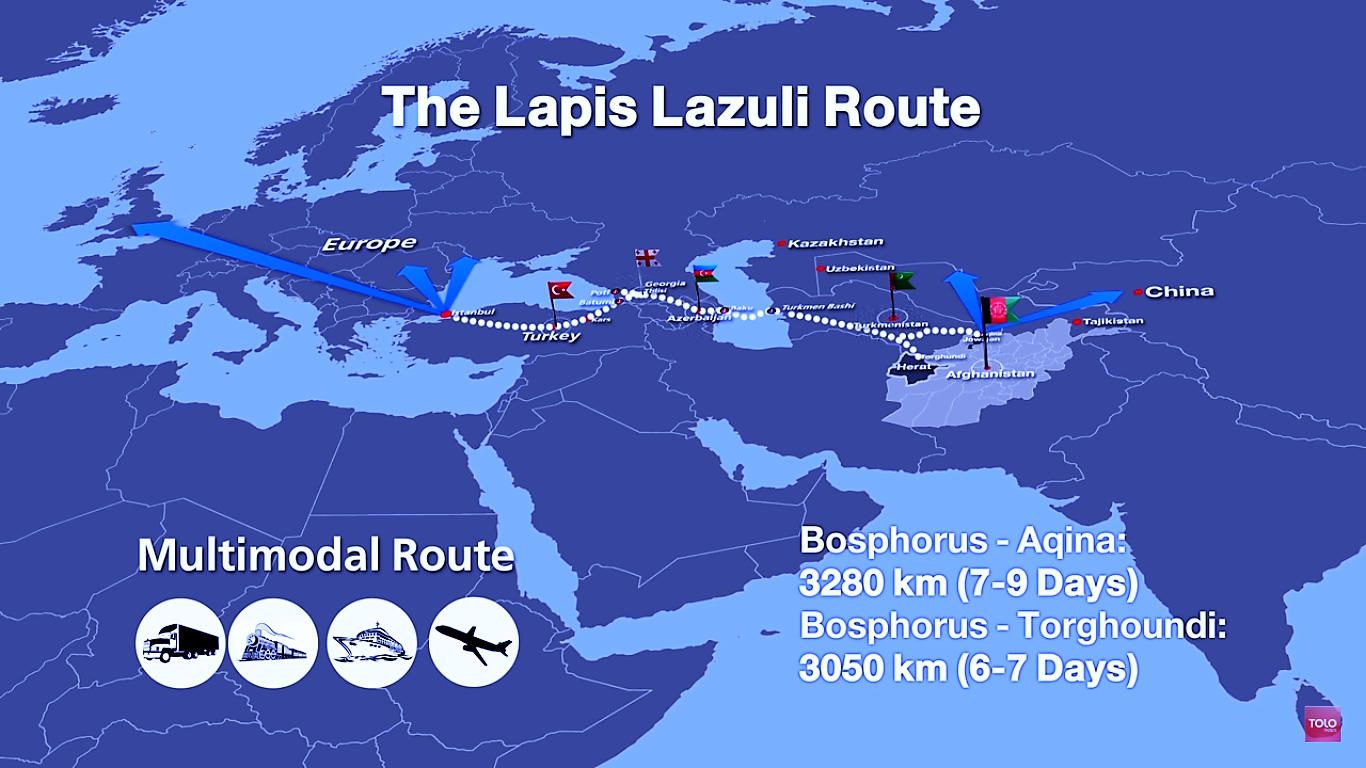
The Lapis Lazuli Transit Corridor connects
Afghanistan with Turkey, bypassing Iran. Despite its unprofitability, the
formation of the corridor, bypassing Iran, was initially motivated by political
goals.
The Lapis Lazuli Corridor starts in the
city of Torgund in the Herat province of Afghanistan, connects by rail and road
to the capital of Turkmenistan, Ashgabat, then to the port of Turkmenbash on
the Caspian Sea, after crossing the Caspian Sea, it passes through Azerbaijan,
through Georgia via Batumi and Poti, or Baku-Tbilisi-Kars, then heads to Turkey
and finally to Europe.
In fact, the Lapis Lazuli Transit Corridor
is being connected to the main artery of the Middle Corridor, thereby achieving
a synergy effect that will attract additional cargo flows through the Middle
Corridor.
The Lapis Lazuli Corridor repeats the
historical route by which lapis lazuli and other semi-precious stones were
exported from the Badakhshan province of Afghanistan to the Caucasus, Russia,
the Balkan Peninsula, Europe and North Africa.
Among the cargoes intended for the European
market, the transportation of Afghan cotton, fruits and sesame is considered.
Despite the fact that the Lapis Lazuli
Corridor has not yet had the ability to generate significant volumes of cargo
flows, the corridor is developing, for which the Asian Development Bank has
allocated $ 2 billion for the project budget.
By the end of 2024, significant progress
had been made in the development of the Lapis Lazuli Corridor, primarily
through the engagement of Taliban officials, in terms of increasing the
capacity of Afghan border crossings and facilitating the transportation of
goods through them.
The unstable political environment in
Afghanistan poses a number of infrastructure challenges for the development of
the Lapis Lazuli Corridor.
Within two weeks, Afghan goods have to
travel 3,000 km by road, rail, and sea before reaching European markets. In
addition, high tariffs for crossing the Caspian Sea, the necessary operations
for transshipment of cargo by rail, road, and sea, make the Lapis Lazuli
Corridor unprofitable compared to other transit routes, which is a major
economic constraint.
Although the Khaf-Herat railway is
operational between Iran and Afghanistan, and this route could connect Turkey
and Afghanistan via Iran in the shortest possible distance, Ankara and Baku aim
to reduce Iran’s influence in the region and completely cut it off from the
Lapis Lazuli Corridor, which is also in Georgia’s interest, as cutting off Iran
would make the Baku-Tbilisi-Kars railway more attractive.
As noted, the Iranian route is the shortest
east-west corridor for Afghanistan, however, experts believe that Turkey and
Azerbaijan’s pressure on Iran is also due to the Zangezur Corridor, where Iran
has a difficult position regarding the opening of this corridor.
Azerbaijan is most interested in the launch
of the Lapis Lazuli Corridor. In practice, Azerbaijan will fully control the
Afghan cargo flow.
Azerbaijan still has to create and develop
its own transport infrastructure. If, in addition to Chinese and Kazakh cargo,
Afghan cargo also passes through this infrastructure, its railway will be
loaded, as well as the Baku-Tbilisi-Kars highway built with its investment.
In addition to Azerbaijan, Russia has its
own interests, namely, its goal is to include the ice-free ports of
Makhachkala, Astrakhan, and, in the future, Lagan, on the Caspian Sea, in the
transportation of the Lapis Lazuli Corridor. By joining the Lapis Lazuli
Corridor, Russia will open a new corridor for its sanctioned products to enter
the Afghan market, which is its main priority.
At the end of 2024, Kabul and Moscow signed
an agreement on the supply of gasoline, diesel fuel, gas and wheat to
Afghanistan. The agreement envisages the supply of 1 million tons of gasoline,
1 million tons of diesel fuel, 500 thousand tons of liquefied gas and 2 million
tons of wheat from Russia.
The logical continuation of the Lapis
Lazuli Corridor is its extension to Pakistan. Recently, Islamabad has taken a
special place in the region, deepening trade relations with Azerbaijan, Russia,
Turkmenistan and Afghanistan.
The expansion of the Lapis Lazuli Corridor
towards Pakistan has significant advantages. With the largest Pakistani ports
of Karachi and Qasim, it will be possible to export goods from the
participating countries of the Lapis Lazuli Corridor to the main consumer
markets of the Arabian Sea and the Indian Ocean.
Under such a development scenario, the
Middle Corridor will lose cargo flow from Turkmenistan in addition to
Afghanistan, which will negatively affect the load on the Georgian transport
infrastructure.
The issue of extending the Lapis Lazuli
Corridor to Pakistan has become particularly relevant recently, given that
Kabul and Islamabad have jointly switched to synchronizing the development of
transport infrastructure.
One such project is the Trans-Afghan Railway, which will not only connect the Afghan railway with Uzbekistan and Pakistan, but also significantly improve the transport infrastructure within Afghanistan.
Info: transcor.ge