News
Logistical Capabilities of the Caspian and Central Asian Regions
2026-05-02
The transit network in the Caspian region and Central Asia
is currently facing serious challenges as growing trade flows exceed the
functional capacity of existing pipelines, railways and maritime hubs. In this
changing environment, the Trans-Caspian international transport route – often
referred to as the “middle corridor” – is becoming an increasingly important
alternative for transporting goods between Asian and European markets.
At a recent summit in the Azerbaijani capital, energy and
transport leaders noted that the region is entering a more volatile era. They
observed that the scale of trade turnover is testing the resilience and
capacity of the infrastructure connecting East and West. At a regional forum on
April 23-24, delegates described a system that is still functioning, but is
overburdened. Ports and railways are particularly vulnerable to financial
constraints and operational disruptions, they said.
Despite growing concerns about resource constraints, some
analysts believe the region is in a strong starting position. Askar Ismailov,
advisor for Central Asia at the Global Gas Center, stressed that the basic
transport infrastructure to meet initial demand is already in place.
He said that large-scale capital spending is not necessary
to increase the system’s capacity.
In the discussion in Baku, Ismailov spoke not only about
physical infrastructure but also about the importance of security of supply. He
stressed that the global order has fundamentally changed and no single route
can be considered permanently secure. He argued that, given the current
international situation, diversification and quantitative growth of existing
transit routes is the only way to ensure a stable supply of resources.
The participants in the discussion also spoke about the fact
that a significant part of the region’s export structure is still tied to a
limited number of channels. For example, Kazakhstan remains dependent on the
Caspian pipeline consortium through Russia, without which it cannot deliver a
large part of its production to the Black Sea. Another challenge is that
Azerbaijani oil exports are mainly carried out through the Baku-Tbilisi-Ceyhan
and Baku-Sufs systems.
John Patterson, a member of the British Chamber of Commerce
in Azerbaijan, said that the main challenge now is the pace of selecting and
creating new transit routes. He drew attention to the expected growth in global
demand for energy resources, which requires an urgent expansion of the pipeline
network. Referring to the recent fluctuations in the prices of Brent crude oil
and liquefied natural gas, Patterson warned the high-ranking officials in the
hall that if transit problems are not urgently resolved, the current market
fluctuations will become a harbinger of wider economic challenges.
The panelists also discussed how connectivity can be a tool
for strategic influence. In their assessment, in an era of reshaping global
supply chains, the ability of countries to efficiently transport goods and
energy has become a serious strategic asset. Patterson noted that by improving
various transport links by the countries of the Middle Corridor - whether by
road, rail or pipeline - the international market will be able to effectively
bypass traditional maritime bottlenecks, such as the current Strait of Hormuz.
It is worth noting that Azerbaijan is increasingly seen as a
key point in this strategy. Since Baku already has established pipeline
connections to Western markets, it has the necessary technical knowledge and
experience to help the countries of Central Asia transport natural resources.
It is worth noting that this role is not limited to the energy sector; During
the discussion, Patterson suggested that everything from raw materials to
finished goods could use this corridor to reach the European Union, effectively
connecting major manufacturing zones with consumer markets.
The speakers highlighted the growing dynamism that is being
observed in the Middle Corridor. They assessed that interest in the Middle
Corridor is growing sharply against the backdrop of the reconfiguration of
global logistics routes. This route, which connects China with the South
Caucasus and Europe via the Caspian Sea, is becoming a vital alternative to
trade routes that are currently disrupted by geopolitical instability.
It is worth noting that the increase in traffic on this
route is already noticeable in its rail and maritime segments. That is why, in
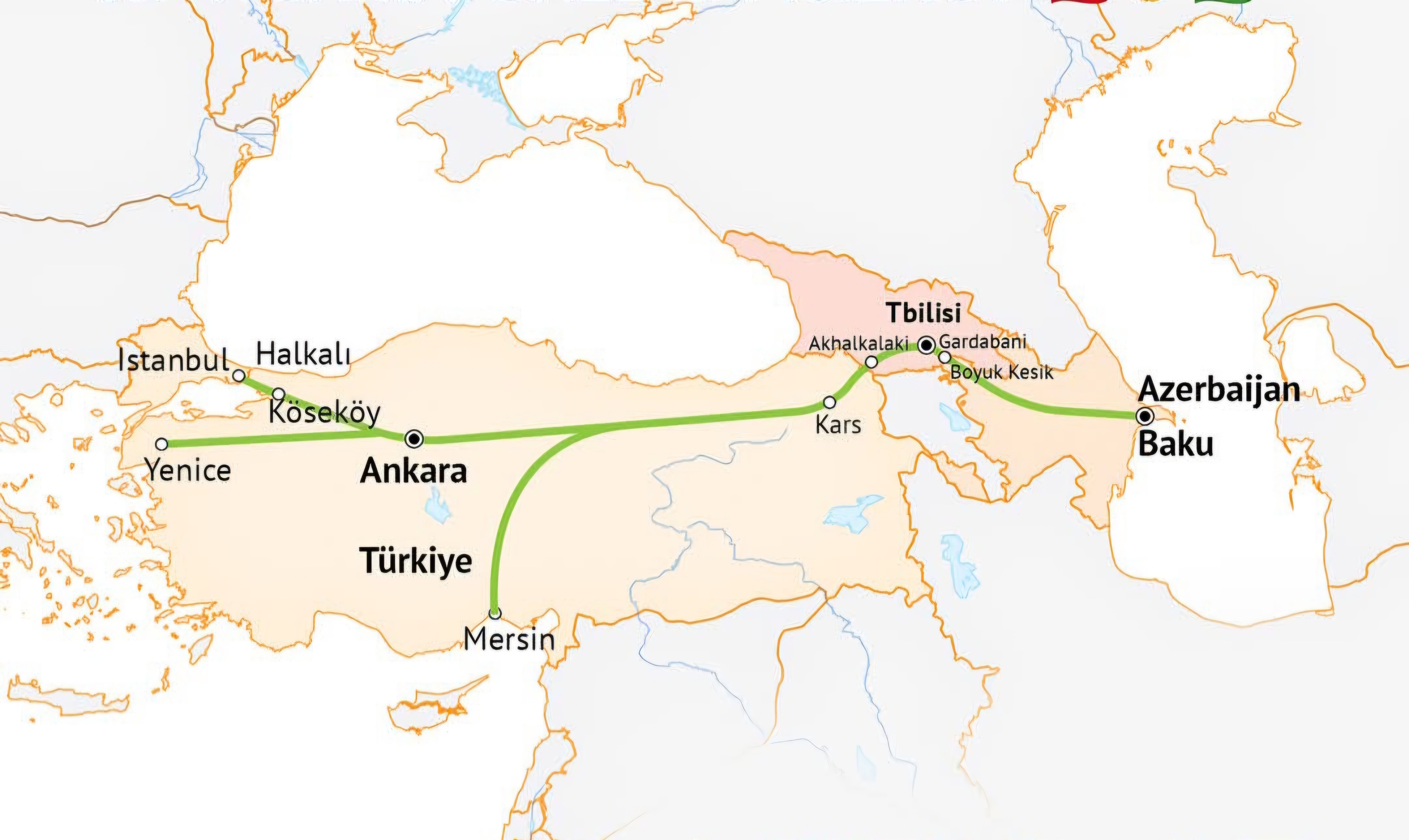
order to increase cargo throughput, the Baku-Tbilisi-Kars railway is actively
starting the process of expansion. A large-scale increase in cargo flows is
also recorded in the ports of the Caspian and Black Seas. It is also noteworthy
that the demand for capacity from Azerbaijani terminals to the ports of
Kazakhstan, including Aktau and Kuryk, often exceeds the pace of ongoing
modernization projects.
It is also noteworthy that against the background of
increasing logistical pressure, the leaders of the region have actively begun
to reconsider several projects that were suspended long ago.
The head of Kazakhstan’s “Oil Council,” Asylbek Jakiyev,
stressed that there is potential for resuming talks on a special pipeline
running along the bottom of the Caspian Sea, and that this route could directly
connect to the Baku-Tbilisi-Ceyhan network. In his speech, Jakiyev did not deny
that such an initiative would require high-level diplomatic coordination and
efforts from Kazakhstan, Turkmenistan, and Azerbaijan, but noted that such an
opportunity should not be missed.
Beyond discussing logistical possibilities, the high-level
leaders and experts also discussed natural and regulatory factors that could
hinder the process. One of the factors cited was the decline in the Caspian
Sea, which has already posed a direct threat to the functioning of ports and
requires expensive dredging. As it turns out, the current situation has forced
many shipping companies to choose smaller vessels when purchasing ships, as it
is becoming increasingly difficult for deep-draft tankers to enter ports.
The leaders participating in the discussion agreed that the Caspian and Central Asian corridor has begun to transform from a static transit zone into a rapidly changing, but high-risk route in the past few years. According to their conclusion, those who prioritize resilience and multi-directional connectivity will win in this situation.
bm.ge