News
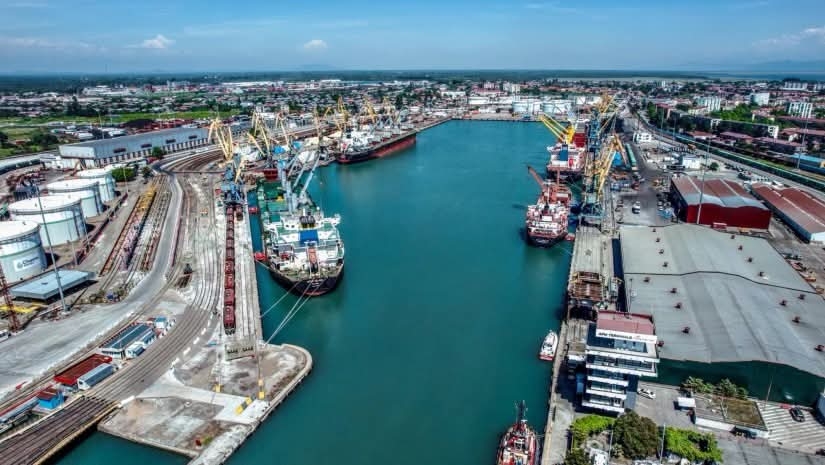
Poti Port in Engineering Perspective and the Middle Corridor
2026-06-25
A seaport, no matter how powerful and modern it is equipped
with marine cranes, multi-hectare container yards, closed warehouses and a
high-tech internal transport park, will simply “drown” if its serving port
railway infrastructure cannot function properly. The internal operational
capacities of the port and the serving railway station are components of a
single technological cycle, the synchronization of which with minute accuracy
determines the entire transit potential of the country.
The example of the main sea gate of Georgia — “Port of Poti”
and the railway station “Port of Poti” clearly shows the challenges we face
today against the backdrop of the growing cargo flows of the “Middle Corridor”.
Let’s look at this issue from an engineering perspective,
using the “problem-solution” principle:
✖️ Problem 1: Insufficient
length of railway tracks laid out in the port territory.
The operational and freight tracks laid out in the internal
territory of the port cannot physically accommodate modern standard container
trains (Block Trains, 850–1050 meters long). As a result, the train arriving
from the highway is split into 2-3 parts, which increases shunting work both at
the station and in the port territory, which leads to time losses.
➕️ Engineering solution:
At the expense of geometric displacement and reconstruction of the extreme
turnouts, increasing the useful length of the internal railway lines to 1050
meters. This will allow us to receive complete trains without dismantling.
✖️ Problem 2: Single-track
configuration of access roads.
The single-track configuration of the access tracks leading
directly from the railway station to the freight terminals creates a
technological conflict: while the empty train is being taken out of one
terminal, the loaded wagons intended for the other terminal are forced to wait
for this single line to be freed.
➕️ Engineering solution:
Arrangement of a double-track configuration of the access tracks and the
introduction of two-way switches between the tracks. This will allow shunting
trains to move independently of each other and quickly pass other cars.
✖️ Problem 3: Space
shortage and urban conflict.
The railway station and seaport are physically “compressed”
by the development of the city of Poti. The railway does not have free land
plots for easy expansion of the territory, and the crossing of road and rail
flows creates traffic jams.
➕️ Engineering solution:
Implementation of the “Dry Port” concept. A large preliminary sorting yard is
being built outside the city. Mainline trains are sorted there, and only
prepared groups of purpose-built cars enter directly on the coastal strip. At
the places of crossing the flows, the levels should be separated by transport
overpasses.
✖️ Problem 4: Information
disconnection.
The train schedule and the port’s internal operating system
(TOS) often fail to update data in real time, leading to equipment downtime.
➕️ Engineering solution:
full digital synchronization (EDI platforms). The delivery of wagons should be
carried out on a Just-In-Time basis — the crane must know in advance which
container is placed on which wagon, so that work can begin within seconds as
soon as the train arrives.
✖️✖️ Fundamental problem:
institutional disconnection and the absence of a “unified technological
process”.
In Soviet times, we determined the operation of ports and
railways based on a “standard technological process” sent from Russian research
institutes. Today, this “vertical” no longer exists, and it is very good that
it does not exist. The reality is that today in Poti there is practically no
modern, jointly developed “working framework”. Work is often carried out with
outdated inertia and fragmented agreements.
➕️ Managerial solution: It
is necessary for the port and railway station management to jointly develop a
new, independent “unified technological process” of work, signed by the head of
both entities. This should become an operational “constitution”, the
unconditional observance of which will be the supreme obligation of both
parties.
Human factor: a united team
All engineering projects and digital algorithms will remain
only on paper if they are not backed by the highest professionalism of the
service personnel. The railwayman and the port employee are parts of a single
organism and a single team, and their coordination is the main formula for the
success of logistics.
Conclusion:
The development of a modern seaport is unthinkable without the modernization of the railway infrastructure and the development of human resources. Engineering approach, geometric accuracy, management coordination and unified teamwork are what will allow the Port of Poti to fully realize its geostrategic potential.
Dato Gochava, Professional Railwaymen's Club