News
Pylonology ● Sea Pilot | Oct 26
2026-10-07
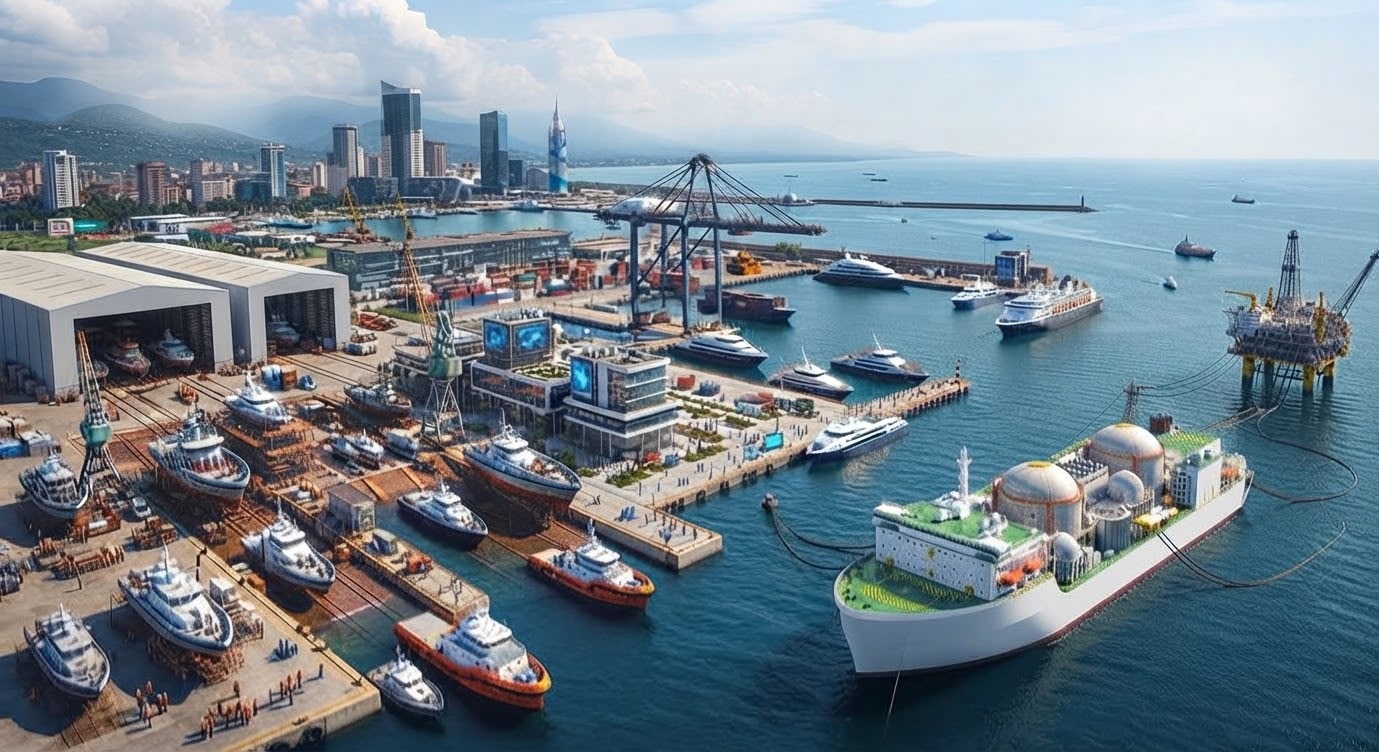
Small-Scale Shipbuilding Potential
The production of small and medium-sized specialized vessels
in Georgia is viewed as a key avenue for the development of the maritime
industry. Unlike large-scale shipbuilding, small-scale shipbuilding allows for
operations to begin on a relatively modest scale, with the potential to
gradually expand technological capabilities. Potential vessel types include
pilot boats, workboats, small tugs, rescue and hydrographic vessels, and port
service craft, as well as tourist and fishing vessels.
Specialized and small-batch production plays a significant
role in this segment. Vessels serving various purposes can be created based on
a single basic design, thereby optimizing the production process. Furthermore,
different companies can specialize in specific areas—such as hull construction,
electrical systems, engines, and other components—while a final manufacturer
integrates these elements into a finished product.
The development of shipbuilding also generates demand for
vessel maintenance, repair, and dry-docking services. Consequently, the
expansion of the industry could involve not only the construction of new
vessels but also the provision of services covering their entire operational
lifecycle. Georgia’s ports, existing maritime infrastructure, and established
base of maritime education and professional expertise are crucial assets in
this regard.
Manufacturing and repair infrastructure has historically
existed in Poti, including at the Shipyard #201 site. However, modern
shipbuilding requires—alongside physical infrastructure—capabilities in modern
design, digital manufacturing, quality control, and engineering expertise that
meets international standards. Developing these areas, including the training
of qualified personnel, is a key prerequisite for establishing the industry.
Demand from Georgia’s ports and the regional maritime sector
can be viewed as the initial market. The development of ports and the increased
volume of traffic through transit corridors are driving demand for various
types of specialized maritime services. The production experience gained in the
local market can, in turn, be leveraged to enter the Black Sea and other
regional markets. Technological cooperation with foreign companies, licensed
production, and joint projects are viewed as additional mechanisms in this
process.
In the long term, the development of small-scale
shipbuilding could advance to the stage of creating proprietary designs and
engineering solutions. In this scenario, the sector would integrate fields such
as metallurgy, mechanics, electrical engineering, design, logistics, and
maritime technology. Furthermore, the introduction of the first specialized
Georgian vessels into commercial operation could serve as a foundation for
testing local production capabilities and facilitating subsequent regional expansion.
Floating Nuclear Power
Placing small modular reactors on floating platforms is
considered a new direction in the development of nuclear energy. A practical
example of this approach is the *Akademik Lomonosov*—a floating nuclear power
plant that began commercial operations in 2020 in the Russian Arctic city of
Pevek. Modern small modular reactors make it possible to deploy compact energy
generation systems at various maritime locations.
One potential advantage of floating nuclear plants is their
locational flexibility; such a facility can be positioned near the coast to
supply generated energy to the mainland. In the future, similar platforms could
be used not only for electricity generation but also for producing hydrogen or
fresh water, as well as for powering remote offshore facilities. At the same
time, locating a nuclear facility in a marine environment imposes specific
requirements regarding safety and technical management.
Alongside technological issues, legal and international
regulatory frameworks present a significant challenge. Floating nuclear
facilities are subject to both maritime and nuclear safety regulations
simultaneously. Consequently, it is necessary to clearly define
responsibilities, safety standards, and protocols for the management of
radioactive materials and for emergency response. The management of the
decommissioning and subsequent dismantling of such facilities is also a crucial
issue.
For Georgia, floating nuclear power technology can currently
be viewed more as a future technological prospect than as an immediate
investment project. Its development requires an appropriate legal framework,
specialized infrastructure, and high safety standards. Nevertheless, this trend
demonstrates the growing convergence of the energy and maritime sectors,
suggesting that marine areas could potentially become new hubs for energy
generation in the future.
Georgia’s Maritime Potential
Georgia’s maritime potential is defined by more than just
its coastal location and the existence of ports. While Poti and Batumi serve as
active port hubs and the infrastructure at Supsa and Kulevi is operational, the
development of the Anaklia deep-sea port is elevating the country’s maritime
capabilities to a new level. The efficiency of this infrastructure becomes
particularly significant when various ports and transport networks operate as
an integrated system. Furthermore, a substantial portion of the maritime
economy is generated beyond the immediate confines of the ports themselves;
vessels require services such as pilotage and tugboat assistance, technical
support, supplies, repairs, waste management, and other ancillary services. The
expertise of Georgian seafarers and maritime specialists also constitutes a
valuable resource for the country—skills that can be utilized onshore in areas
such as port operations, technical inspections, training, safety, and
management. The construction and repair of small and medium-sized vessels is
considered an additional area of focus,
linked to the local development of engineering, metallurgical, mechanical, and
electrotechnical expertise.
Expanding Georgia’s maritime capabilities is closely linked
to the development of the Middle Corridor. Crucial to this process is not
merely the volume of cargo transported through the country, but the economic
value generated within Georgia—spanning maritime services, logistics, repairs,
manufacturing, digital services, and vocational education. The Anaklia Port
could become a significant new link in this system, though the ultimate outcome
will depend on the extent to which the surrounding infrastructure, businesses,
and services are developed. Thus, assessing Georgia’s maritime potential
requires looking beyond port cargo throughput; key indicators include the
participation of local companies in maritime services, the execution of
technical work within Georgia, the creation of new professional opportunities,
and the integration of local products and expertise into the maritime economic
value chain. The evolution of this process creates an opportunity for Georgia
to become part of a broader maritime economic system, extending beyond its role
as a transit hub.
The Maritime Industry of the Future
The maritime industry of the future may see the emergence of
projects that currently appear unusual or utopian, yet could become reality
through technological advancement. Such concepts include floating cities that
integrate residential and commercial spaces with energy, water supply, and
medical service systems; floating industrial platforms capable of small-vessel
manufacturing, maintenance, or the assembly of offshore energy equipment; and
floating shipbuilding facilities, where the production platform moves between
locations to operate according to specific orders. The development of such
approaches could be facilitated by the more active use of marine space,
particularly in areas where coastal land is scarce or expensive. Floating
energy islands are considered another avenue for the future; these could
integrate wind and solar power generation, energy storage, and hydrogen
production, alongside subsea technical stations and service bases for
autonomous vessels. Underwater data centers and floating logistics
platforms—capable of receiving, storing, and distributing cargo—are also being
considered in this context. A more long-term prospect involves a network of
floating ports, where berths and technical and energy infrastructure would be
situated partially at sea. While some of these concepts may never materialize
in their currently envisioned forms, the research and testing involved are
already yielding technologies destined for use in real-world maritime projects.
The history of the maritime industry demonstrates that many technologies began
as mere imaginative ideas before eventually becoming standard practice.
Sea Pilot