News
Reduced local transportation on Georgian Railways
2025-04-06
Against the backdrop of the country's
economy's increasingly high growth rates in recent years, paradoxically enough,
local transportation on Georgian Railways is permanently decreasing.
It is well known that the development of
the country's industrial potential depends, first of all, on its transport
"backbone", mainly on local freight transportation by railway.
Against the backdrop of the country's
economic growth, the trend of a permanent decrease in one of the important
transport indicators - local railway transportation - calls into question the
reality of increasing the country's economic growth rates at the expense of the
development of industrial sectors.
In 2024, the lowest rate of local
transportation in the last 15 years was recorded on Georgian Railways - 1.4
million tons, which amounted to 10% of the total freight turnover, as well as
the minimum. In 2011-2024, local railway transportation decreased by 53% from 3
million tons to 1.4 million tons.
Naturally, the question arises, what
determines the trends of decreasing local transportation by railway?
Given that a significant part of local
transportation is carried out on the branches of the Georgian Railway, the
first and most important reason is the poor condition of the infrastructure, in
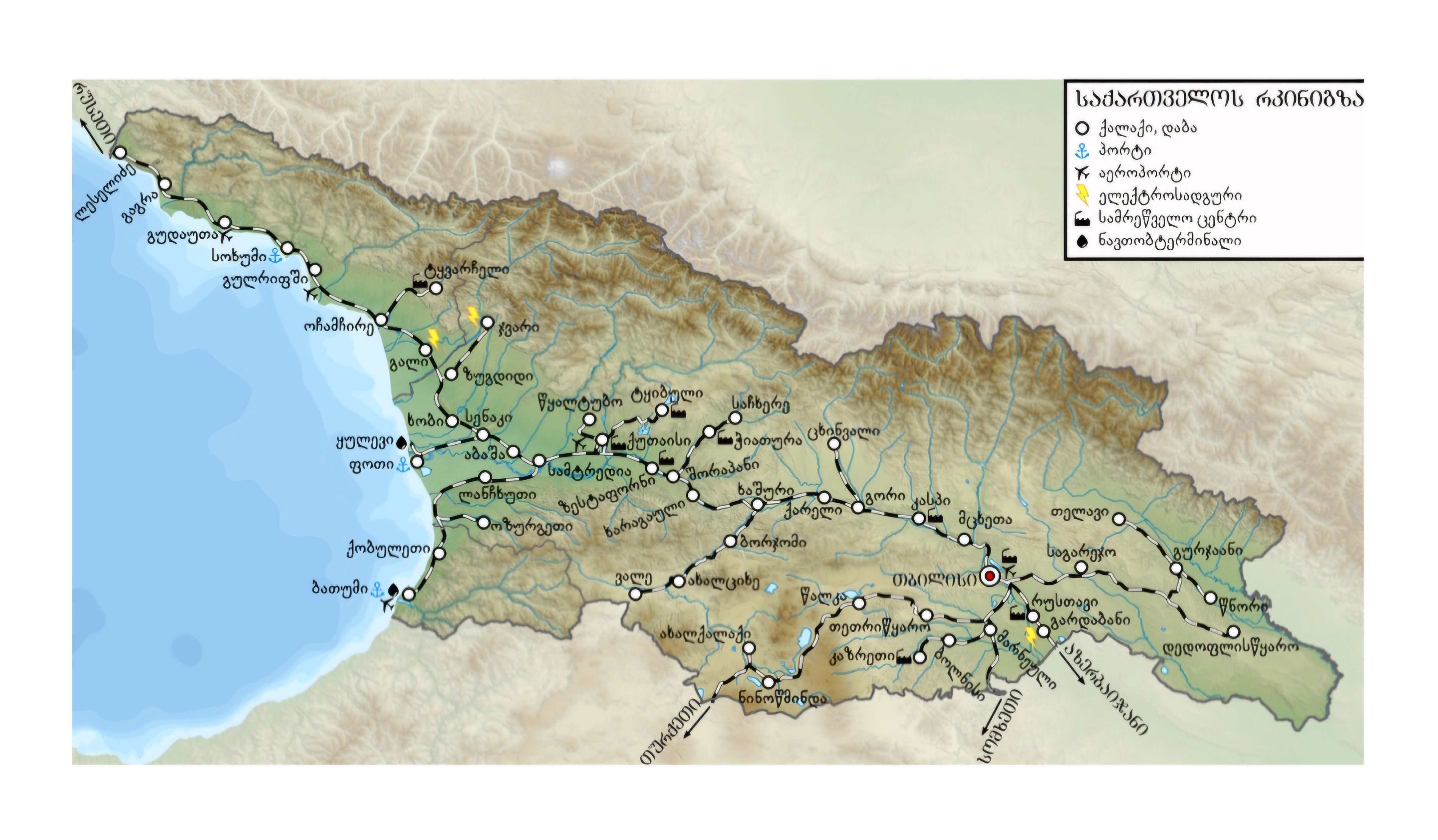
particular, the track, on the branches of the Georgian Railway (see the branch
diagram).
Due to the condition of the track, the
movement speeds and the loads on the wagon axles are limited on the branches of
the Georgian Railway, which means that the railway loses its mobility and
cannot compete with road transportation.
In such conditions, freight road transport
performs "non-profile" types of transportation for it. The movement
of vehicles loaded with construction and inert materials on the roads is
noticeable, which, along with environmental pollution, causes intensive damage
to the road surface.
Overall, railway branches that remain
"inoperative" hinder the development of the industrial potential of
the country's regions. Maintaining such railway branches places an additional
burden on the financially unstable Georgian Railways.
What is the solution?
Based on the current reality, Georgian
Railways has found a solution - the complete dismantling of the railway branch.
In 2021, the Zugdidi - Jvari section was
dismantled with the argument that the mentioned section was inoperative, and at
the same time frequent robberies of the Lindagi were common. By decision of the
Georgian Railways, the initial 11 km of the 35 km Zugdidi-Jvari section were
left in operation, while the remaining 24 km were completely demolished and
canceled. In fact, 9 villages in the region were left without a railway
connection.
In addition, the state had an attempt to
restore one of the railway branches. The real promise, which concerned the
restoration of the Kakheti Railway, was made in the format of pre-election
promises in 2012.
Later in 2019, the promise was reinforced
by the state with specific arguments. In particular, financial resources were
being raised jointly with the Asian Development Bank.
By 2020, it became clear that - "the
Asian Development Bank did not have a single completed, ongoing or planned
railway project in Georgia".
The promise of the Kakheti Railway
Rehabilitation Project has remained unfulfilled to this day.
What is the solution?
In order to develop the industrial
potential of the country’s regions, it will be necessary to build and develop
(finance) the branch infrastructure of the Georgian Railway, a model widely
tested in Europe – the branch infrastructure. This model can be used on the
Kakheti Railway as well.
It is worth noting that the deplorable
condition of the tracks on the branches intended for freight transportation
automatically leads to delays in passenger transportation on the same branches.
Based on the analysis of more than 100
responses by the Transport Corridor Research Center, it was revealed that
passenger transportation on the branches of the Georgian Railway is practically
paralyzed.
The population's demands for the
restoration of traffic on the branches are high. In fact, in a situation where,
as a result of the increase in fuel prices, prices for minibuses in the regions
increased, the railway failed to ensure that the regions' passenger
transportation market adapted to this.
After Covid, the railway suspended
passenger transportation, and in response to this reality, the railway linked
the standard explanation - "Unfortunately, at this stage, it is impossible
to meet the new railway regulations on suburban trains and, accordingly, the
risk of the spread of Covid 19 is quite high."
Naturally, the population's argument was
unambiguous and convincing - "If Covid 19 does not spread in the Batumi
direction, aren't there fewer passengers on the Borjomi train?"
The population's demand is to ease access
to mountain resorts.
The main demand is to restore the Borjomi
train so that the population has (cheap) access to the resort of Bakuriani via
the Borjomi-Bakuriani railway, which is not functioning.
"What about the people... Borjomi-Tbilisi does not run. What is our fault of the poor people, who thinks about us?" (The railway branch is paralyzed).
"When will Borjomi-Bakuriani be
restored?" (The railway branch is paralyzed)
"I have never heard of people and
regions being so divided, Georgia is only Western Georgia? Doesn't the railway
belong to the East too?" (The railway branch is paralyzed)
"When will the “Perevali” train Khashuri-Zestafoni be available?" (Railway branch paralyzed)
“When will Tbilisi-Gardabani resume work?”
(Railway branch paralyzed)
“What did other regions really do wrong, if
the price is one GEL, let it became two, or if it is two GEL, let it became
three, but restore it” (Railway branch paralyzed)
“If trains are going to be run and you
think about the people, what did Borjomi, Nikozi do wrong? People are going to
work. How can you do this to the poor people? Who legalized that?” (Railway
branch paralyzed)
“We ask the railway authorities to publicly explain the reason why they are not allowing the Borjomi train to run.” (Railway branch paralyzed)
“Are you planning to open the
Kutaisi-Sachkhere line and when?” (Railway branch paralyzed)
Will the Borjomi and Nikozi trains be
restored at all? Those villages need it most critically” (Railway branch
paralyzed)
"The movement in the Borjomi direction
should start, the mountain resorts have opened and people will benefit, they
will transfer to "Kukushka" in Borjomi, so that vacationers can
easily and cheaply get to Bakuriani, so measures should be taken to transport
passengers in the Borjomi direction as quickly and safely as possible".
(Easing access to the mountain resorts).
"What did the Batumi-Kutaisi-Batumi direction do wrong?" (The main direction is paralyzed)
"Will Ozurgeti Batumi ever be restored?" (The main direction is paralyzed).
In conclusion – the restoration of the branches of the Georgian Railway and its further functioning requires a systematic solution to the accumulated problems from the state.
Info: transcor.ge