News
Russia s Transport Policy in the Baltic States
2025-03-20
After the collapse of the Soviet Union, the Baltic states inherited Russia's export-oriented port and railway infrastructure, which ensured the maintenance of their own economic growth rates.
Since the 2000s, Russia has been actively pursuing a policy of gradually shifting export-oriented cargo flows from the Baltic ports of Lithuania, Latvia and Estonia - Riga, Ventspils, Liepaja, Tallinn, Klaipeda - to Russian ports on the Baltic Sea - St. Petersburg, Ust-Luga, Vyborg, Kaliningrad, Primorsk, Vysotsk.
If in 2000, 26% of Russia's exports to the Baltic Sea basin were processed through Russian ports, and the rest of the cargo was transported through the ports of the three Baltic states, by 2007 the ratio increased to 55%, and by 2015 to 62%. By 2030, Russia is expected to redirect 95% of its export cargo flow to its own ports and from there to world markets.
In parallel with the expansion of its own port infrastructure in the Baltics, Russia has gradually transferred export cargo, which was previously directed to the ports of the Baltic states, to four large ports owned by it.
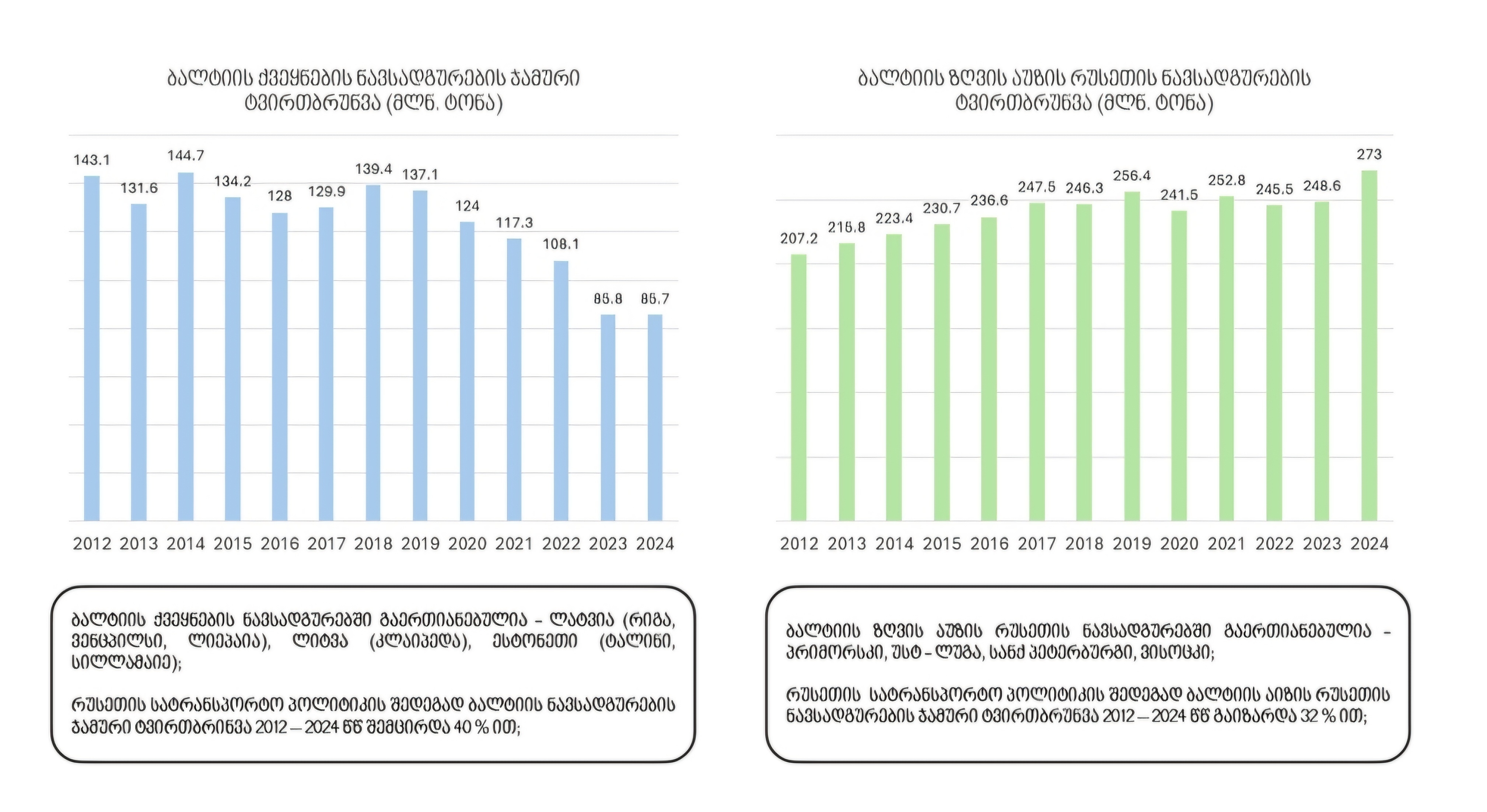
Russia’s protectionist policy towards its own ports (see diagram) led to a 40% reduction in the total cargo turnover of the ports of the Baltic states between 2012 and 2024.
The reduced cargo turnover in the ports of the Baltic states was naturally redirected to the Russian Baltic ports, where the total cargo turnover between 2012 and 2024 increased by 32%.
Paradoxically, against the backdrop of military confrontation, Russian ports in the Baltic Sea basin processed a record 273 million tons of cargo in 2024.
The cargo turnover of Russian ports on the Baltic Sea has increased 3.6 times over the past 20 years, while the total cargo turnover of the ports of Estonia, Lithuania and Latvia, as a result of Russia’s aggressive transport policy, has actually returned to the level it was 20 years ago.
If previously transport occupied a major place in the GDP of the Baltic countries (Estonia – 8%, Latvia – 10%, Lithuania – 15%), then Russia’s actions have significantly reduced the share of transport in GDP, which has caused significant financial losses to the Baltic countries.
Russia’s aggressive policy towards the Baltic countries, in terms of reducing cargo, as well as the ports, has significantly damaged their railways. In 2014-2024, transit cargo turnover through ports on Latvian railways decreased by 6.6 times – from 47 million tons in 2014 to 7.1 million tons in 2024.
Similarly, on Estonian railways, railway cargo turnover decreased by 4 times from 19.2 million tons in 2014 to 4.8 million tons by 2024.
The Baltic countries expected to compensate for the cargo diverted from Russia with Chinese cargo flows, but for China, the route through the territory of one country, Russia, turned out to be financially attractive for transportation to Europe.
The complete redirection of cargo flows from the Baltic Sea to its own ports has directly financially damaged the Russian transport industry, since Russian companies have made significant investments in the Baltic ports and railways, so the infrastructure created in the ports of the Baltic states with their financial contributions has turned out to be unusable.
In the long term, the diversion of cargo flows from the Baltic states to Russia will be economically beneficial for the Russian transport industry, as the port infrastructure will be gradually loaded.
On the other hand, this process will have a negative side effect for Russia; it will have to sell the freed - unusable - transport infrastructure in the Baltic states, thereby ultimately losing the lever of political influence over the Baltic states.
For your information, there are many warehouse and processing port infrastructures created with Russian investments in the Baltic ports.
Large Russian companies will simultaneously lose their dominant positions in supplying the railways of the Baltic states with spare parts and rolling stock. For example, Russia's largest rolling stock manufacturer, Transmashholding, has numerous contracts with Lithuanian Railways.
Russia's withdrawal from the transport industry of the Baltic states will have an additional positive effect, as the widespread policy of corruption and money laundering in Russia will be temporarily stopped.
Despite such an expected scenario, Russia's complete withdrawal from the Baltic region contradicts Russia's state policy, since it never hides that it perceives the transport sector not only as a specific sector of the economy, but also as an important tool for achieving foreign policy goals.
The Baltic states, with financial assistance from the European Union, have found a solution. They are jointly developing the Rail Baltic high-speed railway project connecting them to the European space, which completely excludes Russian interference in terms of both cargo flows and the use of transport infrastructure.
In conclusion, the example of the Baltic states requires detailed analysis in Georgian political circles, since Russia’s policy regarding the direct or indirect acquisition of Georgia’s transport infrastructure and, from its point of view, the supply of cargo flows is still relevant today.
Info: transcor.ge