News
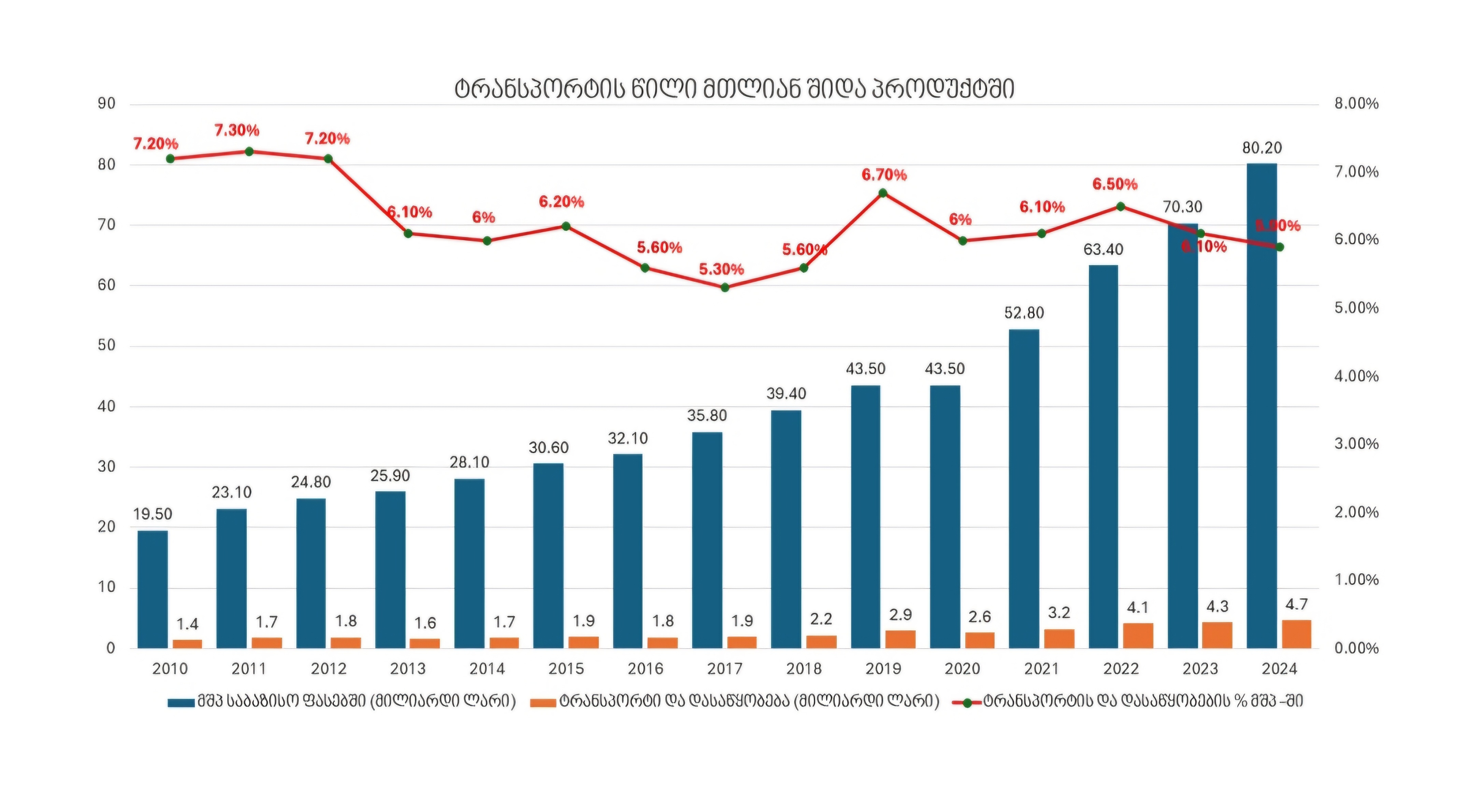
Share of the transport sector in Georgia s GDP
2025-04-25
In a situation where the percentage of the
transport sector in the country's GDP is decreasing, this process indicates a
shortage of investment in the transport sector, which ultimately affects the uneven
utilization of the transport corridor's potential. All this leads to a decrease
in the competitiveness and attractiveness of one of its priorities, the Middle
Corridor, recognized by the country.
If we analyze the share of the transport
segment in the country's GDP over the past 15 years (see diagram), we will see
that in 2010-2012, the share of transport in GDP exceeded 7% and was the
highest in the last 15 years. In 2016-2018, the share of transport in GDP fell
below the 6% mark.
Such a trend indicates a deficit in the
inflow of foreign direct investment in the transport sector.
Such an approach, in part, does not apply
to countries dependent on the export of oil and gas resources. Despite the fact
that Azerbaijan is developing the energy industry, in 2024 the share of
transport in GDP amounted to 6.7%, which is much higher than the indicator in
Georgia.
Of the already reduced foreign direct
investment in Georgia in 2024 - 1.3 billion dollars, investment in the
transport sector - 97 million dollars, amounted to only 7% of the total
investment, which is an extremely low indicator for a country with transit
ambitions.
The low share of transport in the country’s
GDP, in addition to the lack of investment, is caused by the announced and
repeatedly postponed, financially viable unfinished infrastructure projects,
which, in addition to reducing the attractiveness of the corridor, disrupts the
synchronization of the sustainable development of the country’s “hardware
infrastructure”.
First of all, we have in mind several
important infrastructure projects, such as the East-West 430 km expressway
project, the implementation of which began in 2006, the completion dates of
which were postponed 5 times under different governments, and after 19 years,
the final completion date of the project is still unclear.
Also, the project of the Georgian section
of the Baku-Tbilisi-Kars railway, the implementation of which began in 2008 and
even today, 17 years later, the railway is operating with limited capacity.
Below is a list of 50 transport
infrastructure and transport industry-related projects announced and not
implemented, as well as ongoing – “delayed in time” – over the past 10 years:
Anaklia Port and Special Economic Zone –
“Anaklia City”.
Construction of an access railway line and
station to Anaklia Port.
Assigning a new function to the bypass
railway.
Expansion of the container capacities of
Poti Port.
Addition of a railway component to the Poti
Free Industrial Zone.
Arrangement of infrastructure for logistics
centers in Kumi and Kutaisi near Tbilisi.
Construction of a cargo terminal at Kutaisi
Airport.
Development of a new runway and airfield
infrastructure at Kutaisi Airport.
Completion of the railway pass
modernization project.
Increasing the cargo handling capacity of
the Baku-Tbilisi-Kars railway.
Restoration of additional exits of Tbilisi
metro stations (Akhmeteli second exit project).
Development of an environmentally friendly
tram transport network in Tbilisi.
Development of multi-level parking spaces
in Tbilisi.
Renewal of metro cars to international
standards.
Modernization of Tbilisi metro stations.
Restoration of the Tsnori-Sighnaghi cable
car.
Construction of the Lentekhi-Mestia
connecting road and tunnel.
Completion of the Samtredia-Grigoleti road
section, restoration of the damaged bridge.
Construction of the Samtredia-Zugdidi
bypass road connecting Anaklia and Poti ports.
Construction of the Tbilisi bypass road.
Construction of the Chumateleti-Kharagauli
motorway.
Construction of the Batumi-Sarpi motorway.
Construction of the Tbilisi-Rustavi
motorway.
Construction of the Natakhtari-Zhinvali
motorway - rehabilitation.
Construction of the Rustavi-Tsitilei Khidi
motorway.
Construction of the Rustavi-Sadakhlo
motorway.
Construction of the Sairme-Abastumani
motorway - rehabilitation.
Construction of the Grigoleti-Poti motorway
- rehabilitation.
Construction of the Bakurtsikhe-Tsnori
motorway - rehabilitation.
Construction of the Tsnori-Lagodekhi
motorway - rehabilitation.
Construction of the Gurjaani (Chumlaki) -
Telavi bypass road.
Completion of the Khulo-Goderdzi Pass
Motorway.
Construction of the Sno – Roshka – Shatili
– Omalo – Khadori – Batsara – Akhmeta “Mountain Roads” Motorway.
Renewal of the Railway Wagon and Locomotive
Park.
Restoration of the Kakheti Railway.
Expansion of the Telavi Airport.
Implementation of the Omalo Airport
Project.
Arrangement of the Kutaisi Airport Access
Railway.
Arrangement of the above-ground metro in
the direction of Digomi.
Construction of Samgori-Vazisubani,
Akhmeteli-Temka and Sameba-Makhati Mt. cable cars in Tbilisi.
Construction of an above-ground metro in
the direction of Lilo-Samgori-Airport.
Construction of a
smart traffic light system in Tbilisi.
Construction of a “suspension” bridge near
by “Vepkhvi and Mokme”.
“Imereti Agrozone” project – development of
a warehouse.
Construction of counter-railway
transportation infrastructure.
Project for an electric vehicle factory in
Kutaisi.
Stadler train service center.
Joint venture for assembling Belarusian
tractors in Batumi.
Placement of aircraft maintenance centers
at Tbilisi and Kutaisi airports.
Construction of an international standard
auto station in the village of Tsaishi, Zugdidi municipality.
Production of 8E1A electric locomotives at
the Tbilisi Electric Locomotive Factory.
Launch of a Georgian-Chinese enterprise producing asynchronous locomotives and their spare parts.
In conclusion, the decrease in the percentage of the transport sector in the country's GDP is primarily due to the lack of investments and the delay in the implementation of financially viable infrastructure projects.
transcor.ge