News
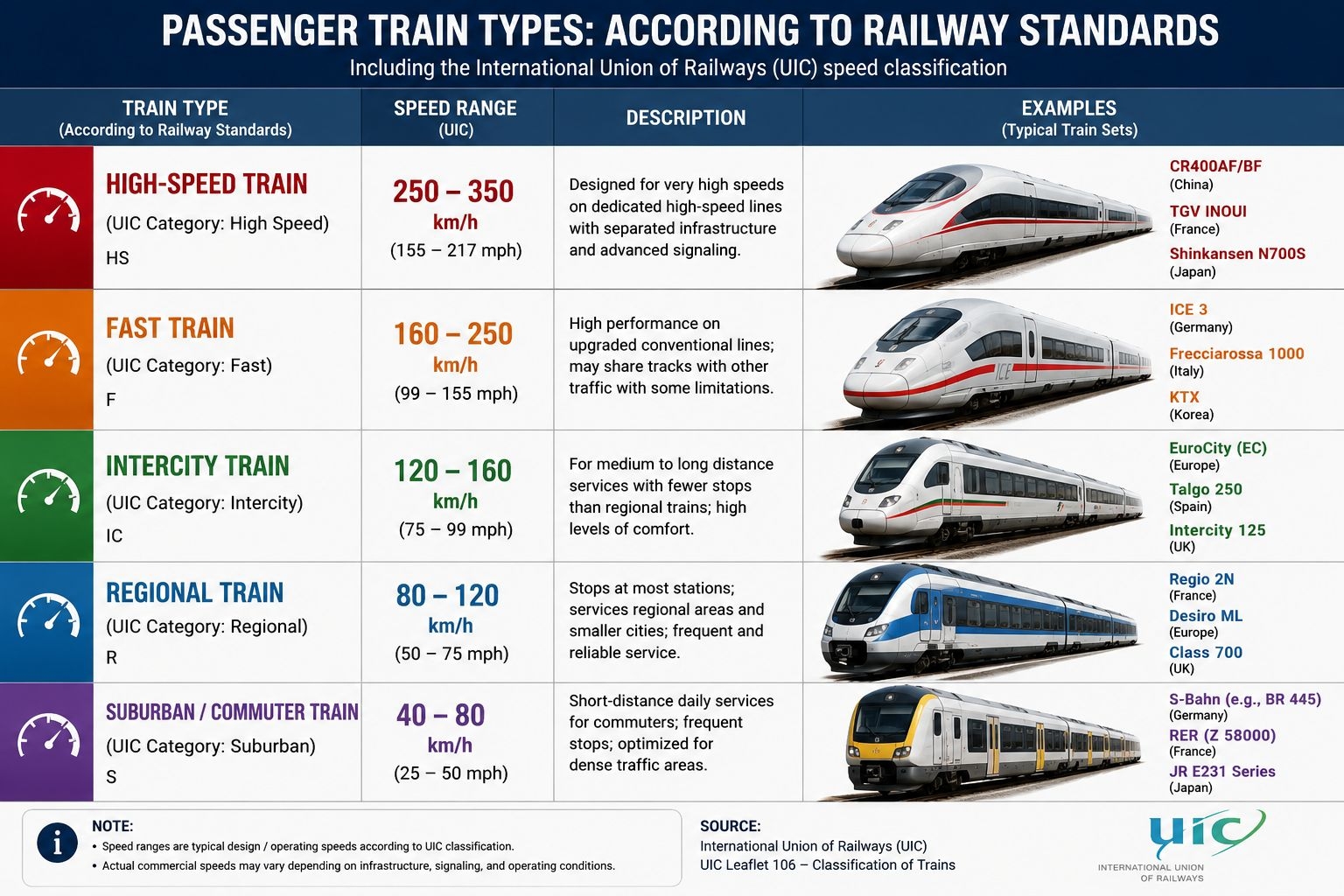
Speed range of passenger trains
2026-05-26
According to railway standards, including the International Union of Railways (UIC), the speed range of High-Speed passenger trains is divided as follows:
● 160 – 200 km/h: This is the limit between traditional and Higher-Speed railways. The name of a train moving at such a speed is Higher-Speed Train (HrST) (also Semi-High Speed). This is exactly the “Stadler” class in Georgia (maximum speed - 160 km/h).
● 200 – 250 km/h: This is the minimum limit in the case of modernization of existing tracks. If the old line is reconstructed, the train must move in this range to receive High-Speed status. A train that travels at this speed is called a High-Speed Train (HST). The minimum European standard. This mainly includes modernized old lines or first-generation High-Speed trains.
● 250 – 350 km/h: This is the standard range for purpose-built High Speed lines. Most of the world’s leading trains (French TGV, German ICE, Japanese Shinkansen) travel at this speed. A train that travels at this speed is called a Very High-Speed Train (VHST). This is the core area of classic European and Japanese “Bullet Trains”. Specially built, straight tracks where trains use their full aerodynamic potential.
● Above 350 km/h: This is already the Ultra High-Speed zone, where mainly Chinese High-Speed trains (for example, Fuxing with a frequency of 400 km/h) and Maglev trains run.
If we go beyond standard steel rail technology, the following stages are:
● Hyper High-Speed (Maglev class): 500 – 600+ km/h.
These are magnetic levitation trains (Magnetic Levitation), which do not have physical contact (friction) with the rails. For example, Japan's latest L0 Series Maglev developed 603 km/h in tests.
● Supersonic Rail / Near-Vacuum (Hyperloop class): 1000 – 1200 km/h. This is the future of railways — capsules moving in vacuum tubes, approaching the speed of sound (because air resistance is reduced to zero).
Dato Gochava, Professional Railwaymen's Club