News
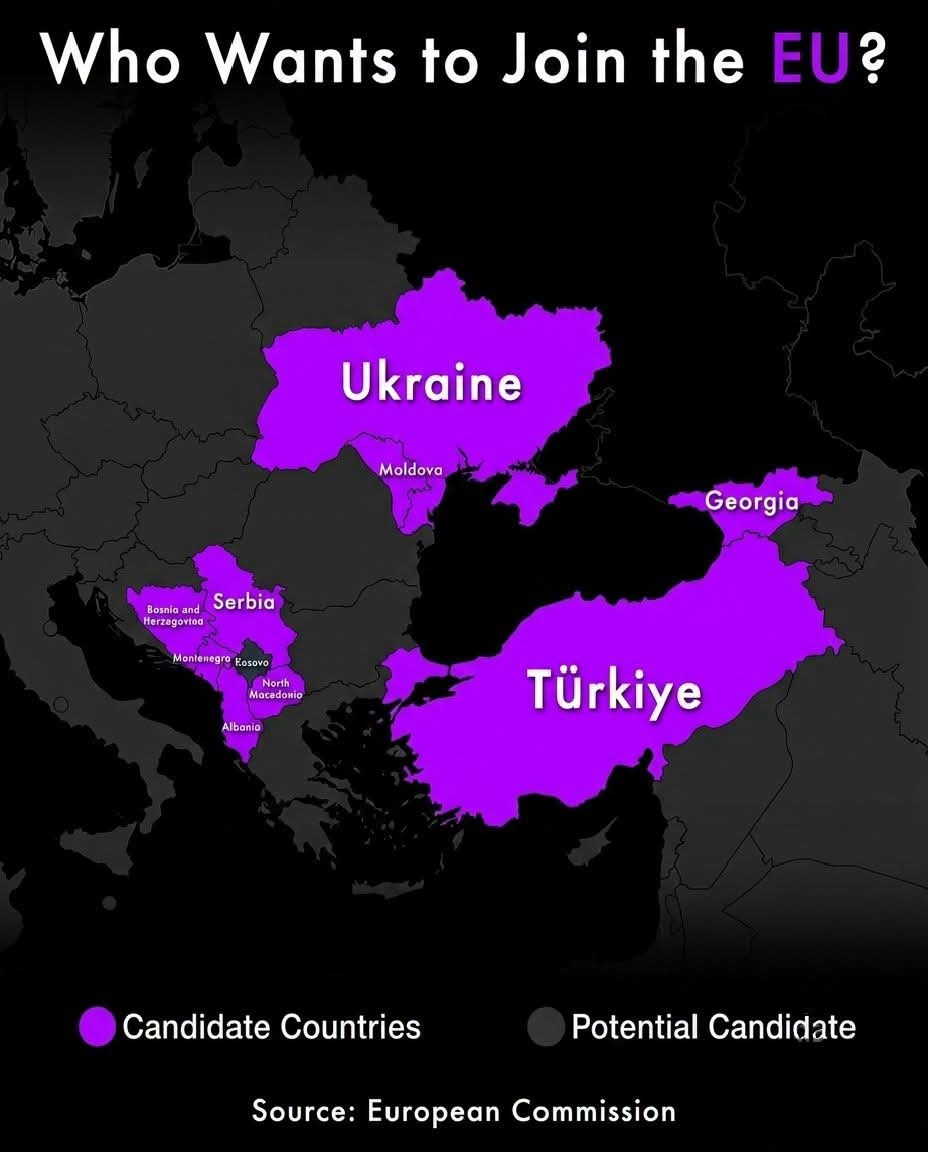
The Map of Europe is Shifting: Who Wants to Join the EU?
2026-07-16
From the frontlines of Eastern Europe to the historic crossroads of the Mediterranean, the European Union is looking at one of the most massive potential expansions in its history. But what does it take to join the world's largest single market, and why does this matter to us across the Atlantic? Let’s break down the map!
The Gravity of the European Union
When you look at the map above, the purple regions represent a geopolitical waiting room. For decades, the European Union (EU) has stood as a beacon of economic prosperity, democratic stability, and freedom of movement. It is far more than just a free-trade zone; it is a highly integrated political and economic union of 27 member states. For the nations marked in purple—the Candidate Countries—joining the EU is seen as the ultimate milestone in their national development.
Currently, there are nine officially recognized candidate countries: Ukraine, Moldova, Georgia, Türkiye, Serbia, Bosnia and Herzegovina, Montenegro, Albania, and North Macedonia. Additionally, Kosovo stands as a potential candidate, marked in grey.
But why are these nations so eager to join, and why is the process taking so long? More importantly, why should Americans pay attention to a changing map thousands of miles away?
Why Should the USA Care?
For an American audience, the expansion of the EU is not just a European issue—it is a cornerstone of global stability and US foreign policy.
Economic Ties: The EU is the United States' largest trade and investment partner. A larger, more integrated European market means more standardized regulations and greater opportunities for American businesses operating abroad.
Security and NATO Synergy: Many of these candidate countries are already NATO members (like Albania, Montenegro, and North Macedonia) or aspire to be. An expansion of the EU often works in tandem with NATO expansion, creating a more secure, unified Western alliance.
Countering Adversaries: In regions like the Western Balkans and Eastern Europe, the US and the EU are in a soft-power tug-of-war against Russian and Chinese influence. When these countries integrate into the EU, they commit to Western democratic standards, effectively closing the door on authoritarian interference and strengthening the global democratic order.
The Eastern Front: Ukraine, Moldova, and Georgia
The most recent and dramatic shifts in EU enlargement have happened on Europe’s eastern flank, driven entirely by the geopolitical earthquake of Russia's 2022 invasion of Ukraine.
Ukraine: For Ukrainians, the desire to integrate with Europe is a matter of national survival and identity. The 2014 Euromaidan protests, which ousted a pro-Russian president, were fundamentally about signing a political and economic agreement with the EU. Following the full-scale invasion in 2022, Ukraine applied for EU membership and was granted candidate status at lightning speed. While full membership will take years of post-war reconstruction and anti-corruption reforms, the EU has made it clear: Ukraine's future is in Europe.
Moldova: Bordering Ukraine, this small, vulnerable nation applied alongside Kyiv. Facing immense pressure from Moscow and dealing with a Russian-backed separatist region (Transnistria) within its own borders, Moldova sees EU membership as its only viable anchor to Western security and economic growth.
Georgia: Granted candidate status in late 2023, Georgia has a fiercely pro-European population. Despite having 20% of its territory occupied by Russia since 2008, the country is fighting to align its political institutions with Brussels, even as internal political battles threaten to slow its progress.
The Western Balkans: The Long Waiting Room
Look to the region just east of Italy, and you will find the Western Balkans. This region is completely surrounded by existing EU member states, yet it remains outside the club. The breakup of Yugoslavia in the 1990s left a legacy of complicated borders, ethnic tensions, and economic rebuilding.
Montenegro and Serbia: These two are theoretically the furthest along in their negotiation processes. However, Serbia faces a massive hurdle: it must normalize relations with Kosovo, a former Serbian province that declared independence in 2008. Furthermore, Serbia has historically maintained close ties with Russia, creating friction with the EU’s foreign policy requirements.
Albania and North Macedonia: These nations have made painful concessions to move forward. North Macedonia even changed its constitutional name (formerly just "Macedonia") to resolve a decades-long dispute with Greece just to unblock its path to the EU.
Bosnia and Herzegovina: Granted candidate status in 2022, Bosnia struggles with a highly complex, decentralized government system established after the Bosnian War, making the sweeping national reforms required by the EU very difficult to implement.
Kosovo (Potential Candidate): Kosovo faces the unique challenge of not being recognized as an independent state by five current EU members (Spain, Slovakia, Cyprus, Romania, and Greece). Until this diplomatic gridlock is resolved, its path from "potential" to "official" candidate remains stalled.
Türkiye: The Frozen Candidacy
Spanning Europe and Asia, Türkiye is the most populous and economically powerful country on this map. It has been an official EU candidate since 1999, but its accession process has practically ground to a halt. Concerns in Brussels over human rights, democratic backsliding, the rule of law, and long-standing territorial disputes with EU members Greece and Cyprus have frozen negotiations. While Türkiye remains a vital NATO ally and a crucial partner for the EU in managing migration and regional security, the prospect of it joining the bloc in the near future is highly unlikely.
The Road Ahead: The Copenhagen Criteria
Joining the EU is not as simple as signing a treaty. Countries must meet the Copenhagen Criteria, which demand:
Political Stability: Functioning democratic institutions, rule of law, and respect for human rights and minorities.
Economic Readiness: A functioning market economy capable of competing within the EU's highly competitive single market.
Legislative Alignment: Adopting the acquis communautaire—the massive body of EU law covering everything from food safety and environmental standards to labor rights and foreign policy.
This process is notoriously rigorous. It requires Candidate Countries to completely overhaul their legal and economic systems, which can take decades. However, the promise of a seat at the table in Brussels, access to billions in developmental funding, and the protective umbrella of the European community makes the grueling journey worth it for these nations.
As the world order shifts, the European Union is realizing that expanding its borders isn't just an economic opportunity—it's a geopolitical necessity to secure the future of democracy on the continent.
Geography Explained / facebook.com