News
The Middle Corridor s Freight Transit Potential in Georgia
2025-03-09
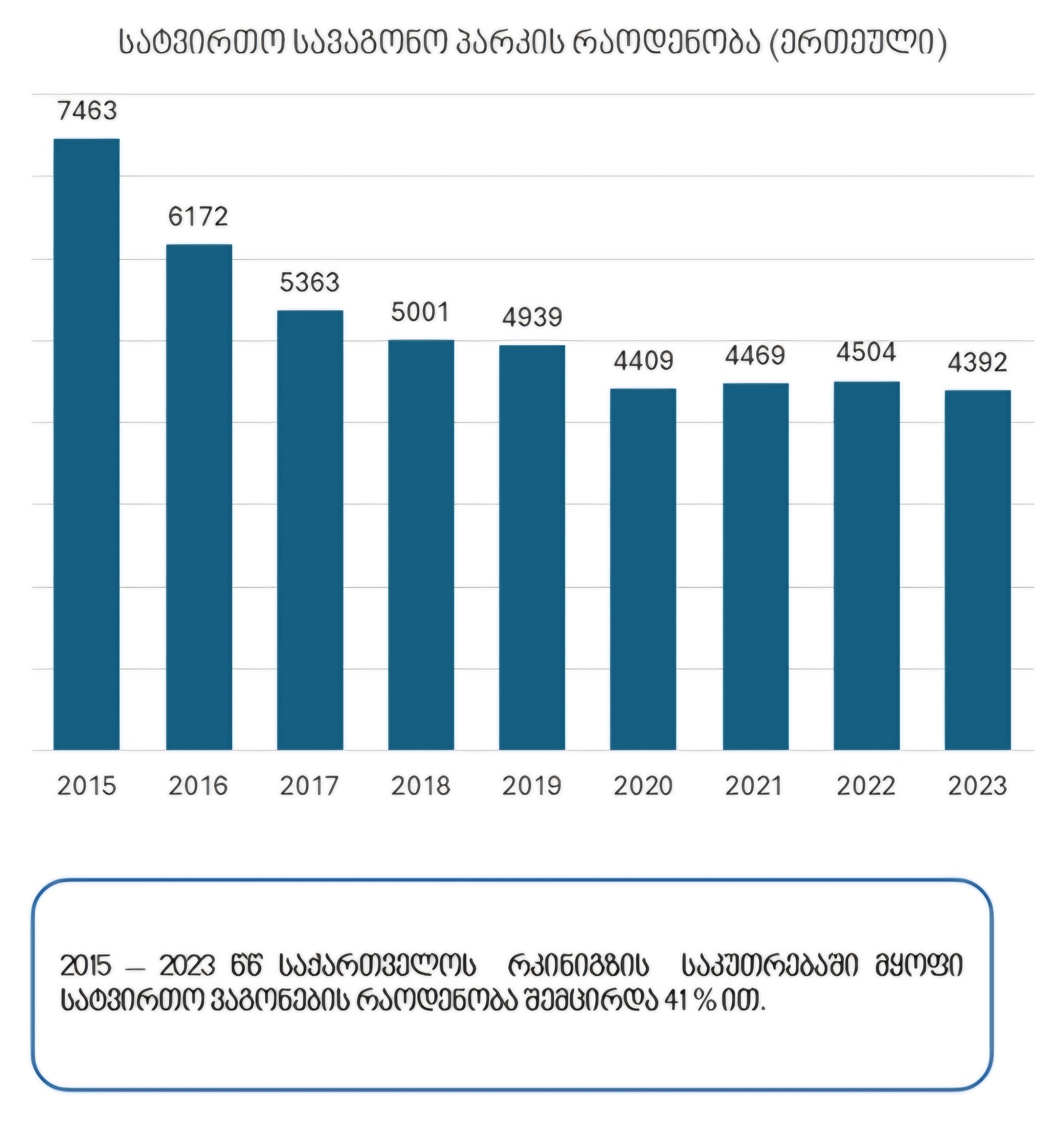
The number of freight wagons owned by Georgian Railways decreased by 41% between 2015 and 2023
A study conducted by the World Bank along
the Middle Corridor in 2023 identified 10 priority recommendations. According
to these recommendations, the existing freight turnover of the corridor will
increase threefold by 2030. The recommendations concern the development of the
countries’ logistics infrastructure, the digitalization of the corridor, and
the simplification of customs procedures. According to one of the
recommendations, the “bottleneck” of the corridor is the shortage of rolling
stock on the Georgian railway section.
Excerpt from the study: “Georgia has a
shortage of railway rolling stock, especially locomotives, which limits the
potential of the Middle Corridor transit route and increases the duration of
transportation on the Georgian section. It is necessary to increase the number
of rolling stock based on the development of an investment program, which will
increase the carrying capacity of the entire corridor.”
Currently, the freight rolling stock of
Georgian Railways consists of 4482 units, which include 90 locomotives and 4392
freight wagons.
The number of freight rolling stock on
Georgian Railways is decreasing annually from 2015 to 2023 (see diagram). In
2015, the railway owned 7463 freight wagons, but by the end of 2023 it owned
4392 units, which is a 41% decrease in the number of wagons during this period.
The situation is similar with the
locomotive fleet, namely, if in 2015 the railway owned 168 locomotives, by 2023
it had decreased to 90 units, a 46% decrease.
The number of electric locomotives in the
locomotive fleet decreased by 36%, and diesel locomotives by 63%. An analysis
of the age of the Georgian Railway rolling stock shows that 64% of the freight
wagon fleet and 62% of the locomotive fleet are over 35 years old. Over the
past 10 years, the number of rolling stock in operation on Georgian Railways
has been decreasing every year, and no major investments have been made in its
replenishment and renewal.
An analysis of the state of the rolling
stock on Georgian Railways shows that it is necessary to first of all direct
investment resources to renew the locomotive fleet, since in conditions of
increased freight flow, a shortage of locomotives will lead to a sharp
limitation of the railway's carrying capacity. It should be noted that in the
conditions of the expected increase in cargo turnover on the Baku-Tbilisi-Kars
railway, Marabda-Kartsakhi section, Georgian Railways-owned locomotives should
be involved in transportation. In such conditions, according to the tender
announced by Georgian Railways in 2023, the purchase of only 10 locomotives
will not be enough.
Based on the fact that the railway's
efficiency indicator (Adjusted EBITDA margin) has been decreasing in recent
years and is below the 40% mark, we can conclude that it will be impossible to
solve the strategic task of replenishing and renewing the rolling stock by
returning only state-owned dividends to the railway. Currently, Georgian
Railways is not yet allowed to introduce financially strong railway operators
with private capital, and it is unclear when it will be allowed. In addition,
since the development of the Middle Corridor is a priority for the state, it is
necessary to develop a 10-year investment program for the renewal of the
railway rolling stock with the involvement of the state.
Accumulation of funds should be carried out by returning the state dividend to the railway and consolidating the financial sources of the state budget. For your information, many states apply this model of infrastructure and rolling stock renewal.
Source: transcor.ge