News
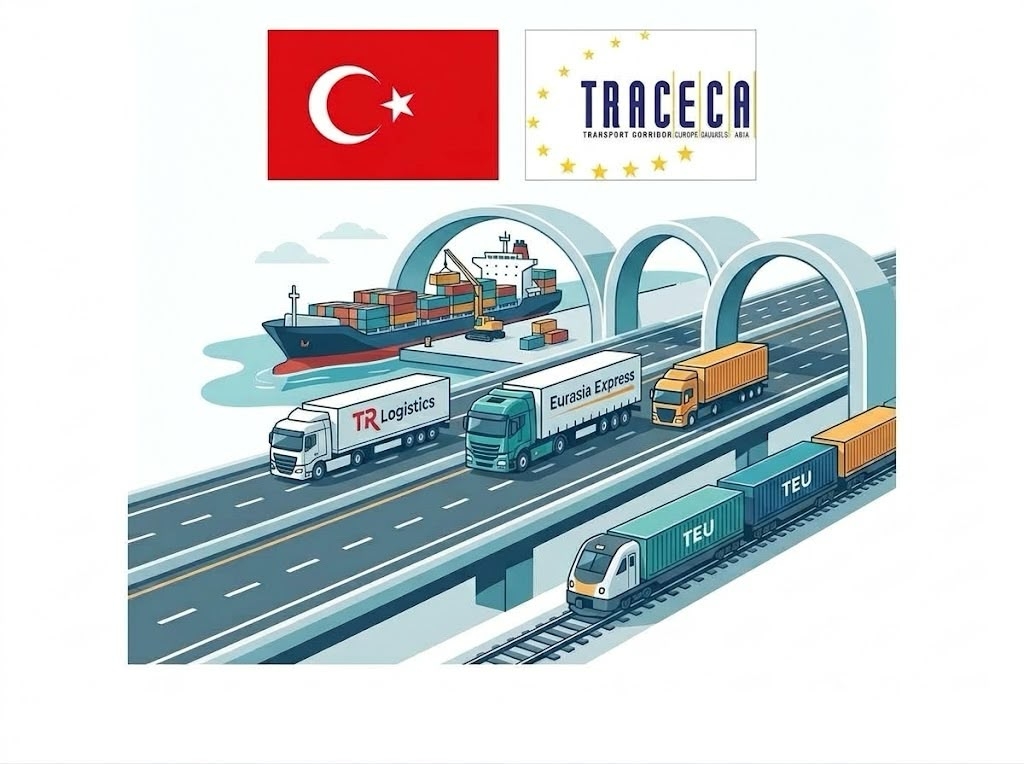
Türkiye`s Vision for the Silk Road: August–October 2026
2026-10-18
Corridors, Infrastructure, and New Freight Flows
Between August and October 2026, two key priorities emerged
on Turkey’s transport agenda: connecting the Middle Corridor to Europe and
reducing infrastructural and administrative barriers to international freight
transport. Official statements and updates from the business sector illustrate
how Turkey is working to translate these objectives into tangible, practical
outcomes.
The Middle Corridor Must Extend to Europe
On August 13, following meetings with Bulgarian
representatives in Sofia, Turkey’s Minister of Transport and Infrastructure,
Abdulkadir Uraloğlu, stated that Turkey should not be the final destination for
the Middle Corridor, the Development Corridor, or the modern Hejaz
Railway—rather, these routes must extend toward Europe. He further noted that,
in this regard, Bulgaria stands as one of Turkey’s most vital partners.
This statement reflects the primary objective of Turkey’s
transport strategy: for the country not only to receive cargo arriving from
Asia and the Middle East but also to transport it—via its own network—to
European markets.
September: Turkey and Kazakhstan Agree to Streamline
Freight Transport
A meeting of the Turkey-Kazakhstan Joint Commission on Land
Transport was held in Antalya on September 15–16. According to the
International Transporters Association of Turkey (UND), the parties discussed
electronic transport permits, a universal document model, cooperation between
ports, and the streamlining of freight transport.
The agreed-upon quotas included:
- 12,000 bilateral transport permits (6,000 of which are
electronic);
- 5,000 third-country permits (2,500 of which are
electronic);
- 15,000 transit permits, issued entirely in electronic
format;
- 3,000 universal transport permits. The parties also agreed
that the issue of quotas and quantitative restrictions within the electronic
permit system would be regulated according to a separate principle.
For businesses, this is a specific development: the
facilitation of freight transport between Turkey and Kazakhstan aims to reduce
administrative bottlenecks along the land-based section of the Middle Corridor.
However, the agreed-upon number of permits does not, in itself, confirm that a
reduction in transit times or costs has already been achieved.
October: Turkey’s Rail Link with Europe Strengthens
On October 9, the Çerkezköy–Kapıkule section of the Halkalı–Kapıkule railway line was officially opened. According to the Turkish Ministry of Transport and Infrastructure, the project was funded by a €275 million grant from the European Union and is intended to improve transport connectivity between Turkey and the EU. [EU-Turkey Transport Programme. ipa.uab.gov.tr]
According to Minister Uraloğlu, the Çerkezköy–Kapıkule
section serves as a key piece of infrastructure for the European leg of the
Middle Corridor. Data released by the Ministry indicates that the project
involved the construction of a 153-kilometer, double-track, electrified line
equipped with a signaling system, designed for an operational speed of 200
kilometers per hour.
The Ministry estimates that once the remaining sections of
the Halkalı–Kapıkule line are completed, annual freight capacity is expected to
increase from 1.5 million to 9.6 million tons. This figure represents the
projected capacity of the fully completed project, rather than current freight
volumes.
Baku–Tbilisi–Kars: From Transit Route to Commercial
Freight Operations
On October 12, the Turkish logistics company Pasifik Eurasia announced a new commercial agreement for the transport of grain from Kazakhstan to Turkey. According to a statement from the company, the initial order amounted to 16,380 tonnes, and a trial shipment was scheduled to take place in October, destined for the Yenice station in the province of Mersin.
The company also set a target of transporting approximately
30,000 tonnes of grain per month for future shipments; however, this represents
a future target volume rather than a figure for shipments already completed.
This example is significant because the efficiency of the
Middle Corridor is ultimately measured by concrete commercial operations. The
Baku-Tbilisi-Kars railway is part of this transport network, which connects the
Caspian region with Georgia and Turkey.
The Lapis Lazuli Corridor and CASCA+: What has been
confirmed?
Regarding the Lapis Lazuli Corridor, reports emerged on
August 12 concerning a meeting between representatives from Turkmenistan and
Afghanistan, during which the development of the corridor was discussed. The
discussion focused on a route connecting Afghanistan, Turkmenistan, Azerbaijan,
Georgia, and Turkey, as well as the simplification of customs procedures and
the improvement of logistics infrastructure.
This was a discussion between Turkmenistan and Afghanistan,
rather than a new agreement announced by Turkey. Therefore, while it reflects
the regional context of the corridor's development, it does not confirm the
launch of a new project involving Turkey's direct participation.
In the case of CASCA+, it is also important to distinguish
specific agreements from broader regional cooperation. Within the
Turkish-language sources reviewed, it has not been possible to independently
verify any new, major agreement announced by Turkey regarding this format
during the period from August to October 2026.
What does this mean for Georgia?
The developments between August and October highlight
several practical aspects of Turkey’s vision: strengthening rail links with
Europe, simplifying administrative procedures for shipments involving
Kazakhstan, and facilitating the movement of commercial cargo via the Middle
Corridor.
For Georgia, the efficient operation of the
Baku-Tbilisi-Kars railway is of particular importance, as the volume of cargo
transiting the country—along with the quality of services provided—directly
influences the competitiveness of the entire corridor.
The core message of Turkey’s strategy for the business
sector is this: the significance of a transport route is not determined solely
by its geographical location on a map. Crucial factors include the ease with
which cargo can be moved, the predictability of tariffs and delivery timelines,
and the efficiency with which the Asian transport network connects to European
markets.
For Georgia, this process offers opportunities that extend beyond merely increasing transit flows. Additional benefits can be realized through the development of logistics services, warehousing, cargo handling, and distribution.
Zurab Maghradze, DBA