News
Ukraine switches to European track standard
2025-03-23
The blockade of Ukrainian ports by Russia
has pushed Ukraine to find alternative ways for its export goods to reach world
markets, which has put on the agenda the gradual transition of its railway
network to the European track standard.
Probably everyone is wondering why the
track width of European railways is 1435 mm, while that of the former Soviet
countries is 1520 mm.
The difference between European and Soviet
tracks has a geopolitical explanation. In the 19th century, in the face of the
expected attack of the European world on the Russian Empire, Russia's strategic
goal was to limit the rapid deployment of troops from them on Russian
territory. Therefore, Russia developed its own standard of track width, which
was later reflected in the railways of the Soviet republics.
In the process of integration with the
European Union, the difference in the width of the railways turned out to be a
significant obstacle for the former Soviet countries. The Baltic countries were
the first to face the need to switch to the European railway due to the
difference in the width of the railways.
Despite numerous obstacles from Russia, the
Baltic states have successfully solved the problem today, and with the
financial assistance of the European Union, they are developing the Rail Baltic
project connecting the Baltic countries with the European space via the
European railway.
As a result of the Russian-Ukrainian
military confrontation, Ukraine found itself in difficult conditions. In
particular, if before the war 70% of Ukraine's export products flowed through
sea ports, during the hostilities, as a result of the blockade of the ports, in
order to reach the world markets, it became necessary to extradite Ukraine's
main export products - wheat and metal - by land routes to the ports adjacent
to the Danube.
The increase in Ukrainian exports to the
Danube ports has led to their congestion. There are frequent cases when there
is a queue of 100 ships waiting to be loaded at the port of Constanta.
Ukraine's railway network faces a similar
problem of congestion. Eleven railway border crossings connecting Poland,
Slovakia, Hungary, Romania and Moldova operate in a constantly overloaded mode.
There are frequent cases when cargo is delayed at border crossings for an
average of 15-18 days.
To overcome the above difficulties, Ukraine
is considering the construction of a European rail line at border crossings as
a priority, which will reduce the time spent at the borders and increase the
country's export potential.
In addition, the construction of a European
rail line from the Polish border to Lviv is being considered as a priority.
Then its expansion to the entire territory of Ukraine. Thus, Ukraine expects to
increase passenger traffic along with cargo exports to the European Union.
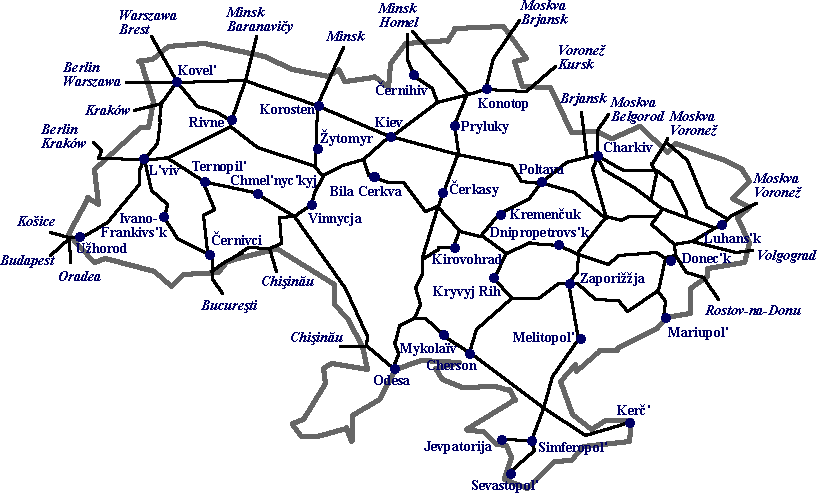
Currently, the issue of expanding the European route system throughout Ukraine
is being actively discussed, but the main obstacle is finances. Despite this,
the main directions of Lviv - Kiev, Lviv - Odessa and Lviv - Krivoy Rog are being
considered.
It is worth noting that in the event of the
opening of blocked ports, these directions will be in demand.
The cost of switching to the European route
from Lviv to Kiev (572 km) is half a billion euros, an average of 800 thousand
euros per kilometer. The estimated cost of extending the European route to Kiev
and then expanding it to Odessa is 2 billion euros.
It will take 20 years and 250 billion euros
to fully upgrade the 20,000 km of Ukrainian railways to European standards.
Naturally, it is unthinkable for Ukraine to
mobilize such financial resources in the current difficult situation.
It is worth considering that the launch of
the European railway will be accompanied by difficulties, since in addition to
the construction of the railway infrastructure, it will be necessary to
purchase expensive rolling stock.
In addition to the existing adapted option
for integrating Ukrainian railways into European networks, when wagons are
replaced at border crossings, Ukraine has begun laying a combined track
structure to enter the European space, for the first time in the Uzhhorod-Chop
(Hungarian border) section. This type of combined track is used in the
Poland-Lithuania-Latvia-Estonia Rail Baltic direction.
Laying this type of track will avoid costly
operations at the trolley replacement station and the areas necessary for
rolling stock reloading operations. The cost of laying one kilometer of
combined track is $ 2.2 million.
Since 2023, the laying of a combined wide
and European 1520/1435 mm track has been underway from Uzhgorod to Chop
(Ukraine-Hungarian border). For this period, 8.5 km of the 22 km section has
been laid with combined track.
Another option for switching to the
European track is the so-called Iberian track - 1668 mm, which is used in Spain
and Portugal and is wider than the so-called Soviet track.
The Spaniards have invented a technology
that is successfully used when crossing the French border, which allows the
automatic expansion or contraction of the track width when the rolling stock is
moving at a speed of 15 km/h.
In 2024, based on negotiations between the
governments of Spain and Ukraine, a decision was made to introduce Spanish
technology on Ukrainian railways. To use the Spanish technology, it will not be
necessary to replace locomotives, passenger and freight cars. It is only
necessary to replace the rolling stock bogies, which will be equipped with an
automatic expansion and contraction system for the track.
Ukraine has long been known for its
technologies for manufacturing railway rolling stock. In addition, it has
thousands of freight and passenger cars, and this factor will make the use of
Spanish construction cheaper.
Info: transcor.ge