News
Which countries control global trade
2026-06-29
Bela Gelashvili
On the map of the world economy, there is a relatively small
group of countries that control the vast majority of international trade and
effectively determine how goods, capital and technologies move around the
world. Despite the fact that more than 190 countries participate in global
trade, a significant part of exports and imports falls on only a few economies.
According to the latest data from the United Nations
Conference on Trade and Development (UNCTAD) and the World Trade Organization
(WTO), the volume of global trade in 2025 exceeded a record level of $ 35
trillion. Of this, about $ 26 trillion comes from trade in goods, and the rest
from the services sector.
The main drivers of this large-scale economic system are ten states, the influence of which significantly exceeds their population or territorial size.
China: The World’s Leading Enterprise and Exporter
China has been the world’s largest trading nation for years.
In 2025, the country’s exports were estimated to reach $3.8 trillion,
accounting for about 14% of global exports. China’s success is no longer based
solely on low-cost manufacturing. The country is increasingly dominating the
production of electric vehicles, batteries, solar panels, semiconductors,
industrial machinery, and artificial intelligence-related technologies.
China’s growing exports are so large that in 2025, the country’s trade surplus exceeded $1 trillion for the first time, raising the risk of a new trade war between the United States and the European Union.
The United States: The World’s Largest Consumer
If China is the world’s largest seller, the United States is
the largest buyer. The country still maintains its status as the largest
importer, buying trillions of dollars worth of goods each year.
The economic impact of the United States is not measured
solely by imports. The dollar is still the main currency of international
trade, and American technology giants create the demand that affects global
markets for semiconductors, electronics, and digital services.
Exports and imports of technologies related to artificial intelligence are growing particularly rapidly, and are already considered one of the main drivers of the new trade cycle.
Germany: Europe's export machine
Germany is one of the world's strongest export economies.
Automobiles, industrial machinery, chemical products, and engineering
technologies place the country at the center of global trade.
Despite increasing competition from China, German industry still maintains a leading position in the export of high-value-added products. China and the US remain Germany's most important trading partners.
The Netherlands: Europe's main logistics gateway
With a population of just 18 million, the Netherlands
consistently ranks among the top countries in world trade rankings. The main
reason for this is the port of Rotterdam, which is Europe's largest freight
hub.
The country plays an important role in re-exporting goods. A large part of imported goods reach other European markets via the Netherlands.
Japan and South Korea: Asia's technological powerhouses
Japan and South Korea maintain a special place in world
trade thanks to their technological and industrial products.
Japan continues to lead in high-precision machinery,
automobiles and robotics, while South Korea is a global player in the memory
chip, electronics and shipbuilding sectors.
The rapid development of AI infrastructure worldwide has given an additional boost to both countries’ exports.
France, Italy and Belgium: Europe’s industrial heartland
Thanks to the EU’s internal market, France, Italy and
Belgium remain the largest players in global trade.
France is strong in aerospace, luxury goods and agricultural
exports.
Italy maintains a competitive edge in design-based
manufacturing, fashion, machinery and food products.
Belgium is one of Europe’s major chemical and pharmaceutical hubs, particularly through the port of Antwerp.
Hong Kong and Singapore: Global trade intermediaries
Despite their small size, Hong Kong and Singapore play a
huge role in international trade.
Both economies function as hubs for global shipping,
financial services, and regional trade. Their role in providing links between
Asian and Western markets is particularly important.
Why is world trade concentrated in a few countries?
Economists believe that four main factors are behind the
concentration of global trade:
Industrial scale;
Developed logistics infrastructure;
Technological advantage;
Strong financial systems.
China, the US and the EU have significant advantages in all four areas, which is why their positions are unlikely to be shaken in the short term.
A new era: AI, geopolitics and the changing trade map
However, the world trading system is facing significant
transformations. The WTO and UNCTAD note that the artificial intelligence
industry, semiconductors, the energy transition and electric vehicles are
already defining new trade flows. One of the main sources of trade growth in
2025 is the growth in demand for AI-related products.
At the same time, geopolitical risks are also increasing.
The crisis in the Red Sea, US-China trade tensions, the impact of the Ukraine
war and new tariffs are forcing companies to reallocate supply chains. As a
result, international trade is becoming more fragmented, although its overall
volume remains at record levels.
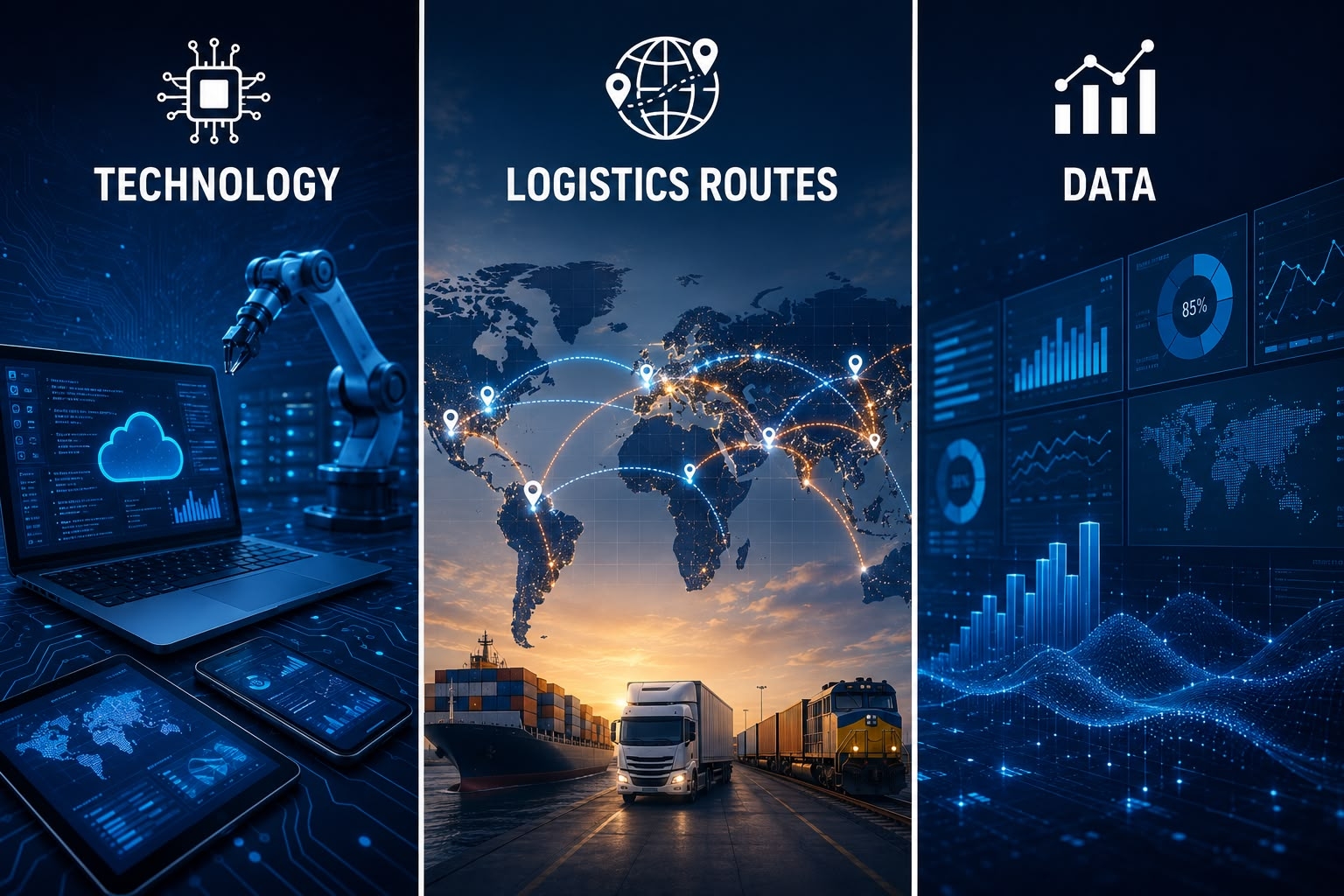
That is why in the coming years the main question will no longer be who sells the most, but who controls the technologies, logistics routes and data. In the global economy of the 21st century, the real power of trade is increasingly shifting to these three components.
Source: commersant.ge