News
Who benefits from the weakening of Georgia`s role in connecting Asia and Europe
2026-08-22
Discussions regarding the diminishing of Georgia’s transit
role go beyond mere economic considerations. The question is: who benefits from
weakening Georgia’s strategic position—specifically its geography, its Black
Sea coastline, and its function within the transport system linking Asia and
Europe?
Today, as global trade increasingly contends with wars,
sanctions, risks associated with maritime chokepoints, and supply chain
disruptions, the existence of an alternative transport corridor is no longer
just a commercial advantage; it is becoming an economic and strategic
necessity.
Consequently, undermining Georgia’s transit role carries a
direct economic cost.
This is precisely where the significance of the Middle
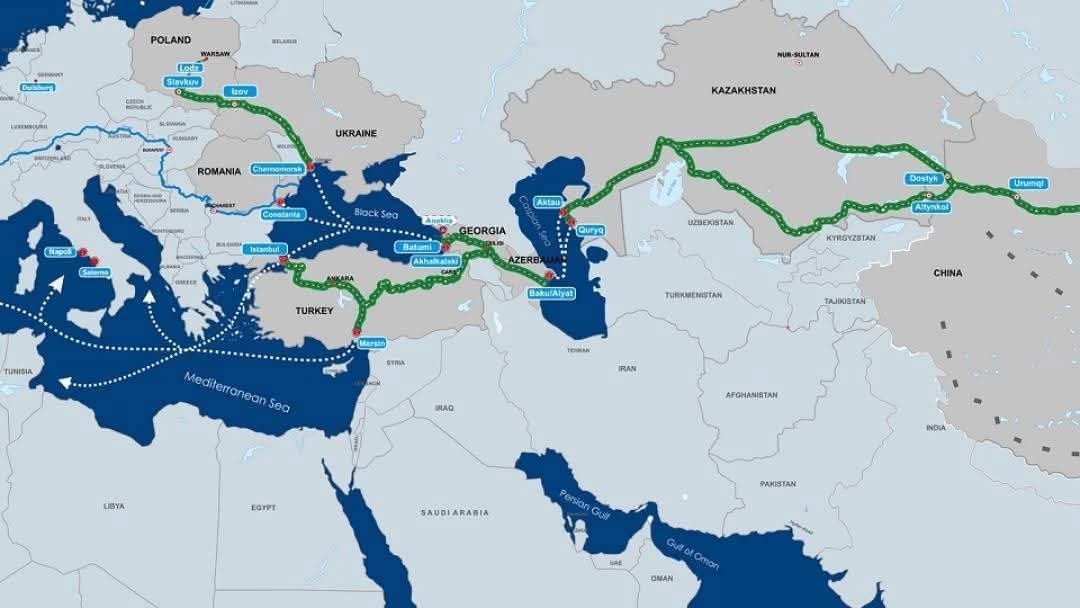
Corridor lies. Its goal is not to replace the Suez Canal; rather, its function
is to establish an additional, diversified route between Asia and Europe—a
connection that enables the global economy to reduce its reliance on any single
specific route or geopolitical region. In the case of Georgia, this is
particularly interesting: the country is situated at a geographic juncture
where flows originating in the Caspian region connect to the European transport
system via the Black Sea. Consequently, Georgia’s significance is defined not
merely by the volume of cargo currently traversing its territory, but also by
the potential role it could play in a future system of diversified global
supply chains.
For this very reason, undermining Georgia’s transit function
could prove economically and geopolitically advantageous for certain actors.
The first category comprises external players whose
interests do not align with the establishment of a robust, independent, and
competitive East-West transport corridor passing through Georgia.
In this context, it is important to distinguish between
official state policy, commercial competition, and deliberate political
opposition. While every alternative route competes with others, competition
does not inherently equate to hostility. The problem arises when weakening a
country’s transit function becomes a specific geopolitical objective. A strong
Georgian corridor means that Central Asian and other Asian nations gain an
additional route for connecting with Europe, thereby reducing their reliance on
other paths. This gives rise to the first geopolitical effect: an alternative
corridor expands the strategic choices available to the countries utilizing it.
If Georgia is weak, options are limited; if Georgia is
strong, options abound. Should Anaklia develop into a fully functional
deep-water port—complemented by appropriate rail and road infrastructure,
logistics hubs, and robust connectivity toward the Caspian—the capacity of the
Asia-Europe corridor passing through Georgia would increase significantly.
Analyses looking toward 2026 also identify the limitations of Georgia’s current
port capacity and the role of Anaklia in the development of the "Middle
Corridor" as key issues.
Consequently, it may be in the interest of certain external
actors not to directly "defeat" Georgia, but rather to permanently
constrain its transit potential—whether by stalling projects, fostering
infrastructural lag, amplifying narratives about the corridor's unreliability,
or promoting regional alternatives capable of transporting cargo while
bypassing Georgia entirely. This brings a second key player into the picture:
regional competition.
If Georgia establishes a robust Black Sea gateway, it
automatically becomes a competitor to other transport routes vying for the same
Asia-Europe cargo flows. This is a matter of natural economic competition. Yet,
for Georgia, the conclusion is simple: if we do not build our own corridor,
someone else will build theirs. In international logistics, a void does not
remain empty for long; cargo always finds a way.
If one route proves slow, costly, or unpredictable, another
emerges. If the second fails, a third appears.
Therefore, the primary threat to Georgia may not be a
deliberate attempt by others to halt its corridor project. A far greater danger
could be our own lag—allowing competing routes to naturally capture the
position Georgia could have secured.
This also requires us to reconsider the concept of the
"internal enemy." I would not label anyone who criticizes Anaklia,
infrastructure projects, or government policy as an "internal enemy."
In a democratic society, criticizing a project is normal—and sometimes even
essential. However, deliberately downplaying Georgia's strategic interest is a
different matter.
If an individual or a political group systematically asserts
that Georgia’s transit role is insignificant, that the Middle Corridor has no
future, that developing Georgia’s ports is unnecessary, that there will always
be better routes for Asia-Europe cargo that bypass Georgia, or that
strengthening the country’s maritime infrastructure is inherently
pointless—then such a position can no longer be categorized merely as political
criticism.
This is especially true when such statements align with the
interests of Georgia’s competitors.
That is precisely where the key distinction lies:
Political dissent is normal. Deliberately downplaying
national interests regarding infrastructure is a different matter entirely.
Georgia’s transit role is not the property of any single
political party.
Not the government’s.
Not the opposition’s.
Not any business group’s.
It is a geographic and economic opportunity for the country.
Consequently, the Anaklia Port should not become merely a
symbol of political infighting. It should be viewed as part of the development
of Georgia’s maritime infrastructure and as a node within the broader Eurasian
transport system. This is particularly important in today’s world. The security
landscape of the Black Sea has changed significantly. Issues in the Red Sea and
the Bab-el-Mandeb Strait have demonstrated how rapidly a regional maritime
security crisis can impact global supply chains. At the same time, new regional
transport initiatives are creating competitive alternatives for Georgia as
well. Analyses looking toward 2026 clearly indicate that Georgia’s position
within the Middle Corridor is being challenged by regional competition and the
development of new routes.
Therefore, maintaining Georgia’s role as a transit hub will
not happen automatically.
Geography gives Georgia an advantage, but geography alone
does not win the competition. Competition is won by infrastructure.
Speed wins.
Reliability wins.
Low logistics costs win.
Efficient customs procedures win.
Port throughput capacity wins.
Railway capacity wins.
The corridor trusted by cargo owners wins.
For this reason, when assessing the significance of Anaklia,
we must look beyond mere berths and cranes. The true importance of Anaklia
begins at the port itself and extends into Georgia’s internal infrastructure.
If the port lacks sufficient rail infrastructure, its capacity will be
constrained.
If the railway lacks sufficient throughput, the corridor
will face bottlenecks.
If customs procedures are slow, cargo transit times will
increase.
If the Caspian segment is not synchronized, the Georgian
port’s competitive advantage will be partially lost.
Therefore, safeguarding Georgia’s transit role is not merely
about the port itself; it is about developing the entire corridor.
And this brings us to the most important conclusion.
An external adversary might attempt to undermine Georgia’s
transit role. A domestic political group might fail to recognize this role or
deliberately downplay its importance for political gain. A competing nation
might establish a new route that bypasses Georgia.
Ultimately, however, the market will decide.
Cargo owners will choose the route that offers the greatest
reliability, speed, and economic viability.
That is precisely why Georgia’s primary response should not
be a war of words.
The answer lies in infrastructure.
There must be a strong port.
There must be a robust railway system.
There must be a powerful logistics system.
Customs procedures must be swift.
There must be high throughput capacity towards the
Caspian region.
There must be a stable connection with Europe.
And there must be a corridor so compelling that cargo owners
themselves would not want to bypass it.
In that scenario, any political narrative would lose its
force; for when a corridor functions effectively, it is driven by its own
economic logic.
Significant international interest already exists today:
according to 2026 projections by Georgia’s Ministry of Economy, interest in the
Anaklia project stems from neighboring states, Central Asia, China, the Gulf
countries, and Western companies; the state views it as strategic
infrastructure of international—rather than merely regional—significance.
This is significant for one key reason: Georgia’s transit
potential is no longer merely a subject of domestic political debate; it has
become a matter of international logistical interest.
Therefore, in my view, the greatest mistake Georgia could
make would be to downplay its own geographical advantage. We need not claim
that Georgia is the only possible route; that is unnecessary. It suffices to
recognize that Georgia represents a significant alternative route—one that
global trade requires. The value of such an alternative increases precisely
when primary routes are placed at risk.
Consequently, diminishing Georgia’s transit role ultimately
means not only undermining the country’s economic potential but also curtailing
the opportunity for global trade to utilize a diversified route through
Georgia. Therefore, there is no single, straightforward answer to the question:
"Who benefits from the undermining of Georgia’s transit role?"
It benefits external forces and competing systems that stand
to gain a stronger position by bypassing Georgia. It benefits those who prefer
maintaining existing regional dependencies over embracing new alternatives.
And, regrettably, it may also benefit domestic groups that
prioritize short-term political interests over the country’s long-term economic
interests.
Ultimately, however, the most important point is this:
Georgia’s transit role should not be treated as an
opportunity to be handed to anyone as a gift. It must be a system so
competitive that the global trading community itself will want to use it.
If we succeed in this, neither external competitors nor
internal political strife will easily be able to strip Georgia of its
geoeconomic role.
For ultimately, global trade does not move on the
strength of slogans.
It moves via ships, railways, and containers; it is driven by cargo owners, timelines, prices, and risks. And it is precisely within this reality that Georgia must find its place—not as a country positioned against anyone, but as an alternative the world needs.
Sea Pilot