News
Why is the actual capacity of a port often lower than its designed capacity?
2026-08-23
When discussing a port, we often hear a specific figure—for
instance, 1 million TEUs per year, 2 million TEUs, or 50 million tons of cargo.
Such data sounds impressive, and the scale of a port is frequently assessed
based on this very number. However, from a professional perspective, an
important question immediately arises: is this the port's design capacity or
its actual, practical throughput?
These two concepts differ significantly.
Design capacity refers to the capability for which the port
and its infrastructure were originally planned. This encompasses factors such
as the number and length of berths, the depth of the water area and approach
channels, container cranes, terminal area, container yards, warehouses, rail
and road connections, and other infrastructure.
Yet, a port is not merely a blueprint; it is a complex
operational system that functions on a daily basis.
A port might be designed to handle a million TEUs, yet in
real-world conditions, it may process far less. The cause may not lie in a
single specific infrastructure element; the problem often arises from the
interaction of the entire chain.
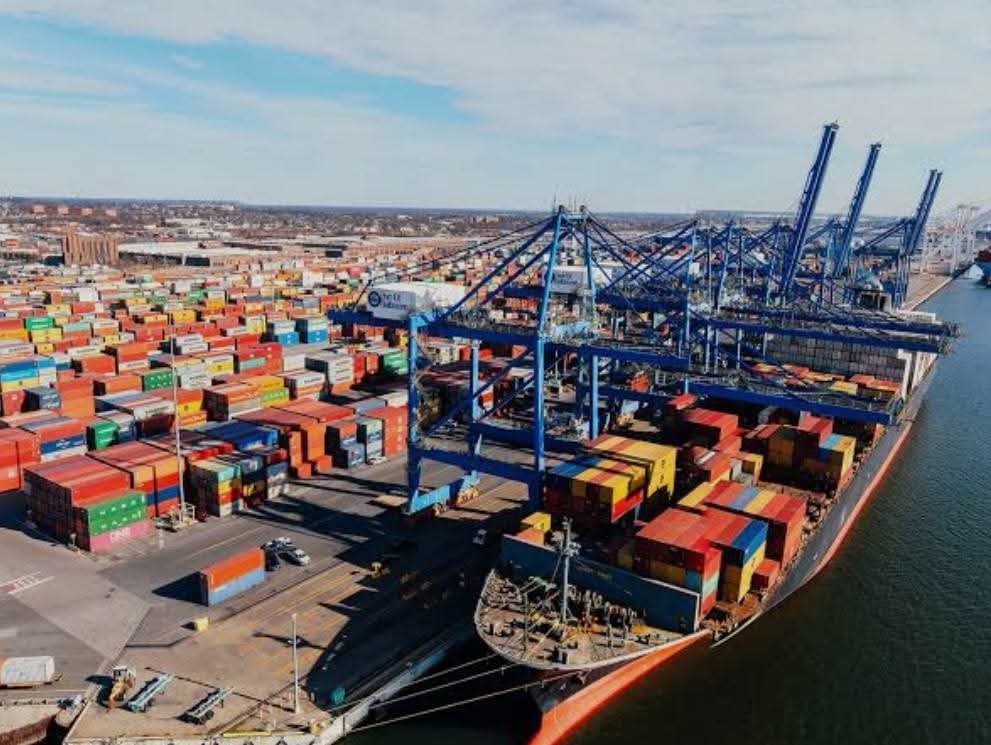
Let us consider a container ship arriving at a port. The
initial critical factor is whether the port can safely accommodate it. Factors
such as the ship's size and draft, the depth of the water area, the approach
channel, the turning basin, wind and current conditions, and navigational
constraints determine the ease of the ship's movement.
This is where the first discrepancy between design
specifications and actual capabilities emerges.
If a port can only accommodate large vessels under specific
hydrometeorological conditions, its theoretical capacity does not automatically
imply that such vessels can be handled in the same manner 365 days a year.
Next comes the berthing operation.
The time a ship spends at the berth directly impacts the
port's throughput. If processing a single ship takes an average of 24 hours,
the berth handles approximately one ship per day. If the same operation takes
36 hours, the resulting annual capacity changes significantly.
Container cranes play a crucial role in this context.
A port's capacity is not defined solely by the number of
cranes. What matters is their actual productivity—how many containers they can
move per hour, the frequency of downtime, the efficiency of cargo operation
organization, and the overall speed of the terminal's operations.
A crane may be technologically state-of-the-art, but if the
underlying logistics process is hindered, its high performance potential cannot
be fully realized.
Then there is the container yard.
This is one of the most frequently underestimated components
of a port. A container unloaded from a ship must be placed somewhere. If there
is insufficient space in the yard, a "bottleneck" arises—a point of
congestion that slows down the entire system.
Moving containers within the yard is not merely a matter of
space. Crucial factors include the logic of container placement, the sequence
of subsequent removal, truck traffic, rail operations, and the performance of
the terminal's internal equipment.
This is precisely where one of the port's most interesting
paradoxes emerges: the berth might have available capacity, yet the terminal
yard could already be overwhelmed. In such a scenario, the port cannot increase
cargo throughput simply by accommodating additional vessels.
The next link in the chain is the railway.
If large volumes of cargo are to be transported from the
port by rail, adequate capacity is required both within the port and beyond it.
The mere existence of a railway is insufficient; factors such as the number of
trains, line capacity, shunting capabilities, the length of the terminal's rail
frontage, and the synchronization of operations are all critical.
The same applies to road transport.
If a port plans to handle thousands of trucks daily but the
access roads cannot accommodate this volume, bottlenecks will arise right at
the port gates.
That is precisely why a modern port cannot be viewed merely
as a docking facility.
A port comprises vessels, the water area, berths, cranes,
the yard, railways, roads, warehouses, digital management systems, and human
resources.
Any limitation affecting a key component of this system will
impact the final outcome.
However, there is another factor - time.
Theoretically, a port can operate 24 hours a day, 7 days a
week, but this does not mean that all its infrastructure elements will
constantly be under maximum load.
Factors such as technical maintenance, crane repairs,
disruptions to berthing operations, strong winds, storms, poor visibility,
navigational restrictions, uneven vessel arrival patterns, and peak periods all
come into play.
Therefore, when assessing practical throughput capacity, it
is essential to account for the so-called "operational reserve."
In other words, a good port is not one that operates at 100%
capacity every day. A good port is one that can maintain stable operations even
under heavy loads and possesses sufficient reserve capacity to handle
unexpected disruptions.
This brings up another important metric - vessel
waiting time.
When evaluating port efficiency, we should not simply ask
how many TEUs were processed annually. We must also ask:
How long did the vessel wait to enter the port?
How long did it wait for a berth?
How long did the loading and unloading process take? How
much time was required for documentation and cargo clearance?
How quickly was the berth vacated?
Ultimately, all these factors determine the port's actual
performance.
Therefore, evaluating port efficiency solely by counting
annual TEU throughput is incomplete.
For instance, two ports might both be designed for a
capacity of 1 million TEU, yet one might actually handle 800,000 TEU while the
other handles 500,000. This does not automatically mean the first is a better
port simply because it handled more cargo; one needs to know the
infrastructure, vessel sizes, average dwell times, berth utilization rates, and
logistical conditions under which these results were achieved.
A port's actual capacity is best understood as the
capability of the system's most constrained link.
If a berth can handle 1.2 million TEU annually, but the
railway can only transport 700,000 TEU, the port's actual systemic capacity is
not 1.2 million.
If the railway can transport 1 million TEU, but the
container yard can effectively handle only 650,000 TEU, a bottleneck arises
nonetheless. Therefore, a port's capacity should not be defined by a single
figure.
It must be evaluated within the context of the entire
logistics chain.
This is particularly important for Georgia—and, by
extension, for the Anaklia deep-sea port. While the ability to accommodate
large vessels is a significant advantage in itself, the ultimate economic
impact depends on how quickly and seamlessly the port can receive cargo from
the ship, process it, temporarily store it, and subsequently distribute it to
Georgian and regional markets.
That is precisely why asking "How many TEUs can it
accommodate?" is insufficient when evaluating a port.
A more appropriate question is:
"How many TEUs can the port handle—consistently,
safely, rapidly, and cost-effectively—under real-world operational
conditions?"
This highlights the distinction between a port's design
capacity and its actual operational strength.
Often, this very distinction determines whether a port remains merely a large piece of infrastructure or becomes a truly powerful international logistics hub.
Source: Sea Pilot