News
Will the Trans-Afghan Corridors Compete with the Middle Corridor
2025-12-16
The countries of the Central Asian region
are considering the possibility of developing Trans-Afghan corridors as a
counterweight to the Middle Corridor. The Transport Corridor Research Center
writes about this.
The TCRC believes that today the
Trans-Afghan projects, which have political, economic and technical
consequences for the entire region, are considered not as abstract geopolitics,
but as a set of very specific solutions. Experts noted that the problem of
geopolitical deadlock in the region cannot be solved only by developing the
Middle Corridor.
“During the discussion of the issue, it was
noted that after 2022, the Central Asian countries will face a logistical
problem for several reasons. First of all, the northern direction via Russia is
politically risky, as for the Chinese routes, they are limited both
infrastructural and politically, and the infrastructure capabilities of the
middle corridor are still far from its ambitions. In this situation, experts
suggest that the emphasis will shift to the almost forgotten southern vector –
deepening transport links with India, Iran and Pakistan via Afghanistan,” the
study says.
TCRC writes that recently there has been an
active movement of cargo from Central Asia, in particular via Afghanistan to
Pakistan and Iran. As a result, it is the Central Asian countries that are
responsible for Afghanistan’s economic stability.
“Afghanistan receives up to 90% of its
electricity from the countries of the Central Asian region. In addition, a
significant part of flour, grain and oil is imported from the countries of the
region. The Trans-Afghan Corridor is related to the realization of grain and
flour markets for Kazakhstan, and to the supply and transit of electricity for
Uzbekistan,” we read in the TCRC study, according to which the stronger the
interdependence between them, the more leverage the Central Asian countries
will have over Afghanistan, and, accordingly, the routes are considered as a
system of two independent branches – Eastern and Western.
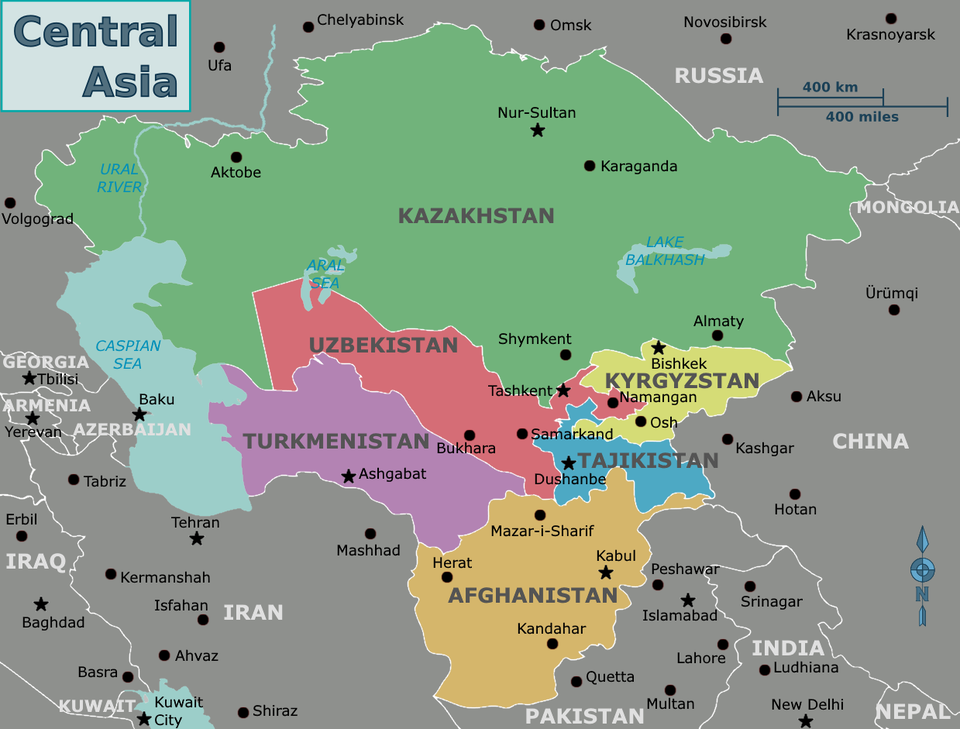
“Eastern branch: the so-called Kabul
corridor – Mazar-i-Sharif – Kabul – Peshawar, and then heads mainly to the
Pakistani ports of Karachi and Gwadar (marked with a blue outline on the
diagram). The route passes through the “Golden Crescent” zone (located on opium
poppy plantations), where drug trafficking and related crime become an
additional risk factor for any transit project. The eastern direction remains a
strategic asset for the future, although it does not represent a realistic core
of the short- and medium-term strategy.
Western branch: heads through Herat, Iran
and Pakistan. It is formed as a connecting route between the railway networks
of Central Asian countries and the seaports of Pakistan and Iran; These include
the ports of Gwadar (Pakistan) and Chabahar (India).
In the short and medium term, the western
direction – via Herat and Iran – is considered the most realistic and viable
option for the development of the Trans-Afghan route,” the study says.
The TCRC also writes about the
“Five-Country Corridor” project, which would connect China, Kyrgyzstan,
Tajikistan, Afghanistan and Iran via a railway network.
The “Five-Country Corridor” project is of
crucial importance for Central Asia. This route provides Tajikistan and
Kyrgyzstan with a real, physical outlet not only to Afghanistan, but also
further afield – to Iran and the southern seas. Under such a configuration,
Uzbekistan gains a strong logistical position in the region. Kazakhstan and
Turkmenistan are additionally strengthening the southern vector, significantly
increasing their transport connectivity in the region. In this regard, the
“five-country corridor” project has the prospect of becoming an important
transport artery for the Central Asian region,” TCRC writes.
In conclusion, the study shows that the
region is not yet ready to consider the Trans-Afghan routes as a single Central
Asian project. However, as a result of the expert discussion, the opinion was
expressed, namely, that for the Central Asian countries, the “Trans-Afghan
corridors” are not just a chance to gain access to the sea.
“This is an additional test for the Central
Asian countries: can these countries act as independent, unified regional
players, create their own rules and not adapt to the strategies of other
countries?
Given that the Trans-Afghan corridors are at different stages of development, it is difficult to imagine them competing in any way with the institutionally higher-level Middle Corridor in the near future,” the study reads.
bpn.ge