commercial-diplomacy
British Exchanges in Batumi
2025-03-08
Porto-Franco, literally – “a free port”. This is how Batumi,
which was part of the Russian Empire, was called in 1878-1886. The idea of
declaring Batumi a free port belonged to England. English diplomats demanded
the declaration of Batumi as a porto-franco at the Congress of Berlin and got their
way. According to the eighth paragraph of the agreement signed in Berlin,
Batumi was transferred to Russia with the status of a porto-franco. Batumi was
the third porto-franco in the Russian Empire, after Odessa and Vladivostok.
Based on the charter of the porto-franco, Batumi was allowed
to import foreign goods freely. These privileges did not apply to Russian-made
export goods.
The decision to occupy Batumi was made by the British
Foreign Secretary on November 13, 1918. Batumi was a strategic location for
basing the British fleet to ensure military operations on other fronts...
During the period of British rule (December 1918 - July 1920), the situation in
Batumi was similar to that in other colonies of Great Britain. Nothing good
came from Britain for Georgia during that period. The oppression and oppression
of Georgians was a joint work of the British and Russians. At that time,
neither the European Union existed, nor the Charter of Human Rights, nor
international law.
However, the following facts are noteworthy for us: During
the British rule, labor and currency exchanges appeared in Batumi, where the
British pound sterling was dominant. British stamps were issued. Ships loaded
with European goods entered Batumi.
During the British rule, the arrangement of this region
according to the English rules began, as well as the improvement of streets and
squares. Several houses in Batumi were covered with roofs specially brought
from England. Labor exchanges appeared in three places in the city, and
currency exchanges were located near them. It should also be said that all this
seemed so foreign to the people of Batumi that the registration of locals at
such labor exchanges was very low, and these exchanges were mainly used by
representatives of other nationalities living in Batumi. As for currency
exchanges, the situation was the same here, they were used by the non-Georgian
population and foreigners living in Batumi. This should not be understood as if
Georgians did not visit such currency exchanges at all. Of course, they did and
slowly began to use the pound sterling, but this concerned the wealthy strata
of the population and not a large part. Ships loaded with goods from English
and other countries were arriving. Batumi's shops and shopping centers were filled
with English goods. At the same time, smuggling flourished, Batumi turned into
a city of smugglers. True, the police fought against it, but this fight was
insignificant. Also, in several places in the city, brothels appeared, which
were mainly used by the English.
As for British stamps, they were issued by the English
several times. A part of these stamps is now kept in the Khariton Akhvlediani
Adjara State Museum.
So, in London, Georgia is very well known, and modern,
democratic Great Britain sees very well the role and place of Georgia in the
new continental order.
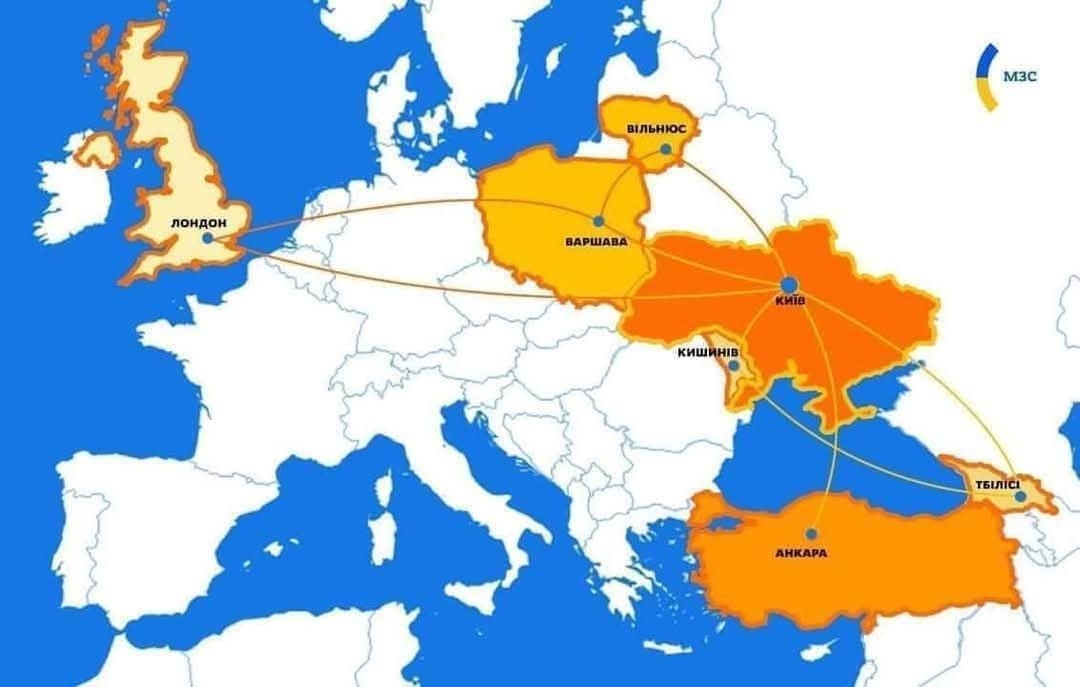
In 1921, Georgia was annexed by Moscow. In 2021, Brexit took place and the British alliance was created, on the map of which Georgia is outlined. Therefore, in the near future, a market economy order will be established in Georgia, with independent exchanges. And the global transit programs related to Georgia - the Middle Corridor, the Lapis Lazuli Corridor, the CASCA route, the GUAM Free Trade Zone, the South-west Corridor, the Viking Route and the continental trade on these routes will be carried out through the Georgian stock, commodity and currency exchanges.