commercial-diplomacy
Economic Causes of the Disintegration of Georgia
2025-08-21
In the 15th century, the painful process of
the disintegration of the Georgian Kingdom began, from which the country could
not recover until the modern era. It is a sad fact that at the end of the
Middle Ages, after the disintegration of Georgia into principalities, the
country was no longer able to maintain the status of an independent nation.
In 1446, George VIII ascended the throne,
the last king of a united Georgia for about 20 years. By this time, the unity
of the country was already in jeopardy due to a number of serious events. In
1463, George VIII was defeated at the Battle of Chikhori, and the Kingdom of
Imereti, ruled by Bagrat VI, declared independence. Two years later, George
VIII attempted to punish Prince Kvarkvare Jakeli, the rebellious ruler of the
Principality of Samtskhe, but Kvarkvare unexpectedly turned the tide of events
when he himself captured and imprisoned George VIII. Bagrat VI took advantage
of his opponent's weakening, invaded Kartli in 1466 and declared himself king
of Georgia. This was not part of Kvarkvare's plans, because instead of the weak
George, he would have to deal with the self-proclaimed king of Georgia, Bagrat.
Kvarkvare released George VIII in the hope that he would regain the throne, but
George VIII failed to seize the throne from Bagrat VI. After a few attempts,
George VIII moved to Kakheti and created a separate kingdom. Bagrat remained
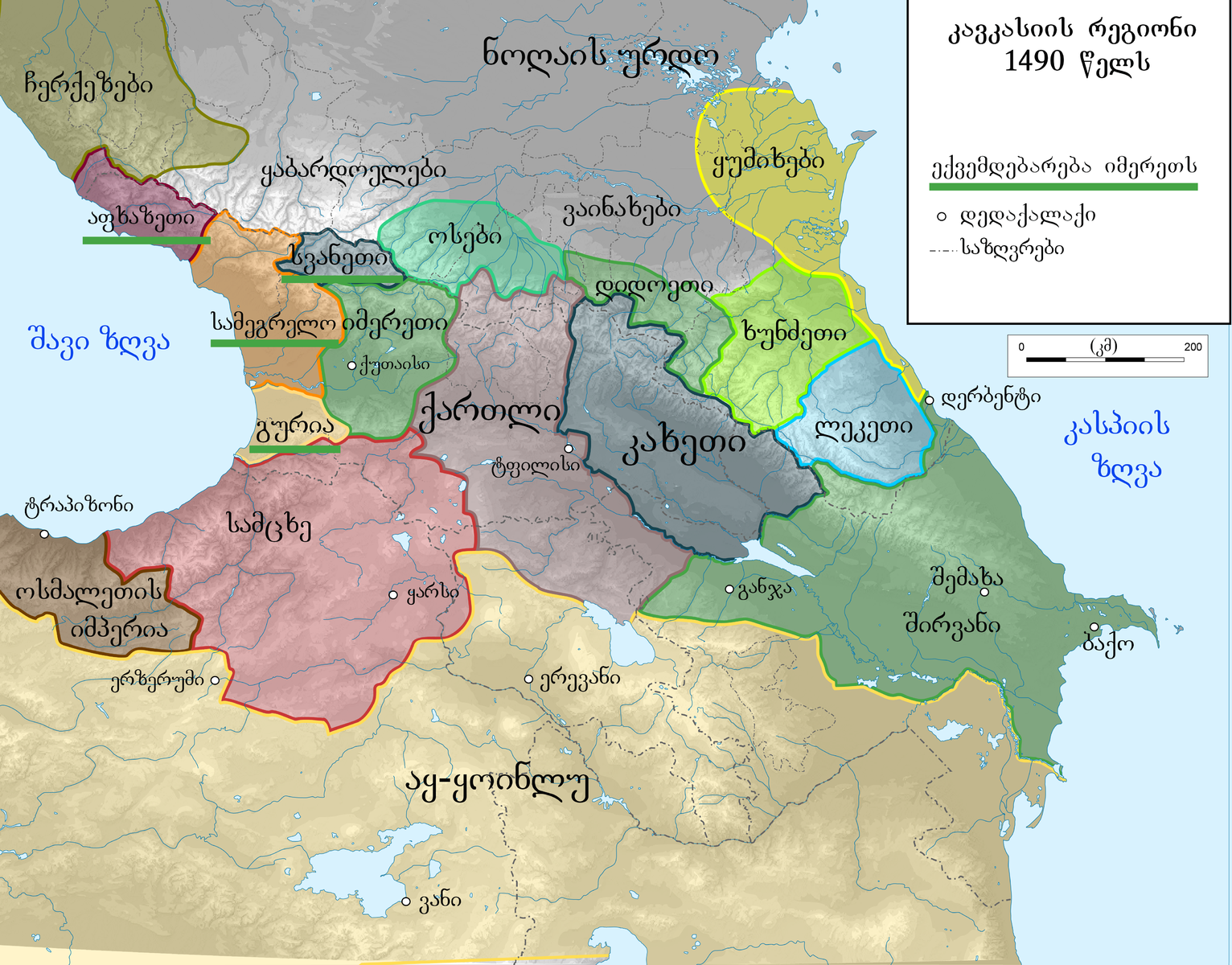
king of Kartli and Imereti, although in 1490 the Georgian kingdom was finally
disintegrated into the kingdoms of Kartli, Kakheti, Imereti and Samtskhe, after
which it was never reunited.
Internal conflicts and disintegration were not alien to feudal societies, where representatives of the aristocracy constantly fought for power. However, it is surprising that Georgia found it so difficult to unite. Several subsequent rulers tried to restore its former glory and territories, but to no avail. Even in the face of a common threat from the Ottoman Empire and Iran, the Georgian rulers were unable to put aside their differences. This is quite remarkable. In 1863, when the Ottoman army stood at the gates of Vienna, it was not up to the Habsburg rulers alone to prevent the threat of the Muslims from the European continent. On the contrary, a European coalition led by the Polish king Jan Sobieski repelled the Ottomans. The Georgian rulers, constantly surrounded by hostile forces, were unable to unite and fight for a common goal. What was the reason for this?
All
Roads Lead to Economics
David Friedman, the anarchist-capitalist
son of Nobel Prize winner Milton Friedman, likes to explain everything in terms
of economics. His 1977 article “The Theory of the Size and Shape of Nations” is
based on the idea that rulers and governments are only interested in maximizing
their tax revenues. In the Middle Ages, there were only two major sources of
taxation: agriculture and trade. While agricultural production and taxes
depended on the amount of land, trade taxes depended on control of trade routes.
However, there is another important difference between these forms of tax
revenue.
Suppose several entities share different
parts of a trade route. If one of them increases its taxes, this will
negatively affect the income of the other entities. The trade route will become
less profitable, trade will decrease, and everyone will suffer. In the case of
such “negative externalities,” players have an incentive to impose much higher
taxes than would otherwise increase total tax revenues. In other words,
countries would be tempted to merge and reduce taxes. If, on the other hand,
there are competing trade routes, rulers will engage in competition for trade
volume and lower their own taxes, which would increase total tax revenues.
Again, total tax revenues can be increased if countries merge.
As for agricultural taxes, rulers have no
incentive to merge. There are reasons to believe that collecting agricultural
taxes involves so-called “diseconomies of scale,” namely, efficiency increases
when it is done in small units. Collecting agricultural taxes over large
territories required significant bureaucratic resources and the ability of tax
collectors to communicate with each other. It was necessary to record who paid
what, so that tax regulations were followed and double taxation did not occur.
In the Middle Ages, bureaucracy was not well developed and communication was
difficult. The easiest way to circumvent this problem was to create small
units. Moreover, it can be added that when independence does not create any
economic problems, rulers may naturally want to create small units that are
much easier to manage.
According to these arguments, countries that derive their income primarily from agriculture have an incentive to secede, while countries that depend on trade routes have an incentive to unite. Friedman applies his theory to European nations, from the Romans to modern nations, and, in parallel with his predictions, concludes that the East-West Mediterranean trade gave rise to the Roman Empire and its Romano-Germanic successors. Then, in the 7th and 8th centuries, the Arab advance in the East closed these trade routes, leading to the creation of small, independent feudal domains around the Mediterranean. Similarly, the landlocked region of Central and Eastern Europe, which was focused on agriculture, was, according to this theory, divided into many smaller units throughout the Middle Ages. The trading economies of France, Spain, and England, on the other hand, were united into large, contiguous kingdoms.
What
was happening in Georgia?
Georgia is located on the Silk Road, a
major East-West trade corridor where major trade routes ran. In 1453,
Constantinople fell, and 37 years later, in 1490, the Georgian Kingdom was
divided into the kingdoms of Kartli, Kakheti, Imereti, and Samtskhe. The fall
of the Byzantine Empire and the establishment of Ottoman control of the
Bosphorus Strait further complicated trade between Asia and Europe through
Georgia. In 1461, the Ottomans captured Trebizond, closing off the remaining
land trade routes to the south. In 1475, the Ottomans captured the northern
Black Sea coast, and Georgia found itself almost completely isolated from
Europe. The Black Sea became an “Ottoman lake,” the Caucasus corridor was
closed, and trade routes to Europe disappeared.
If we believe Friedman, this situation led to the formation of small units. If we share his theory, Georgian rulers were only responding to economic incentives when they broke up into kingdoms. Perhaps it was not the absence of David the Builder II that prevented unification, but insurmountable, severe economic constraints that made it impossible to re-establish a unified Georgian kingdom.
Source: iset-pi.ge