commercial-diplomacy
European Travelers, Scribes, and Merchants on the Silk Road
2025-04-29
“Tbilisi is the place where Asia and Europe
walk hand in hand.” – Alexandre Dumas, French writer and journalist.
Even in ancient times, transit routes from
the Far East, Asia Minor, and the Mediterranean passed through Georgia,
specifically the territory of Javakheti. In the early Christian era,
Javakheti’s involvement in international trade is confirmed by the "World
Road Map" compiled by the Roman geographer Castorius of the second half of
the 4th century, on which, according to one of the routes, the road from south
to north to Transcaucasia would go from the then capital of Armenia, Artashat,
through Gyumri, into Phocaea, pass through Abuli, descend from Khospio to
Tsunda, then from Odzrkhe through the "Iron Cross" pass to
Likhtimereti - Varditsikhe-Kutaisi, from there to Poti, from where it would
branch off in two directions to Trapezund in the south and to Sevastopol
(Sukhumi) in the north (Javakheti, K. Metreveli, 2022)
"The constant entry of camels and
horses into the city and their exit from there... The transport of goods from
distant countries - all this was a special It gives life to these peculiar
hotels (caravans), where merchants of such different languages and countries
live, as if united in one community... Tbilisi can be considered a key place
between Europe and Asia.” - Jacques-François Gamba, French traveler and
merchant, 1824.
The artist Leon Beckett, to the adventure
novel “Claudius Bombardier” written in 1893 by the French writer, classic
adventure writer Jules Verne, included two maps of the railway line - from
Tiflis to Kashgar and from Kashgar to Beijing. The book describes a journey
along the “Great Trans-Asian Railway”, which stretches from Uzun Ada (an island
in the Gulf of Izmir, Turkey) to Beijing.
According to a letter from Louis Grangier,
a French Catholic missionary who visited Samegrelo in 1615, Anaklia (the port)
is marked on a Turkish map of the second half of the 17th century and on a
French map compiled by the geographer Sanson at the end of the same century.
The Italian Catholic missionary Giuseppe
Zampi wrote in 1674: “Now a man cannot be fearless, there is always the fear of
the fall of the Abkhazians. Even the ships that came to Cavros and Morbilla are
now going to Anarchy out of fear.”
"Every year, about twelve sailing
ships from Constantinople and Caffa and more than sixty feluccas from Gonio,
Iris, and Trebizond arrive in Anaklia. In addition to prisoners in Samegrelo,
they are loaded with silk, flax thread, canvas and flax seed, ox hides, marten
and beaver fur, boxwood, wax, and honey." - Jean Chardin (1643-1713),
French jeweler, gemstone merchant, and traveler.
French publicist and traveler, member of
the Paris Geographical Society Jean Mourier wrote in his book “Samegrelo”
published in 1883 that Anaklia has only “20 inhabitants, but it is a very
important port for cargo ships. Corn from the entire Zugdidi region flows here
to be sent abroad or to Odessa by sea.”
Due to its geographical location, Tbilisi’s
status as one of the most important transit cities in the world is associated
with the construction of the Indo-European telegraph line. The telegraph line,
which is 11,000 kilometers long, ran along the following route:
London-Berlin-Warsaw-Odessa-Kerch-Tbilisi-Tehran-Karachi-Calcutta. The laying
of the Indo-European telegraph line was commissioned by the British government
to the company "Siemens & Halske" in order to quickly establish
communication with India, the largest colony. In Georgia, the telegraph line
passed through Sukhumi, Zugdidi, Kutaisi, Gori and Tbilisi. The first land
transcontinental telegraph was opened in January 1870, and for 60 years,
Tbilisi was the most important center of international communication. The
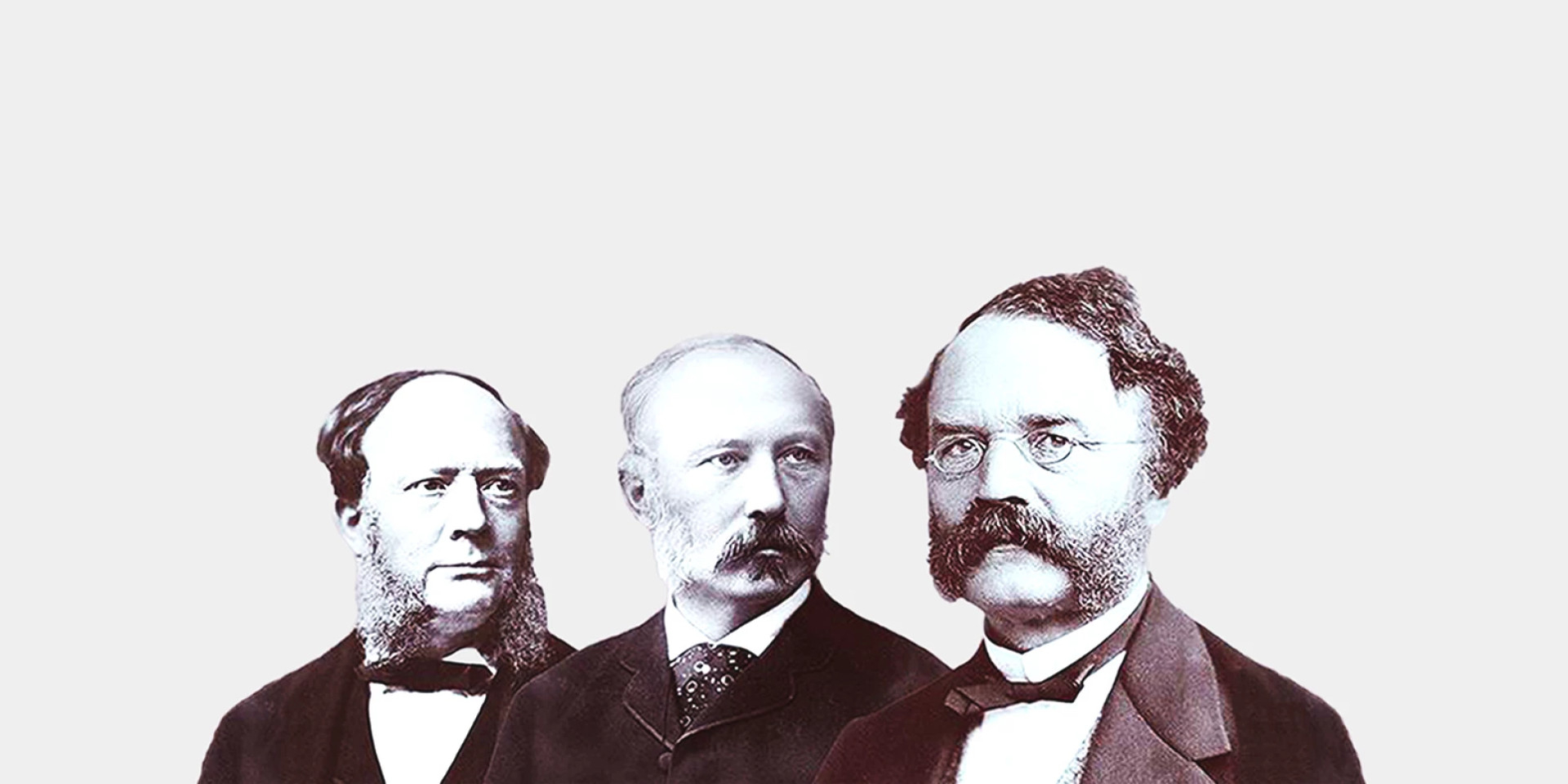
German Siemens brothers - Werner, Otto and Walter Edgne - headed the project.
Letter from Swedish engineer and
entrepreneur Ludwig Nobel to his brothers: "Among all the possible routes
for transporting oil from Baku, I recommend that you choose the route that
passes through Georgia, since between these two countries, in addition to
territorial proximity, there is a completely unique feeling of friendship and
loyalty to each other that has existed for centuries between Azerbaijanis and
Georgians. For us, foreigners, this factor is of particular importance. All
other routes are associated with much greater risks, since nowhere are there
such favorable conditions as in Baku and Tbilisi. Therefore, I am deeply
convinced that we should choose this route." Ludwig, Robert and Alfred
were the founders of the "Nobel Brothers Oil Production Partnership".
Together they made a decision to export Caspian hydrocarbons to Europe. They
discussed several options for transit routes, and agreed on the route chosen by
Ludwig: Baku - Tbilisi - Batumi. 1875
"Four roads converged in Mtskheta, the
capital of the Kingdom of Kartli." - Greek geographer Strabo (64-63 BC,
23-24 AD).
TRACECA.GE