commercial-diplomacy
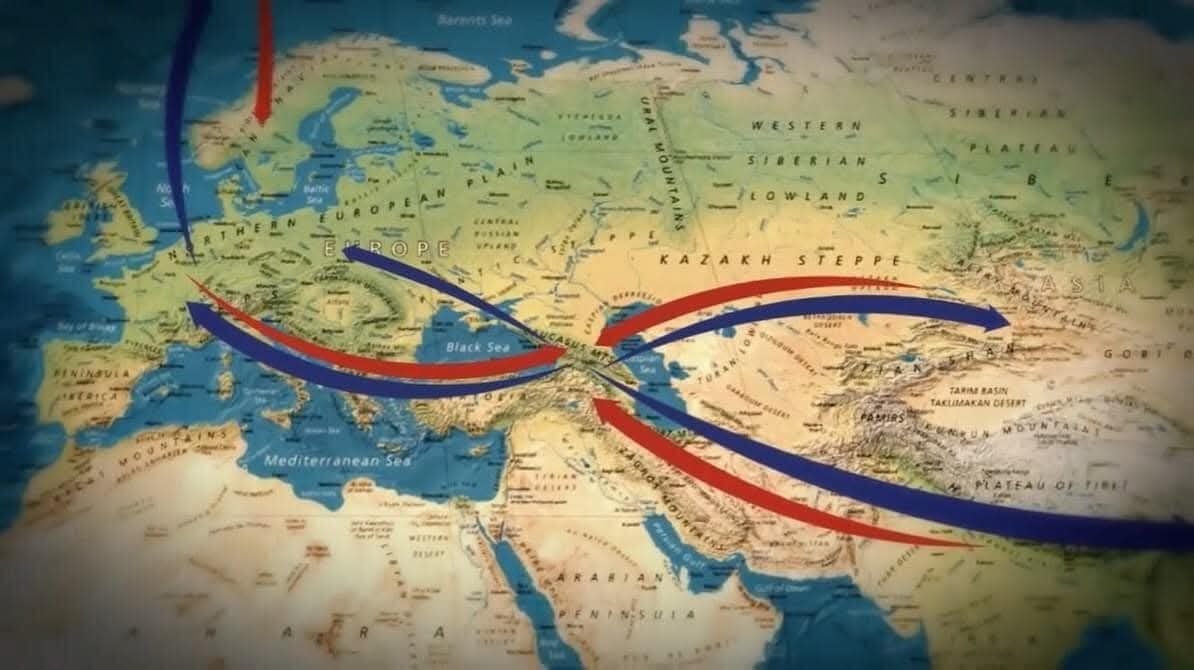
The Forgotten Old and New Silk Road
2025-06-01
2025-06-01
It is known that one of the trade caravans
passed through Georgia in 568. In the 12th century, as a result of the liberal
reforms of the Georgian king David the Builder, which consisted in: limiting
feudal lords, increasing private property for the people, and establishing tax
breaks for foreign merchants; trade between peoples developed. The idea of a
free market born in Georgia in the Middle Ages was justified, and between the
Black Sea and the Caspian Sea, Georgia, on the one hand, became a southern
gateway for European crusaders, and on the other hand, for the East, Georgia
was a kind of converter of Asian capital to European markets. This fact is
confirmed by the unique silver coin of the first king of a united Georgia,
Bagrat III (975–1014), on the obverse of which is written in Arabic “There is
no God but One, He has no partner”; On the reverse, the Arabic inscription
“Muhammad is the Messenger of God” is accompanied by the following in Georgian
script: “Christ, praise Bagrat, King of the Abkhazians”. The coin is kept in
the Hermitage (St. Petersburg).
A similar coin, with praises to Allah on
one side and Christ on the other, probably does not exist anywhere else. This
fact also indicates the uniqueness of the Georgian nation as the only
European-Asian nation. However, this is not all. Even before the birth of
Christ, a silver coin - the Colchian tetri - was minted in ancient Georgia in
the 6th century.
After the collapse of the Soviet Union, the
process of expanding the European Union began. This was followed by the
promotion of such continental programs as the Eastern Partnership, TRACECA
(Transport Corridor Europe-Caucasus-Asia), CASCA (Central Asia-South
Caucasus-Anatolia), GUAM Free Trade Area, Middle Corridor, Viking Train,
Southwest Corridor, and others.
The economies of today's European Union and
today's China are each worth around $19 trillion. To this are added the
industries of Great Britain, Norway, Turkey, the Arab world, Iran, India,
Pakistan, Vietnam, Bangladesh, the "Asian Tigers" and Central Asian
countries in continental trade. Connecting disparate realities requires
courage. This courage is achieved through the appropriate order in the
development of investment and trade.
Georgia, along with Ukraine and Moldova, is
an EU candidate country, which is obliged to implement the recommendations of
the European Commission, including de-oligarchization. The recommendation
involves the transition from a distributive economy to a market economy, which
should facilitate investment and trade between Europe and Asia.
In parallel with this process, talks have
begun on opening the borders between Azerbaijan and Armenia, and Armenia and
Turkey. Iran is also trying to design transit routes with both Armenia and
Azerbaijan. In addition, Armenia is working on developing free trade
opportunities with Iran and India. Negotiations have also begun between the EU
and India on a free trade agreement, which should be completed in December
2025. This is complemented by EU initiatives in Central Asia. In 2024 and 2025,
within the framework of the Global Gateway, European and international
institutions have allocated a total of 22 billion euros to support sustainable
connectivity in Central Asia, with a focus on the development of the Middle
Corridor. As well as critical raw materials and environmental protection
projects.
The above facts indicate that the Caucasus is becoming an economic connector of major global markets, which will increase both its capabilities and responsibilities.
In the medium and long term, all three
countries of the South Caucasus - Azerbaijan, Armenia and Georgia - will
provide transport and logistics spaces to service trade caravans and generate
revenues. However, for global investors, it is important that the financing of
such transit infrastructure is regulated by the free capital market. This means
that investment decisions in ports, railways, hydroelectric power plants,
highways, energy carriers and similar projects should be made on the stock and
loan markets - banks independent of the state, as well as on independent
exchanges. The investment environment is strengthened by stock and currency
exchanges, and the exchange of goods - by the commodity exchange.
The challenge for all three countries of
the South Caucasus is to adapt to the new order of global trade. It is in the
interest of all three countries to respond to the orders of global markets with
high quality and competitive prices. And competition is the basis for
development and success.
In addition to the great prospects of the
Georgian deep-sea port project on the Black Sea, there are no less than two
other projects - the Black Sea Green Cable and the Baku-Tbilisi-Kars railway.
The first is the Renewable Energy Road, and the second is the Iron Silk Road.
Finally, the most important thing - as geopolitics specialist Teimuraz Zakradze calls the "Golden Section" of the Silk Road, this is the shortest railway line between Asia and Europe with the route: Tbilisi-Samtredia-Sukhumi-Adler-Sochi-Kharkov. It is because of this "golden section" that the free world decided to restore order on the Silk Road.
Zurab Maghradze, Ph.D.