commercial-diplomacy
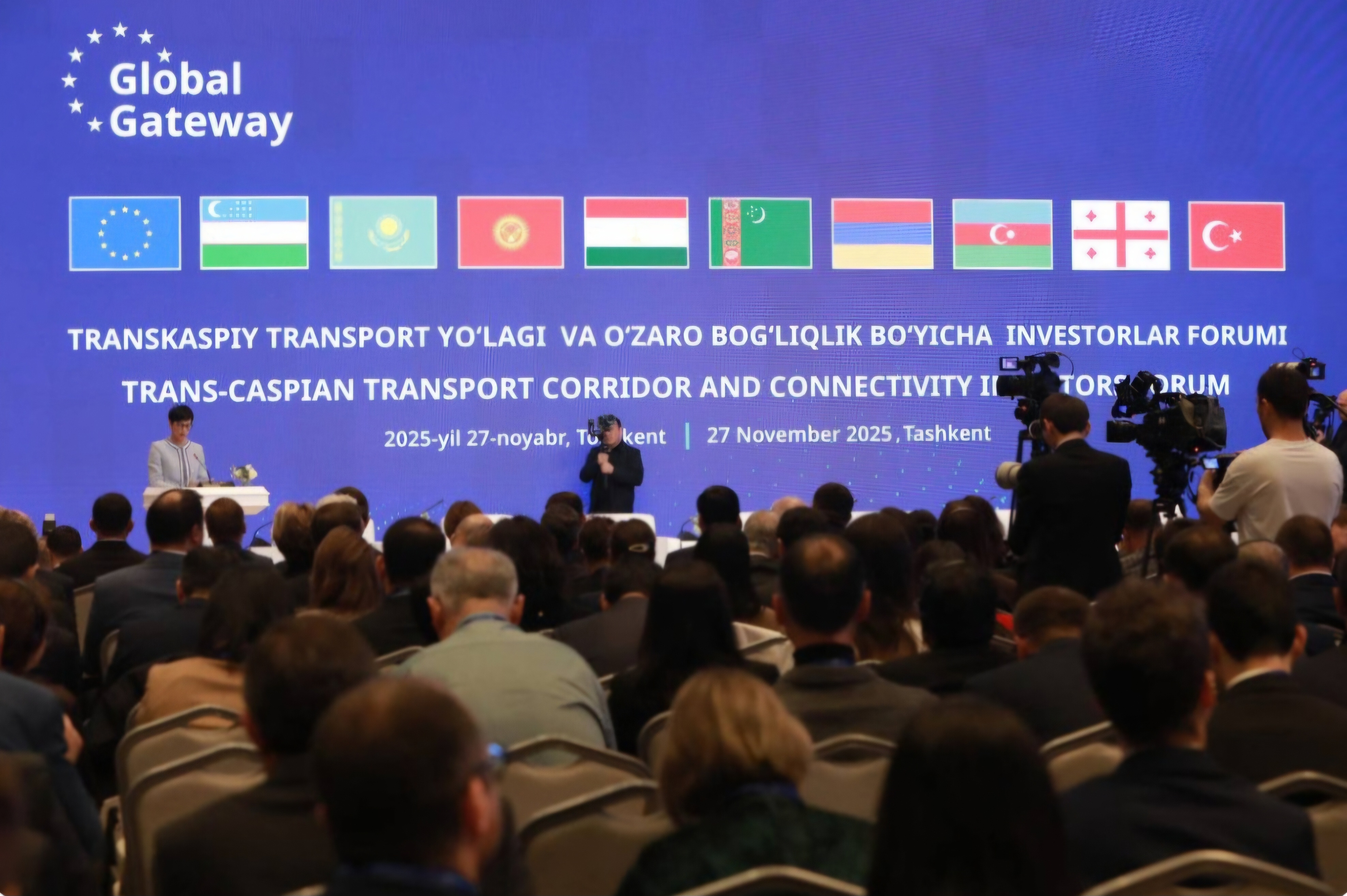
The Trans-Caspian Route is a Geopolitical and Economic Victory
2025-11-30
30-11-2025
The Trans-Caspian Transport Corridor and
Connectivity Investors Forum was held in Tashkent. The event brought together
representatives of the European Union, the Black Sea region and Central Asia,
experts and specialists.
A number of documents were signed to
modernize the transport corridors. One of the packages supports a high-level
dialogue, which allows governments and the private sector to jointly define
investment priorities. The initiative is a partnership between the European
Union and the World Bank and has a total budget of €10 million.
The discussions focused on regional and
transport links between the European Union and Central Asia. The participating
countries shared their current investment efforts, as well as future plans.
These discussions were deepened by a
meeting of transport ministers and a high-level panel, which brought together
ministers from the European Union, international financial institutions and
representatives of Central Asia and the South Caucasus.
According to the EU, the participants of
the event reaffirmed the strategic importance of the Trans-Caspian Transport
Corridor (TCTC) as a fast, safe and reliable route connecting Europe and Asia.
Discussions focused on inter-regional connectivity, including through the South
Caucasus and the Black Sea region, and between the EU and Central Asia - in the
areas of transport and trade, as well as the energy and digital sectors.
Participants stressed the need for coordinated action and prioritization of key
investments, which is important for eliminating logistical bottlenecks,
harmonizing regulations and scaling up high-impact infrastructure investments.
Marta Cosma, European Commissioner for
Enlargement, said: “Reliable routes connecting Europe and Asia are a
geopolitical and economic win for everyone. We have all learned the hard way
that overdependence makes us vulnerable.
Investing in transport infrastructure,
digital and energy connections creates more options and reduces the risk of
blackmail. We need a reliable, long-term alternative to the Northern Corridor.
Freight traffic along the Middle Corridor has quadrupled since 2022. By 2030,
this figure could triple again if the right investments are made to increase
capacity and close bottlenecks.”
Commissioner Kosma underlined the
importance of discussions with regional and international partners as a step
towards advancing a comprehensive agenda for Central Asia, the South Caucasus
and the Black Sea region.
Deputy Prime Minister of the Republic of
Uzbekistan Jamshid Khojayev, European Commissioner for International
Partnerships Joseph Sikella, and European Commissioner for Neighbourhood Policy
Marta Kosma also stressed in their speeches that the Trans-Caspian Transport
Corridor is an infrastructure initiative of strategic importance for the
Central Asian states. It will play a significant role in strengthening
Uzbekistan’s transit and logistics potential and transforming the country into
a central international transport hub connecting the East and the West.
The forum experts noted that the
Trans-Caspian Transport Corridor is considered a key initiative of the EU’s
“Global Gateway” investment strategy in the region. Today, the corridor is
shaping up as a key route connecting China, the Middle East and Central Asia
with Europe. It is expected that by 2030, the annual volume of cargo
transported along the middle corridor will reach 10-11 million tons.
According to Transport Minister Ilkhom
Mahkamov, one of the priority areas identified in Uzbekistan’s 2030 Strategy is
a significant expansion of the country’s transit and logistics potential.
The forum paid special attention to
cooperation between the parties. Uzbekistan and the European Union are actively
participating in the development of this corridor. It was noted that in 2024,
cargo transportation along the Trans-Caspian route showed steady growth,
exceeding 1 million tons, which is five times higher than the volume recorded
in 2019.
French Transport Minister Philippe Tabaro
stressed that cooperation between all parties is particularly important for the
advancement of this sector. The forum held thematic sessions on coordinating
the regulatory framework for transport and logistics, attracting investment in
infrastructure, and digitalizing trade routes.
It is worth noting that in December, Georgia, Turkmenistan, Azerbaijan and Romania will sign an agreement on the Caspian and Black Sea corridor.
Info: europetime.eu