commercial-diplomacy
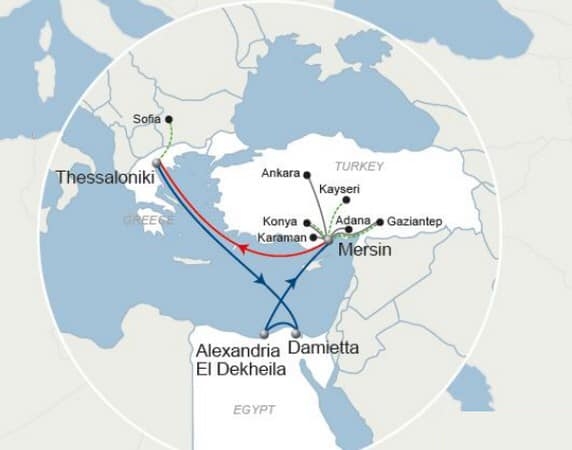
Transit route: Alexandria – Mersin – Akhalkalaki
2025-02-15
"Days of Georgian Culture" were held in Egypt in
March 2010, followed by "Days of Egyptian Culture" in Georgia in
2011. Between 2011 and 2013, 5,950 Egyptian nationals traveled to Georgia; of
these, 643 held temporary residence permits, and 12 held permanent residence
status.
In 2016, Egyptian Ambassador Tarek Maat stated that Egypt
could utilize Georgia as a gateway to access markets in other countries. He
noted that he had received a directive to this effect from the President of
Egypt.
Let us now look much further back in time.
The multi-layered archaeological site of Brili is located in
the Rioni (Phasis) River valley, within the Oni district of the Racha region. A
vast number of Egyptian artifacts—items of a type not produced anywhere
else—have been clearly identified at the Brili burial site. A massive hoard
weighing 12 kilograms was discovered in a tomb excavated in 1961; this was just
a single tomb, yet there were many others like it. Egyptian scarabs bearing
hieroglyphs were discovered in the burial sites; these scarabs closely resemble
those associated with the Pharaoh Senusret.
An Egyptian papyrus dating back to the 14th century BC has
been found; it describes a lack of copper in Egypt and notes that ore was
imported from Syria, the Apennines, and Rechena (Racha).
The primary center of the sun cult in Egypt was a city the
Greeks called "Heliopolis" (from the Greek *Helios*—sun, and
*polis*—city), whereas in Egyptian, the city was known simply as
"On." Notably, near On, a tributary of the Rioni River is named
"Khakaura"—a name that exactly mirrors the Egyptian name of Senusret.
Vyacheslav Ivanov, a professor at the University of
California, concluded that Proto-Georgians arrived in Egypt during the 4th
millennium BC, bringing with them the foundations of culture and statehood. In
ancient Egypt, a victorious warrior would often cut off an enemy's right hand
to claim a reward known as the "Gold of Valor." This practice mirrors
the legend of the Georgian hero Aluda Ketelauri.
Roman Scholz, director of the Swiss genealogy center iGENEA,
states: "I believe that the Egyptian pharaohs and the ancestors of
Europeans lived in the Caucasus approximately 9,500 years ago (in the 75th
century BC). About 7,000 years ago, their direct ancestors settled in Europe,
while some migrated to Egypt and eventually became pharaohs."
Another German scholar, Kurt Polycarp Joachim Sprengel
(1766–1833), writes: "The culture of the Colchians and Phoenicians
undoubtedly exerted a profound influence on Egyptian culture. The Egyptians
adopted the arts of agriculture and pharmacology from Colchis. They also
adopted deities from the Colchians and Phoenicians, and later from the Greeks;
indeed, the deities of the ancient Egyptians are almost entirely of Colchian
origin." Let us now turn our attention to the Colchians and consider the
words of the Greek scholar Kafantaris:
“The Colchians, who inhabited Crete at that time, can not
only dream of—but also fully grasp—the fact that they once dominated the
Mediterranean and stood as hegemons of the world of that era.”
Nor should we forget that a statue of a Georgian king once
stood in the central square of Rome.
Let us pause here and bring this context into the present
day. We have before us a statement made in 2016 by an Egyptian diplomat, noting
that Egypt’s goal is to access the markets of other countries via Georgia.
Prior to that, in 2011, another significant event occurred: during the opening
of Asia’s largest library in India, U.S. Secretary of State Hillary Clinton
voiced her support for the “Iron Silk Road.” That same year, under the liberal
administration of Barack Obama, the Baku-Tbilisi-Kars railway was named one of
the world’s top 100 global projects.
In antiquity, Alexandria was renowned for its lighthouse—one
of the Seven Wonders of the World—and for possessing the world’s largest
library. It was no coincidence that Hillary Clinton voiced her support for the
"Iron Silk Road" precisely during the opening of Asia's largest
library.
In short, the Baku-Tbilisi-Kars railway connects Georgia to Greece and Italy. At the same time, the Akhalkalaki railway station is linked—via Kars—to the port of Mersin in southern Turkey. From there, shipping routes extend to the Egyptian ports of Alexandria and Dekheila.
Source: