commercial-diplomacy
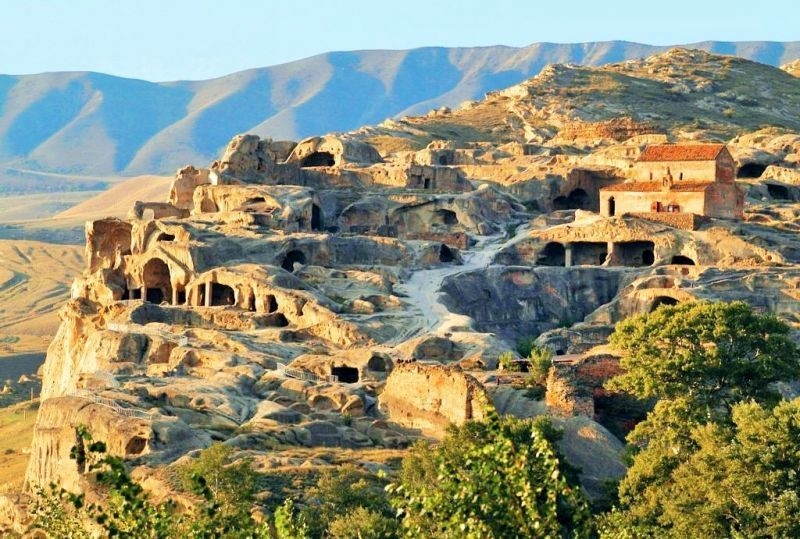
Uplistsikhe was connected to the Silk Road
2025-06-21
There are three largest rock-cut complexes
in Georgia: Uplistsikhe, David Gareji and Vardzia. The oldest of them is
Uplistsikhe.
Uplistsikhe is located on the left side of
the Mtkvari River, 10 km from Gori. It is carved into an easily worked
sandstone massif on the southern slope of the Kvernaki Ridge. It covers an area
of 9.5 ha.
Uplistsikhe is the only monument of
antiquity in Georgia that is currently preserved above ground. It is an ancient
city carved into the rock and has streets, squares, water channels, various
buildings, four gates, a secret tunnel leading to the Mtkvari River, a wall and
other...
B.C. At the turn of the 2nd and 1st
millennia, one of the powerful communities in the Uplistsikhe area used the
existing natural caves for housing. In the 10th-6th centuries BC, Uplistsikhe
was the fortress of the chieftain (chief) of the dominant community of Shida
Kartli. Apparently, at this time it was named Uplistsikhe - the fortress city
of the ‘‘Lord’’, ‘‘Chief’’. The word ‘‘Lord’’ is ancient and originally meant
God, but in the process of the formation of a class society, it also acquired a
secular meaning. From here came the king, the bishop, the ruler. ‘‘Tsikhe’’ was
a word denoting a dwelling, and later it was applied to a fortified place.
There is a legend that Uplistsikhe was
built by slaves. A slave was given a pickaxe, the edge of which was covered
with usual metal, and then precious metal came. The slave had to work so hard
that he wore out the usual metal, then he received freedom and precious metal
as a gift. Archaeological materials prove that the population lived here
already in the 16th-15th centuries BC, and in the 10th-6th centuries BC it was
already a temple city, and in the 1st-3rd centuries AD In the 13th century, it
was already an important military-strategic and at the same time an important
pagan cult place.
After Christianity was declared the state
religion in Georgia (30s of the 4th century), urban life in Uplistsikhe
declined, but it still remained the strongest fortress.
In the Middle Ages, Uplistsikhe was a
flourishing fortress city, with a population of 20,000 people. During the
Mongol invasions (13th century), it was severely damaged, after which
Uplistsikhe ceased to exist as a large and powerful city. In the 15th century,
Uplistsikhe was a monastery, and in the following centuries it was gradually
emptied of its population. Then, the population of nearby villages, who were
being attacked by the enemy, took refuge in Uplistsikhe. In recent centuries,
only shepherds from time to time took refuge in the magnificent ruins of the
city. The caves, lit by fire, It still looks like this today.
In 1920, there was a strong earthquake in
the vicinity of Gori, which partially damaged the Uplistsikhe complex.
In the second half of the 20th century,
archaeological expeditions revealed unique materials, and treasures were found
at a depth of 6 meters - beads, bronze rings, fragments of vessels, etc. The
most important thing is the terracotta statue, which is the image of a goddess.
It is dated to the 4th-3rd centuries BC and is kept in the Museum of Art of the
Treasures.
Uplistsikhe was connected to the Silk Road,
this road passed here, and traces of wheeled transport can still be seen along
the entire length of the road in Nakalakar. In Uplistsikhe, an aqueduct was
brought from the Kvernaki ridge, and the fortress also received water from the
Mtkvari River through a tunnel.
An ancient rock carving preserved in Nakalakar
The halls and buildings are distinguished by the geometric precision of their
layouts and architectural forms. The ancient theater (caisson hall) is located
on the southwestern edge of the city. It dates back to the 2nd century AD. Its
ceiling is decorated with elaborate ornaments, in the middle is a stage, and
behind it was a seating area for spectators, which was destroyed by the 1920
earthquake.
From here you can see the old village of
Uplistsikhe and the remains of its houses, where people lived until the 1960s,
then moved across the river. The reason was that a resident accidentally
discovered a tomb here. It turned out that the population lived on the tomb.
On the way from the theater to the “Tamar
Hall”, you will come across a prison, which is an 8.5-meter-deep pit. It is
located on the main street. The pit narrows down so that the prisoner He could
not sit down. Since it was on the main street of the fortress, everyone passing
by would see who was sitting in the pillory, and this was how they humiliated
the prisoner.
Tamar's Hall was named in honor of Queen
Tamar, although Tamar never lived here. The hall was originally intended for
ceremonial cult ceremonies during the pagan era. The ceiling of the hall had
two columns carved into the rock in the middle, which no longer exist today;
later a cellar was built in the northern part. The ceiling of the hall imitates
a gable roof, with a circular hole cut through it, which let in light and also
served as a ventilation function.
In the second half of the 6th century, a
large three-nave basilica was carved out of the rock in the central part of the
city. The Church of the Prince, which stands in the northern part of the
fortress city, was built in the second half of the 10th century. We must assume
that the name comes from both the name of the city itself and the name of the
Lord. The Church of the Prince is a three-nave basilica built on a rocky
foundation. It is noteworthy that the church was built on the rock itself
without any foundation and withstood the earthquake of 1920. It is said that
egg yolk was also used in the construction, which gave strength to the walls.
At the end of the 19th century, the church was renovated. In the 18th century,
a bell tower was built on the roof of the southern nave, above the entrance,
and the floor of the church was paved with bricks. According to legend, the
interior of the church was painted with frescoes from the second half of the
10th century, which were whitewashed by the Russians in the 19th century. The
temple has been damaged and repaired many times. It was significantly renovated
in the 17th-18th centuries.
Outside the church there are offering jars.
When a child was born in the family, wine was poured into the jar, and when the
child turned 16, they brought it to the church and left the jar there.
The tunnel was one of the entrances to
Uplistsikhe. It is carved into the rock and is 41 meters long. During the
siege, the city was fortified from here with water and aqueducts.
The once magnificent fortress-city is now an open-air museum.
Info: novators.ge