commercial-diplomacy
What kind of country should Georgia be
2025-06-07
"The present is born of the past, it
is the parent of the future" - Ilia Chavchavadze, writer, politician.
The strong Georgia of the Middle Ages was
created as a result of King David's liberal reform - by restricting feudal
lords and introducing tax breaks for foreign merchants. Restricting feudal
lords strengthened the factor of private property of the people, which allowed
people to accumulate wealth. As a result, a middle class emerged in the
country, which became interested in participating in making important
decisions, and already during the time of Queen Tamar, the idea of the
"Isani tent" (lower house) appeared. The first bicameral
parliamentary system was formed a century later in Great Britain.
"On Georgian soil, the Occident (West)
and the Orient (East) should be united, their harmonious fusion", -
Konstantine Gamsakhurdia, writer.
According to the World Bank’s 2023 report
on the Middle Corridor, the following cities should become the main economic
centers of Georgia - Tbilisi, Rustavi, Gori.
In the context of the new geopolitical
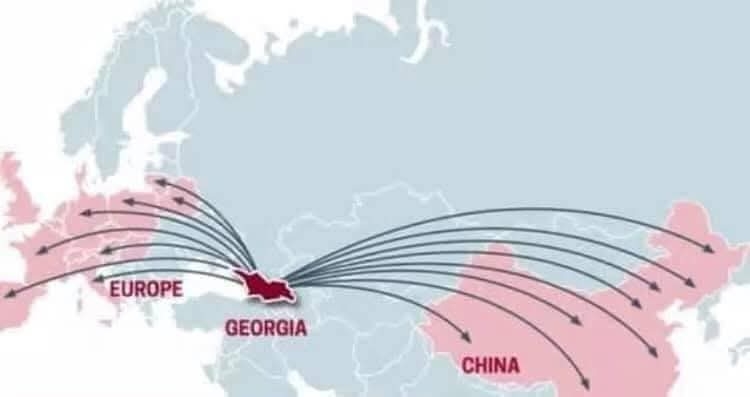
order - TRACECA and the Eastern Partnership, Georgia’s main challenge is to
manage to harmoniously combine the command-administrative economy of Asia and
the free market economy of Europe. 26 centuries ago, the Colchian Tetri served
this purpose, through the then mints and caravans.
Modern continental trade, accordingly,
requires well-organized platforms. Stock, commodity, currency and specialized
exchanges will turn the cities of Georgia into the main economic centers.
Independent exchanges will ensure a fair order in the exchange of goods,
currencies and securities between Europe and Asia, which will also lead to the
exchange of cultures. It is in the cities of Georgia that a church, a mosque,
and a synagogue stand side by side. Here, on the obverse and reverse of the
coin of the first king of united Georgia, Bagrat III, the praise of Allah and
Christ are depicted together.
If we compare the economy to the human
body, what the heart performs for a person, the bank performs the same function
for the economy. The heart supplies blood to the body, the bank supplies money
to the economy. However, in the human body, the liver is a blood filter, and
the stock exchange performs the function of a filter for the economy. An
economy without an exchange is the same as a person without a liver.
Switzerland is the heart of global capital.
The liver of global capital is Georgia.
Exchanges independent of the state and
banks in Georgia mean that Georgian citizens should own controlling stakes in
economic power - ports, railways, hydroelectric power plants, airports, and
sectoral industries.
The leading financial centers of Europe are
London, Dublin, Geneva, Luxembourg, Paris, Amsterdam. And in Asia - Hong Kong,
Singapore, Shanghai, Shenzhen, Seoul, Dubai. There is a void in the area
between the financial centers of the Occident and the Orient. This void must be
filled by the country of the Colchian white gold. And the harmonious fusion of
Asian and European capital requires a responsible unit, the national currency
of Georgia - the lari. This is the function of Georgia.
"Western Europe is precious, but we
cannot give up the East for Europe, it would be better to pay for their wedding
with a Georgian feast," - Grigol Robakidze, writer.
For greater clarity, the name of the
international multimodal transit project "CASCA" is associated with
the regional name - Central Asia, South Caucasus and Anatolia. The initiative,
which connects two seas, actually serves the common goals of the railways of
Kyrgyzstan, Uzbekistan, Turkmenistan, Azerbaijan, Georgia and Turkey and
establishes the multimodality of the route.
Georgia's business is to share European
investments with Central Asia and Anatolia through the Georgian feast as per
Robakidze.
Georgia combines transit routes, global trade zones and economic corridors - TRACECA, CASCA, CAMCA, CAREC, LAPIS LAZULI, VIKINGTRAIN, GUAM (for more information about each program, see the website: traceca.ge).
"Without economic freedom, no freedom
is attainable" - Margaret Thatcher, Prime Minister of Great Britain.
The European Commission has defined a
de-oligarchization recommendation for Georgia's European integration. The goal
of which is the country's transition from a distributive economy to a liberal
economy. This is exactly what began in Georgia in the 12th century during the
time of Great David.
In the medium term, Georgia's market
economy should create prosperity, which is the main and solid basis for the
de-occupation of Georgia. The long-term goal is to connect Asia with Europe in
the shortest possible way. This means the construction of new energy carriers
and railway infrastructure with the participation of the equity capital of the
Georgian people. And this shortest path passes through Abkhazia and Crimea.
Finally,
"A commercial business must have a commercial basis. Nobody remembers economics anymore; we are almost following this politics!" - David Sarajishvili, industrialist and philanthropist.
Zurab Maghradze, Ph.D.