commercial-diplomacy
Why the Eastern Partnership means the restoration of the Silk Road
2026-04-30
The Eastern Partnership (EaP) is a European Union project
prepared by Poland and Sweden. The Eastern Partnership was inaugurated in
Prague on May 7, 2009. The project includes the European Union and 6 Eastern
European countries - Ukraine, Belarus, Moldova, Georgia, Azerbaijan and
Armenia. Since 2021, Belarus has suspended its EaP membership due to the sharp
deterioration in the overall situation in terms of human rights, democracy and
the rule of law.
Since the EaP is an EU project, let us clarify the main
goals and objectives of the EU itself: The main policy objective of the EU is
to ensure the free movement of people, goods, services and capital within the
single, internal market; The issue of jurisprudential legislation and home
affairs; the maintenance of a common policy in trade, agriculture, fisheries
and regional development. In other words, the European Union is a free market
area.
After the collapse of the USSR, a free market for goods and
capital was not established in the countries of Eastern Europe, where companies
could attract investment by listing their securities on an independent stock
exchange. Nor were independent commodity exchanges developed, where producers
and traders could conclude trade deals on fair terms. Accordingly, the European
Union has defined a strategy with the Eastern Partnership - the expansion of
the free market to the East.
Why does Europe need an open and free market order in the
Eastern Partnership (EaP) countries?
Before answering this question, we should draw a parallel
with the EU and other related initiatives:
1. TRACECA, which stands for the Europe-Caucasus-Asia
Transport Corridor, strengthens the EU's connectivity with the countries of
Central Asia. All five EaP member states participate in the TRACECA project.
2. GUAM - an organization for democracy and economic
development. The name "GUAM" is an acronym for the names of the
countries united in it - Georgia, Ukraine, Azerbaijan, Moldova (EaP countries).
On September 20, 2022, within the framework of the 39th session of the GUAM
Council of Foreign Ministers, a Protocol on the Rules for Determining the
Country of Origin of Goods and a Convention on Mutual Assistance in Consular
Matters between GUAM Member States were signed. The Protocol envisages free
trade between GUAM Member States on the basis of the cumulation principle. In
particular, it allows GUAM Member States to use each other's raw materials, as
a result of which the product will be assigned the status of origin in the
country where it took its final form.
3. In March 2019, the Foreign Ministers of Romania, Georgia,
Azerbaijan and Turkmenistan signed the Bucharest Declaration on the Development
of the Caspian Sea-Black Sea Transport Corridor. In 2024, Turkmenistan
confirmed its intention to create the route.
4. CAMCA
(Central Asia-Mongolia-Caucasus-Afghanistan) Regional Forum,
created to facilitate discussions on means of economic growth and development
in 10 countries of the region: Afghanistan, Armenia, Azerbaijan, Georgia,
Kazakhstan, the Kyrgyz Republic, Mongolia, Tajikistan, Turkmenistan and
Uzbekistan. The Forum promotes dialogue and interaction among emerging leaders
from all sectors of the 10 countries, as well as cooperation with international
leaders and stakeholders.
5. At the initial stage of the Viking container shipping
project, only Eastern and Northern European countries were involved, namely:
Lithuania, Belarus, Ukraine, Moldova, Romania and Bulgaria. The cargo was
served by the ports of Klaipeda (Lithuania), Odessa and Chornomorsk (Ukraine).
In 2015-2016, Georgia and Azerbaijan were added to their ranks. This expansion
created a new route for transporting cargo from the Caspian Sea basin to the
Scandinavian countries.
6. There is also a South-Western transit corridor - from
India through the ports of Iran to Armenia, and from there through the Black
Sea ports of Georgia to Europe.
7. The Trans-Caspian International Trade Route (Middle
Corridor) is worth mentioning, out of the 3 founding countries of which two are
EaP members, Azerbaijan and Georgia. The route unites 11 countries, of which
Ukraine is already a member. It is a well-known fact that the European Union is
interested in the exploitation of critical mineral deposits of Central Asia
with an investment of 12 billion euros, which will be implemented precisely
through the Middle Corridor.
8. The Black Sea fiber-optic cable project also starts from
Azerbaijan and connects to the EU energy markets through Georgia.
As can be seen from the listed programs, there are no
transit corridors without the Eastern Partnership (EaP) countries. The European
Union needs strong Eastern European countries with open and free markets as
partners.
Of the 5 EaP member states, Ukraine, Moldova and Georgia are
already EU candidate countries. In addition, the 8th summit of the
"European Political Union" (EPC) will be held in Armenia on May 4,
2026, and the "first EU-Armenia summit" will be held on May 4-5. This
is a historic event, where the President of the European Council, Antonio
Costa, and the President of the European Commission, Ursula von der Leyen,
together with the Prime Minister of Armenia, will discuss the country's new
strategic agenda for European integration and visa liberalization issues.
The shortest route from Asia to Europe runs through Abkhazia
and Crimea. Moscow has seized these very places, which hinders the Silk Road.
That is why it is waging war in Ukraine. That is why it wants to violate the
integrity of Ukraine, violate the integrity of Georgia, so as not to allow the
restoration of the Silk Road. But the European Eastern Partnership will
inevitably take place. This is a difficult and contradictory process. In the
order of the Silk Road restored by the Eastern Partnership, Moscow will no
longer be a geopolitical player.
Finally,
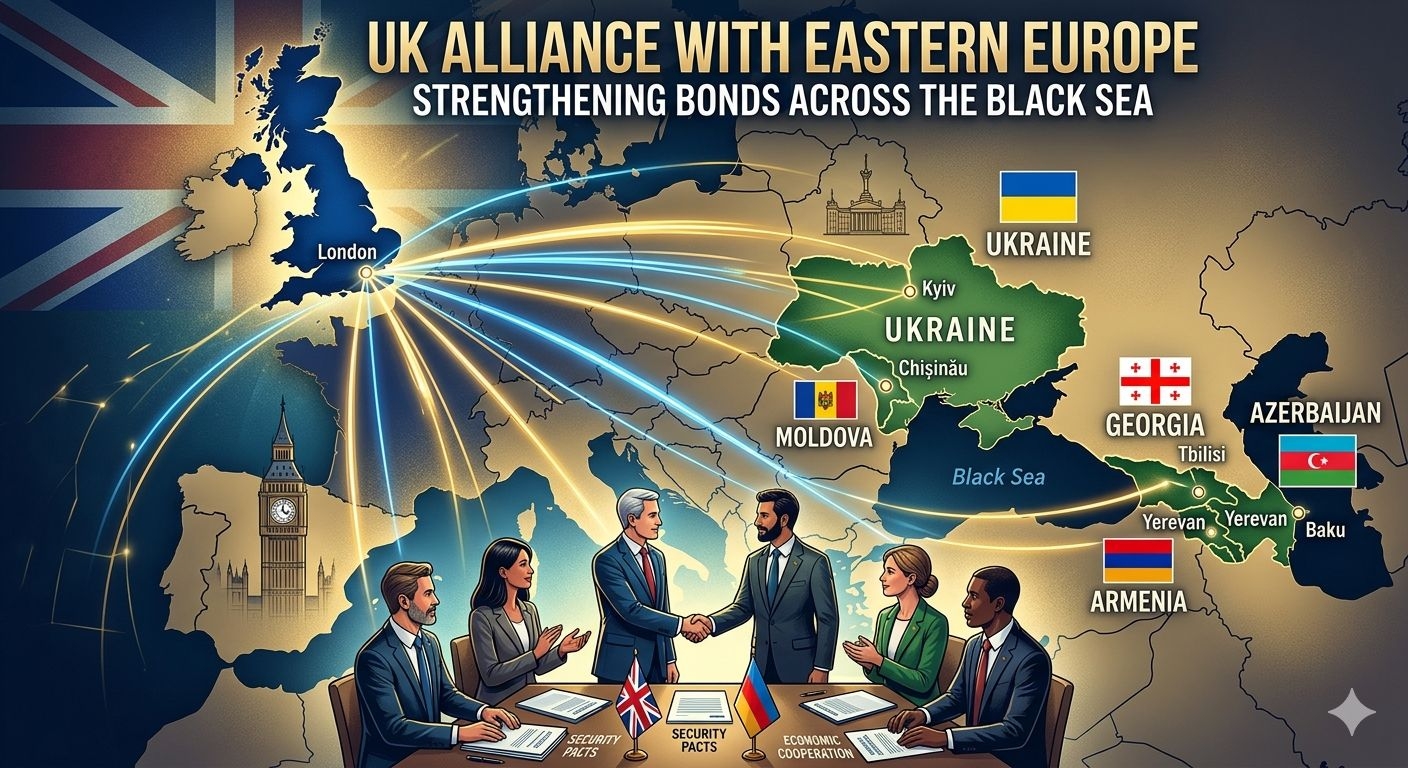
After Brexit, the UK-backed initiative: the Security Axis - London, Warsaw, Kiev; the Lublin Triangle with the Baltics; the Quadriga with Turkey and the Moldova-Georgia Trio, is a separate umbrella in the restoration of the Silk Road, with countries from the Baltic Sea to the Black Sea. And this initiative also means the expansion of the European free market to the East.
Author: Zurab Maghradze