pylonology
Global Shipbuilding Centers and Georgia`s Opportunities
2026-11-24
Shipbuilding
Shipbuilding is one of the oldest, most complex and strategically important industries, closely linked to a country’s economic strength, international trade, technological progress and maritime security.
A significant share of the global economy depends on maritime transport. Approximately 80% of international trade by volume is carried by sea. Raw materials, energy resources, food products, automobiles, industrial equipment and millions of tonnes of other goods move along maritime routes every day. Without ships, the functioning of the modern global trading system would be virtually impossible.
However, the development of maritime transport depends not only on ports, terminals and shipping companies. One of its fundamental pillars is shipbuilding — the industry responsible for producing the vessels that make maritime transport possible.
Shipbuilding involves far more than manufacturing a steel hull and launching a vessel. It is a high-tech industrial sector combining naval architecture, engineering and design, metallurgy, mechanical engineering, electronics, automation, energy systems and information technology.
A modern shipyard is a complex industrial facility. Its operations involve engineers, designers, welders, mechanics, electrical technicians, programmers, logistics specialists and professionals from many other fields. Even the construction of a single vessel often requires coordinated cooperation among hundreds of suppliers and subcontractors.
Consequently, the development of shipbuilding does not simply represent the economic success of an individual enterprise. It also generates additional demand for steel production, mechanical engineering, electrical manufacturing, engineering services, logistics and vocational education.
Shipbuilding also has considerable strategic importance. A country capable of designing and building its own vessels is less dependent on foreign production capacity, technologies and supply chains. This is particularly important for naval forces, coast guards, port infrastructure and the provision of specialised workboats.
How Have the World's Shipbuilding Centers Evolved?
Historically, shipbuilding developed in close connection with maritime trade, colonial expansion, the strengthening of naval fleets and the Industrial Revolution. For centuries, the United Kingdom, the Netherlands, Germany and other European countries held leading positions in this sector.
However, from the second half of the 20th century onwards, the geography of global shipbuilding underwent a major transformation, with the industry's main production centers gradually shifting to East Asia.
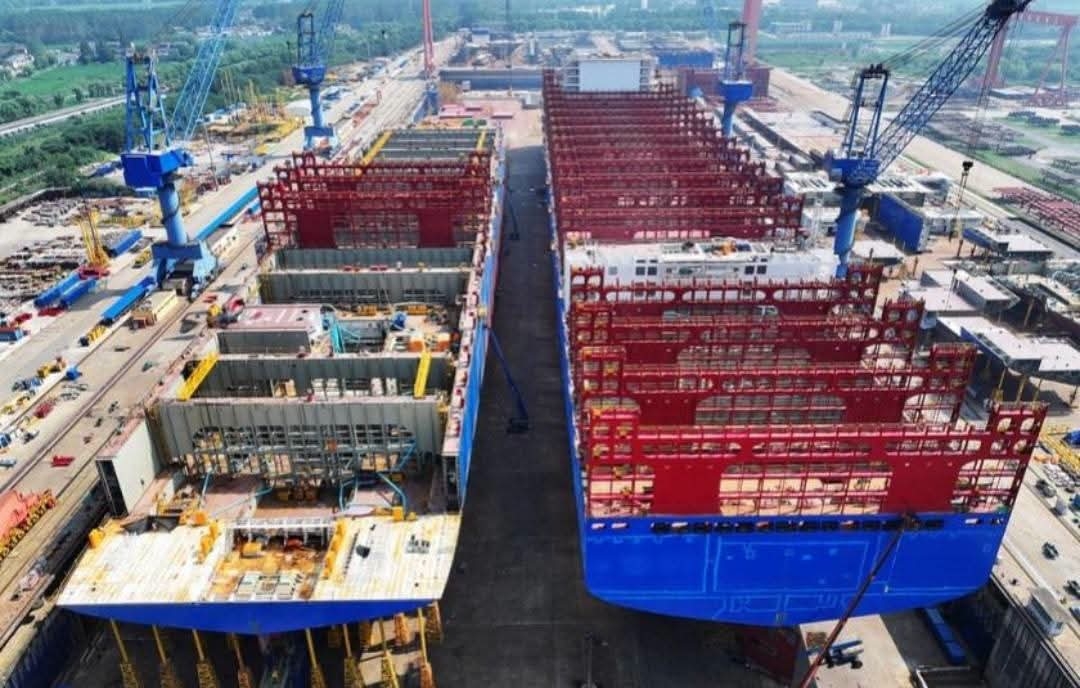
Today, three countries dominate the global shipbuilding industry:
China — 54.57%
The world's largest shipbuilding nation (2024 data).
South Korea — 28.02%
Particularly strong in LNG carrier construction and the production of technologically advanced vessels.
Japan — 12.56%
A major producer of dry bulk carriers, tankers and energy-efficient vessels.
Source: UNCTAD, Review of Maritime Transport 2025. Figures are based on gross tonnage.
These figures clearly demonstrate the high level of concentration in global shipbuilding: the three countries together account for approximately 95% of worldwide production.
Why Is Shipbuilding Economically Important?
The economic impact of shipbuilding extends far beyond the revenue generated from the sale of completed vessels. Each order creates a broad network of industrial production and services.
For example, even the construction of a medium-sized tugboat requires hull materials, engines, generators, navigation systems, radars, communication equipment, hydraulic machinery and numerous other components. The process also involves design, engineering supervision, quality control, testing and certification.
As a result, shipbuilding generates not only direct manufacturing jobs but also additional demand for local suppliers and service providers.
The construction of small and medium-sized vessels offers particularly interesting opportunities. While global attention is often focused on large container ships, giant tankers and cruise liners, the daily operation of ports also depends on tugboats, pilot boats, rescue vessels, patrol boats, crew transfer boats and other specialised craft.
This segment offers opportunities to establish competitive businesses with relatively modest production capacity, particularly when shipyards focus on the specific needs of regional markets.
What Does Shipbuilding Development Mean for Georgia?
For Georgia, shipbuilding should not be viewed merely as an attempt to revive a historic industry. It could become an important pillar of the country's maritime economic development.
Georgia has a Black Sea coastline, operational seaports, an existing maritime education system and a foundation of qualified personnel. It also has opportunities to develop demand for port-related and specialised vessels.
The development of the ports of Poti, Batumi and Anaklia creates the conditions for shipbuilding and ship repair to be considered not as isolated projects, but as interconnected components of a broader industrial system.
In this regard, the construction of small and medium-sized vessels is particularly promising. At the initial stage, Georgia does not need to compete with Chinese and South Korean industrial giants in the construction of ocean-going tankers and container ships. A more realistic approach would be to target regional markets, specialise in the production of specific vessel types and gradually expand domestic manufacturing capacity.
For Georgia, shipbuilding is about much more than producing vessels. It represents an opportunity to develop engineering expertise, acquire new technologies, build industrial experience, create jobs and generate additional economic value.
The key question for Georgia should not simply be how many ships the country can build annually. Far more important is how many local companies, specialists and related industries can participate in this process, and how much economic value will ultimately remain within the country.
Sea Pilot