pylonology
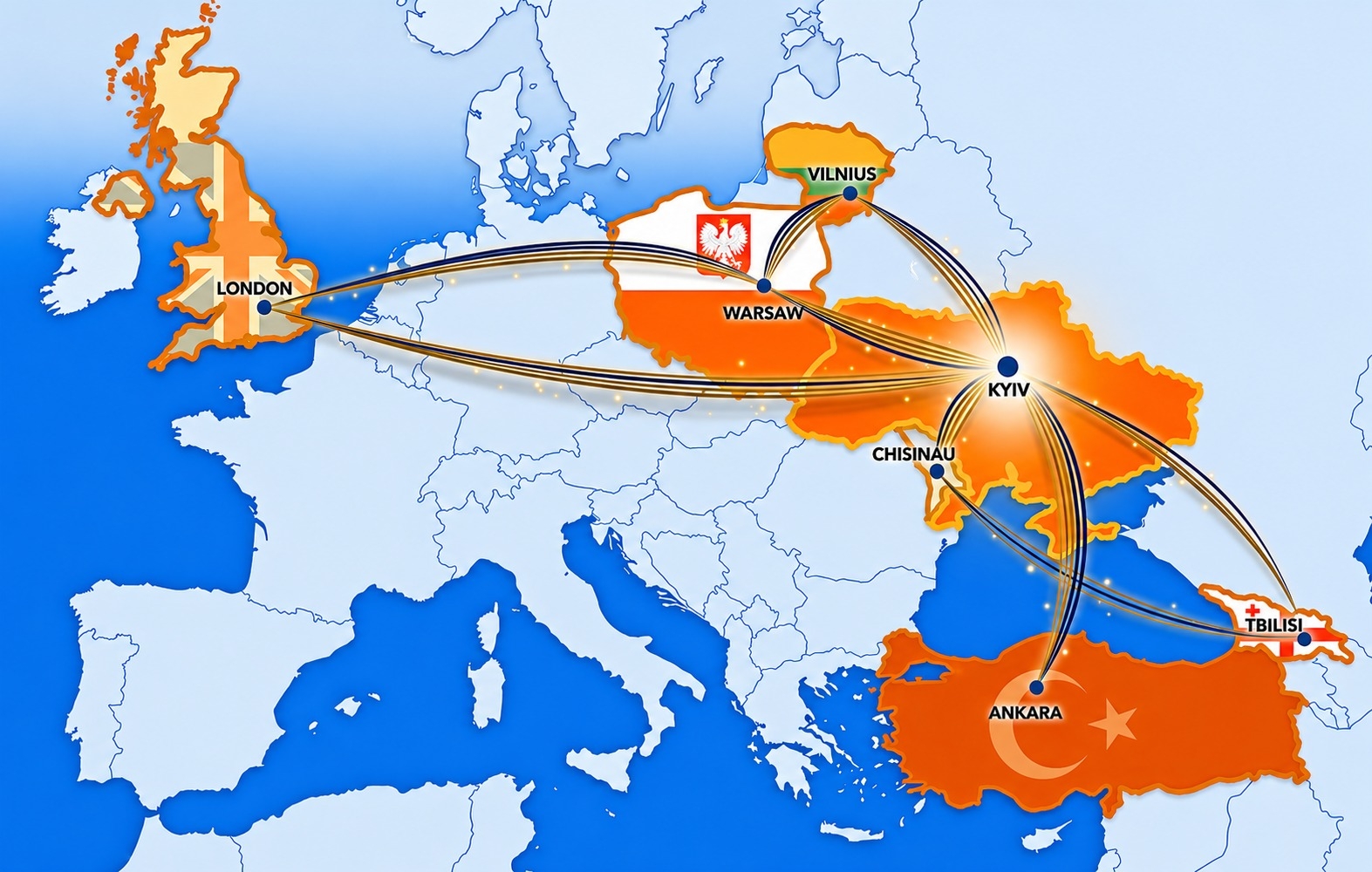
London–Black Sea–Baltic Alliance
2026-10-14
The perspective of the new geopolitical axis of regional
security
Europe's security architecture is changing. Russia's war
against Ukraine, security challenges in Eastern Europe and the strategic
importance of the Black and Baltic Seas have reinforced the need for the UK,
Poland, Ukraine, the Baltic States, Moldova, Georgia and Turkey to work more
closely together.
"London-Black Sea-Baltic Alliance" can be
called a unified geopolitical concept of this cooperation. At this stage, this
name does not refer to an officially created international organization. It
combines existing partnerships and opportunities for future cooperation.
The essence of the idea is simple: the security of the
Baltic and Black Sea regions is interconnected, and the political, military and
diplomatic participation of Great Britain adds an additional strategic
dimension to the cooperation between the countries of this space.
1. How the basis of cooperation was formed — chronology
2020 - Lublin Triangle and Quadriga
On July 28, the Lublin triangle was created - Ukraine,
Poland and Lithuania. On December 18 of the same year, Ukraine and Turkey held
the first meeting in the "quadriga" format at the level of foreign
affairs and defense ministers. This strengthened the basis of cooperation
connecting the Baltic and Black Sea spaces.
2021 - formation of an associated trio
On May 17, Ukraine, Georgia and Moldova created an
associated trio, the purpose of which was cooperation in the process of
integration into the European Union. In the view of Ukrainian diplomacy, these
formats served to create a space of security and prosperity between the Baltic
and Black Sea regions.
2022 - London-Warsaw-Kiev tripartite cooperation
On February 17, Great Britain, Poland and Ukraine announced
the deepening of trilateral cooperation. Cyber security,
energy security, fight against disinformation and support of Ukraine against
Russian aggression were identified as priorities.
2024 - Enhancing security partnership
Great Britain and Ukraine signed a security cooperation
agreement, which included strengthening defense capabilities and maritime
security. Britain has also been involved in supporting the development of
Ukraine's naval capabilities.
2025 - Centenary Partnership and Black Sea-Baltic Security
Connection
On January 16, London and Kyiv signed a centenary
partnership agreement. The document envisages the strengthening of the defense
industry, maritime security and strengthening the security of the Black, Baltic
and Azov seas. This is a particularly important basis for the concept.
2026 - Strengthening British-Polish and North Baltic
cooperation
On May 27, Great Britain and Poland signed the Security and
Defense Partnership Agreement. And in March, Britain and the Northern Baltic
partners reaffirmed their cooperation on issues of security and support to
Ukraine. These developments strengthen the capacity for cooperation between
London and the countries of the region.
2. The main purpose of creating the alliance
The main goal of the concept will be to create a space of
security, political and economic cooperation with the participation of Great
Britain, connecting the Black and Baltic seas.
Its strategic basis is three circumstances:
● Geographic interdependence: Military or hybrid
threats in the Baltic region can affect Central and Eastern Europe, and the
security of the Black Sea is important for the economic and military stability
of Ukraine and the region.
● Great Britain's capabilities: London can offer its
partners military expertise, intelligence cooperation, naval capabilities,
defense technology and diplomatic support.
● Interests of regional partners: Poland and the
Baltic states are interested in protecting the eastern flank; Ukraine — by
protecting sovereignty and territorial integrity; Moldova and Georgia — with
security and European integration; And Turkey with the stability of the Black
Sea and maintaining regional influence.
These interests overlap, but not all countries have the same
priorities.
3. Main tasks
1. Unified security vision. Development of threat
assessment, early warning, and information-sharing systems in the Black Sea and
Baltic Sea regions.
2. Defense cooperation. Joint exercises, air defense
coordination, maritime security, and cooperation against drone and
cyberattacks.
3. Energy independence. Protection of energy
infrastructure, diversification of supply sources, and enhancing the resilience
of critical facilities.
4. Transport and trade corridors. Development of
ports, as well as rail and road connections, across the Baltic and Black Sea
regions to reduce reliance on a single transit route.
5. Countering hybrid threats. Coordinated action
against disinformation, cyberattacks, damage to critical infrastructure, and
threats to maritime communications.
6. Support for European integration. Supporting the
European aspirations of Ukraine, Moldova, and Georgia, while taking into
account the political decisions of the respective countries and the procedures
of the European Union.
These objectives represent the goals of the proposed
concept, rather than an approved program for an already established alliance.
Some of these elements are already reflected in existing agreements and
cooperation frameworks.
4. What role will Georgia play?
This concept holds particular significance for Georgia.
Situated on the eastern coast of the Black Sea, the country is well-positioned
to play a key role in developing transport and economic links between Europe
and the South Caucasus.
Georgia’s participation could encompass:
● Cooperation regarding Black Sea maritime security and the
protection of ports;
● Development of the Middle Corridor, as well as railway and
transit infrastructure;
● Ensuring the security of energy and digital connections;
● Cooperation in countering disinformation and cyber
threats;
● Supporting closer political and economic alignment with
the European Union. However, Georgia’s actual participation will depend on its
foreign policy course, its relations with partners, and specific agreements.
Neither its geographical location nor its existing partnerships automatically
guarantee security assurances.
5. Key Obstacles
The implementation of this concept will face several
significant challenges.
First, there are divergent strategic interests.
Turkey pursues its own regional policy and seeks to maintain room for maneuver
in its relations with Russia. Not all participating countries will be equally
prepared to reach an agreement on every issue.
Second, there is institutional ambiguity. The Lublin
Triangle, the Associated Trio, the "Quadriga," and the
UK-Poland-Ukraine format are mechanisms with different objectives and
participants. Merging them into a single alliance would require separate
political decisions and agreements.
Third, there is the issue of coordination with NATO and
the EU. Any new structure must complement existing mechanisms rather than
create conflicting obligations. NATO’s collective defense guarantees apply only
to members of the Alliance, in accordance with the terms of the relevant
treaty.
Fourth, resources and political will. Effective
cooperation requires funding, shared priorities, regular meetings, and concrete
projects.
6. Outlook: From Idea to Real-World Cooperation
The most realistic path is not the immediate creation of a
new military bloc, but rather the interconnection of existing frameworks.
In the first phase, it is possible to strengthen regular
political consultations, dialogue on maritime security, and cooperation in
cybersecurity. In the second phase, joint infrastructure projects, defense
production, the exchange of intelligence, and agreed-upon crisis response
procedures could be developed. In the third phase—provided the participants
possess the necessary political will—it would become possible to establish a
permanent coordination mechanism. The 2025 agreement between Great Britain and
Ukraine, the British-Polish defense partnership, and the activities of the
Lublin Triangle serve as existing pillars in this regard. However, their
existence does not yet imply the formation of a unified "London–Black
Sea–Baltic Alliance."
Conclusion
A "London–Black Sea–Baltic Alliance" could
emerge as a promising political concept for security cooperation across Eastern
Europe and the Black Sea region. Its primary advantage would lie in
integrating the capabilities of Great Britain, the regional roles of Poland and
the Baltic states, Ukraine’s defense experience, and the European aspirations
of Georgia and Moldova within a single framework.
Ultimately, the success of this concept will depend on
whether the participants can move beyond individual, separate formats toward
shared priorities—specifically in the realms of security, energy, trade, and
critical infrastructure.
Should this cooperation be institutionalized, it could evolve into a significant geopolitical network linking the Black and Baltic Seas. Otherwise, it will remain a collection of useful, yet mutually separate, partnerships.
Zurab Maghradze, DBA
Sources:
gov.uk
mfa.gov.ua
gov.pl