pylonology
Pylonology ● The Human Gateway
2026-10-20
Nikifore Irbakhi, also known as Nikoloz Cholokashvili (c.
1585–1658), is one of the most prominent figures in 17th-century Georgian
diplomacy. A diplomat, clergyman, and cultural intermediary, he sought to
bridge the gap between Georgia and Europe.
His significance is particularly evident when viewed through
the lens of "pylonology." A pylon is a gateway—a structure that
enables the transition between distinct spaces. Irbakhi himself became such a
gateway: an individual who connected Georgia’s political, ecclesiastical, and
cultural spheres with Europe.
Between Languages and
Royal Courts
Irbakhi was multilingual. According to historical sources,
in addition to Georgian and Mingrelian, he was proficient in Greek, Turkish,
Arabic, Russian, French, Spanish, and Italian. This linguistic mastery provided
a unique advantage to his diplomatic endeavors, allowing him to establish
direct connections between disparate worlds.
Commissioned by Teimuraz I, Irbakhi traveled to Europe,
where he established diplomatic relations with various European political and
ecclesiastical centers. His activities were linked to the Spanish royal court
and the Papal court in Rome, while sources regarding his travels across Europe
also point to Italy, France, Germany, Hungary, and Poland. Since the level of
evidence for each segment of this route varies, historical accuracy is of
particular importance here.
His primary role was not merely to speak on behalf of
Georgia; he sought to open a political and cultural path for Georgia toward
Europe.
When Diplomacy Became a Book
Irbakh’s involvement extended beyond diplomatic
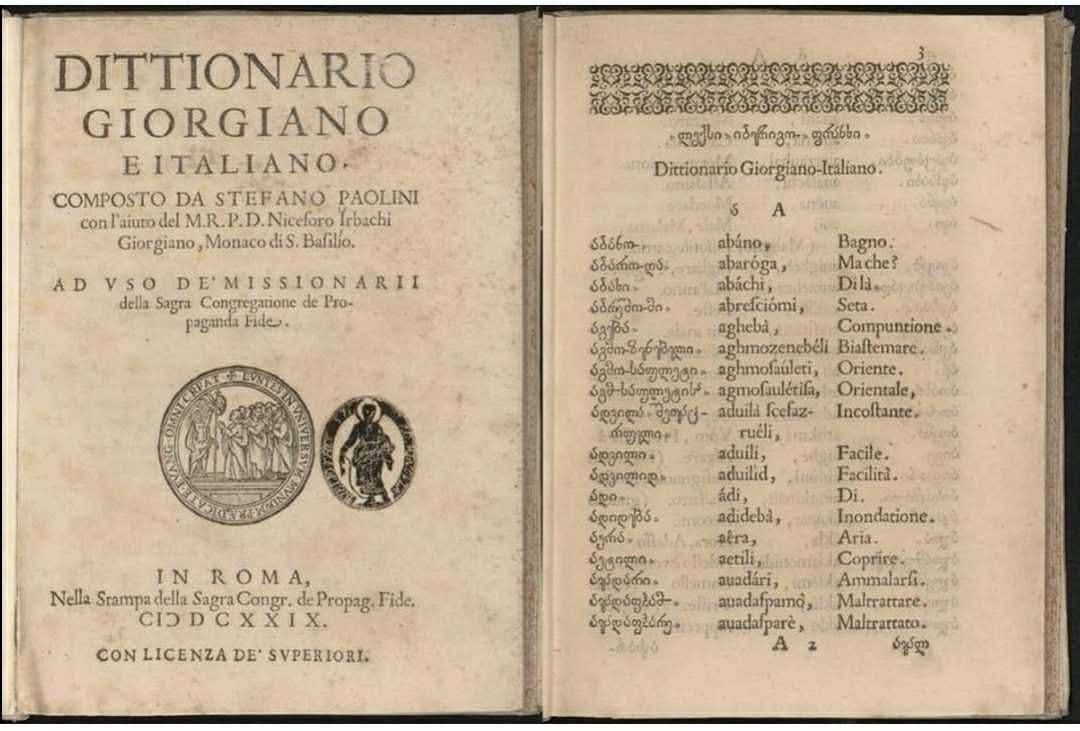
negotiations. In 1629, in Rome, he collaborated with Stefano Paolini to compile
a Georgian-Italian dictionary. Containing approximately 3,084 entries, this
work holds special significance in the history of printed Georgian books.
Here, the central theme of Irbakh’s story becomes especially
clear:
Individual →
Language → Translation
→ Book → New Connection.
If Irbakh himself served as a gateway between Georgia and
Europe, the dictionary became the tangible extension of this connection. He
made the Georgian language more accessible to the European world.
His work demonstrates that diplomacy is not merely about
treaties and political negotiations. Sometimes, the most significant outcome of
diplomacy is that people begin to understand one another.
Irbakhi as a Pylon
Pylonology (the study of gateways) is the science of
connecting worlds that are distant from one another; it is a field that
examines spaces, pathways, and economic, political, and cultural interactions.
From the perspective of pylonology, the example of Irbakhi
illustrates that a gateway is not just a physical structure. A gateway can be a
person, a language, a diplomatic mission, or a book—anything that creates
mutual access between distinct realms.
Irbakhi is precisely such a "living pylon." He is:
Georgian, yet active in Europe;
An Orthodox cleric, yet working within the Catholic world;
A diplomat, yet also engaged in the cultural sphere;
A translator—not just of languages, but of political
interests as well;
An ambassador, whose mission leaves behind a lasting legacy
in the form of a book. Georgia and Europe were separated by more than just
geographical distance. They were distinguished by different languages,
religious traditions, political interests, and cultural experiences.
Irbakh’s mission was, in essence, to navigate these very
differences.
He had to be capable of engaging with diverse people,
grasping the norms of different worlds, and articulating Georgia’s interests in
a way that others could understand.
Thus, Irbakh was not merely someone who crossed a border; he
was a mediator of that boundary—an individual who created the possibility for a
relationship between two sides. He forged a path across the divide.
And this, precisely, is the core tenet of the *pylonological* perspective: a gateway does not merely separate two spaces—it connects them.
Zurab Maghradze, DBA