silk-road
Institutional mechanisms of the Trans-Caspian International Transport Route
2026-04-07
Levan Lomsadze, Founder and Director of
“GEORAIL-consulting” LLC. Academic Doctor of Railway Engineering
In the process of forming the Middle
Corridor as a competitive direction, the Trans-Caspian International Transport
Route (TITR) Coordination Committee is an important institutional mechanism.
The concrete results of its activities are reflected in the increasing rates of
transportation along the Middle Corridor.
In order to increase freight flows along
the Middle Corridor, in 2014, the Trans-Caspian International Transport Route
(TITR) Development Coordination Committee was established.
From the very beginning, the TITR
Coordination Committee was equipped with institutional mechanisms for the
development of the Middle Corridor, later the newly created organization began
to function in various directions, including: attracting additional cargo,
forming an agreed transport and tariff policy, establishing measures to
increase competitiveness in relation to alternative corridors, developing
measures to mitigate administrative barriers at the borders of the countries
participating in the corridor and at the junction points of railways.
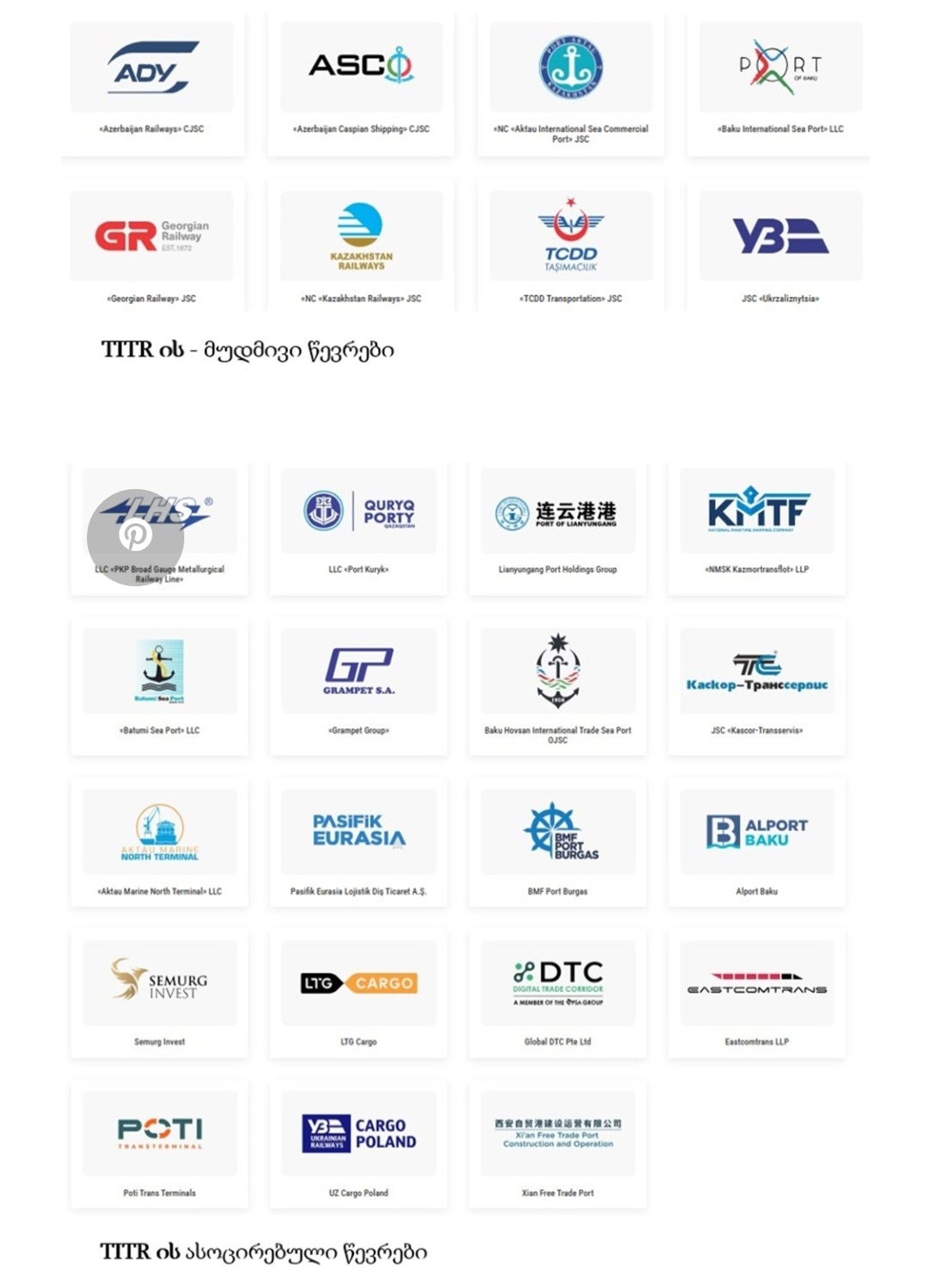
Currently, the TITR Coordination Committee
includes 8 permanent and 19 associate members from various countries, both
commercial and non-commercial.
During the period of operation of TITR,
which began in 2017, transportation indicators have been increasing steadily,
the growth of cargo turnover has been increasing annually since 2021 and
reached a maximum in 2025 - 1.9 million tons.
When comparing the transportation figures
for 2024 and 2025, no significant progress is noted, which indicates the need
to activate institutional mechanisms along the Middle Corridor.
As for container cargo, which is the most
financially profitable direction for the corridor, significant progress is
observed, namely in 2025 it reached a maximum of 76,900 TEU, which is a 36%
increase compared to the previous year.
In 2023 - within the framework of the
Tbilisi Silk Road Forum, in order to strengthen the Georgian transit corridor,
in particular, to stimulate transportation between China, Europe and Turkey, a
joint venture was signed between Georgia, Kazakhstan and Azerbaijan - the
Middle Corridor Multimodal, which gave rise to a new trend in the development
of the corridor.
The goal of the joint company was to
promote the growth of container transportation in the Middle Corridor.
Specifically, with the active involvement of the railways of the partner
countries, the number of block carriers in the Middle Corridor was to increase
and the service for cargo owners was to be provided on a "one-stop
shop" basis.
In 2024 - the Trans-Caspian International
Transport Route TITR Association determined container transportation tariffs on
the two Kazakh sections of the Middle Corridor.
The tariff for a 20-foot container on the
Dostyk (Kazakhstan-China border) - Aktau route was set at a fixed rate of 0.31
USD per container-kilometer, and on the Aktau-Dostyk route - at 0.16 USD per
container-kilometer.
The establishment of a single “through”
tariff on a specific route is undoubtedly a step forward for the Middle
Corridor.
Due to the temporary closure of the
Baku-Tbilisi-Kars (BTK) railway line during the modernization period, starting
from 2023, in order to continue container transportation services from / to
Turkey, the TITR Association approved new tariffs for feeder vessels on the
Black Sea in 2024 from the ports of Poti and Batumi - via the port of Samsun -
to the port of Karasu (Turkey).
2025 - China Railways joined the Middle
Corridor Multimodal joint venture through its subsidiary CRCT (China Railway
Container Transport Company).
The addition of a Chinese operator to the
joint venture automatically contributed to the extension of the Middle Corridor
route and the attraction of Chinese cargo flows. All this had a positive impact
on the formation of block trains from China via the Middle Corridor. In 2025, a
record 392 block trains were transported through the Middle Corridor.
In 2026, in order to attract additional
cargo shipments and increase competitiveness on the Trans-Caspian International
Transport TITR route, the route participants agreed on tariff conditions for
transportation in the eastern direction.
Participating companies received a 50%
discount on container shipments from the ports of Batumi and Poti to Kazakhstan
and China.
Participating companies agreed on a 33%
discount from Turkey to Kazakhstan, China and Central Asian countries via
Kazakhstan.
It is worth noting that the tariff discounts imposed on container shipments from Georgia and Turkey to the East are important in terms of increasing “reverse” cargo, since one of the “bottlenecks” of the Middle Corridor is the lack and imbalance of container cargo from Europe to Central Asia.
transcor.ge